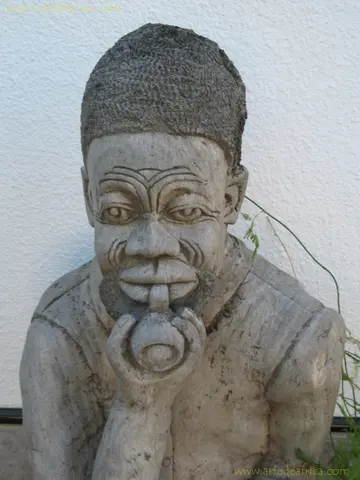
Royal art
The ancient kingdom of Ghana, the empires of Mali and other Central African kingdoms, until slavery by Europeans, or the kingdom of Benin until its plunder by the English at the end of the century XIX, they knew a great splendor as evidenced by the works of Sapi, bronzes of Benin and Ife or terracottas Nok, Kapsina or Sokoto, to mention but a few examples. The courts of these kings were decorated with beautiful objects of ivory, gold, bronze or precious stones. They showed a refinement that some European courts would have wanted, says German historian and ethnologist Leo Frobenius.
True richly decorated palaces were built, some of which still have their vestiges like those of the kingdoms of Abomey, the headquarters of Grassland or the ancient cities of the Yorubanot counting the photographs of the numerous drawings of the court of Benin. All these kings, chiefs, and high officials of the court liked to surround themselves with beautiful objects and ornaments that would affirm their rank. Artistically carved furniture, bronzes, ivorys, weapons and scepters enhanced their rooms and ceremonies in which they manifested themselves with all their galas. Normally only kings and high dignitaries could possess these objects, which were reserved for them as ivory, stones and precious metals. Many of these objects had a religious symbolism, like the monarch, which is not considered divinity, but whose power is sacred because it comes from divinity.
Real art in a strict sense is art at the service of the power entrusted by the sovereigns or realized exclusively for them and for the royal family, it is the material manifestation of the status of the sovereigns. The sovereigns reserved the monopoly of precious materials, ivory, gold, bronze and copper. Copper for a long time became more precious than gold given its scarcity in Africa and the abundance of the latter. Although used by different ethnic groups, ivory was used mainly by the Sierra Leonean Sapi who sculpted objects of insurmountable aesthetics, known as “Afro-Portuguese marfiles”, which arrived at the end of the century. XV to all the royal and princely European courts. The Bini, from the former kingdom of Benin in Nigeria, also stand out for their meticulous and artistic work with ivory.
The Empire of Mali, formerly Ghana and later Songhaï, was reputed for centuries for the abundance of gold that was used even for dog collars. In 1324 his emperor Mansa Moussa on his pilgrimage to Mecca and, by the way, on his courtesy visit to Pharaoh of Egypt, brought him such much gold, among others present, that the gold price dropped in Egypt for several years. All kings and notables of the various kingdoms Akan They have made a profuse use of gold in their garments, thrones, scepters and in all kinds of ornaments and symbols of power.
There was a time when copper, much more scarce than gold, was valued. Hence its use, allied with tin, since the century XII and for centuries the Courts of Ife and Benin will stand out for the castors in the service of their sovereigns, the Oni de Ife and the Oba of Benin. The perfection of the heads of queens, of sovereigns, of the plates that covered the walls of the palace, the figures of warriors, musicians, messengers and other court figures will cause such admiration, being known after the plunder of Benin by the English in 1897that the most well-known thought that these were vestiges of the Greeks and the Romans because the Africans could not perform such perfect works and with such advanced knowledge of the techniques of foundry. In reality the so-called African bronze, not to what in Europe is meant by bronze, but brass.
In addition to ivory and precious metals, wood has also been widely used to enhance the sumptuousness of palaces, especially prestigious furniture that may provoke the admiration of guests to the Court. These furniture, not intended for use but to be seen, were decorated with court scenes, warriors or tribals and often with scenes inspired by their cosgomonies. Numerous statues of the kings, chiefs and notables have also been carved in wood.
The African artist who works for the Court is, with the exception of traditional African art, a professional. But his artistic productions do not seek art by art according to the Western concept. The beauty is present in most African achievements, but far from the European aesthetic feeling. The purpose of the beauty of the objects produced for the court is to strengthen the power and dignity of the sovereign. Thus, numerous objects are sculpted in wood or cast into noble materials, which enhance the prestige of the sovereign and are grouped under the name of royalties, scepters, canes of ceremony, flycars, stopping weapons, pipes and stools that are not intended to be used but have a ritual value. Everything we in the West understand by traditional African art has a ritual value, including so-called real or court art when the sovereign receives his power from divinity. Having this power emanated from God is the link between heaven and earth, between man and the divine world, so that the objects around him also have a religious connotation.
In a broader sense what we define as real art includes all the artistic manifestations made for the characters of the court and the notables, among which we must highlight the griot, genealogist, poet, singer, historian and rapsoda who with his word can exalt a sovereign or sink a kingdom. For centuries Africa was ruled by a multitude of small kingdoms that often depended on a superior king. In Cameroon, in Grassland, we find a particular category of kingdoms, the so-called “chefferies” or “jefatures”, which although small regions are true with a perfectly structured hierarchy whose chiefs enjoy all the attributions Throughout the history of Africa there have been numerous kingdoms and empires, some of extraordinary importance and power and others, small, sometimes independent and others subject to a higher hierarchy. Also the chiefs of the canton and the village enjoyed great authority and prestige as well as the notables who formed the advisory council of their sovereigns and chiefs. They are all the owners of the so-called royalties and jewels, these objects constitute, according to rank, their symbol of authority, and they are all included in this chapter dedicated to the royal arts.
Jesús Arrimadas Saavedra