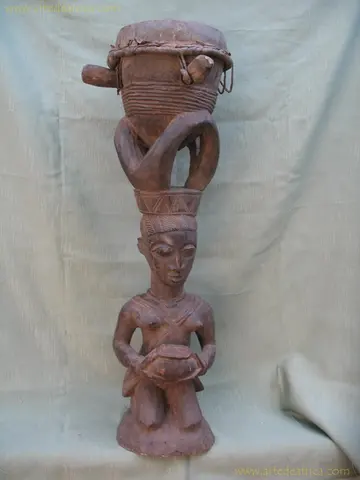
Drum N-Def
The Drum Baga with female (or male) cariatids belongs to the SIMO society, as does the NIMBA mask.Caryatids drum of the drums…
MEMB-1

List of the historical catalogue
Text and organisation of the original catalogue · Jesús Arrimadas Saavedra
Music, or even better, rhythm, is something inherent in the African, as inseparable as the music of the word is. In fact most of the languages of West Africa are very musical. Any object capable of percussion serves to set the pace and for those who hear it to start to mark it. Musical instruments accompany all manifestations of social and religious life. Funeral ceremonies, rites of initiation, fertility of the land or of the woman, mourning uprisings or exits of masks are not conceived without the accompaniment of the instruments that correspond to each occasion, with the permanent presence of the tam tam or drum. The drums speak, transmit messages and establish a dialogue between them. It is drum is associated with the person. Bells and bells, koras and balafones, harps of ropes and of sheets or sanzas, scrapers or awakos and the infinite variety of drums, metal, wood and leather, slotted wood, mobile, fixed, arm, etc., not to mention the numerous flutes, whistles, horns, tubes and olifantes. Some of these instruments such as bells, sonajeros and iron drums have, in addition, as a function, to mark the rhythms and pauses of the divinatory processes. The musical instruments accompanied the griots to sing or narrate the praises to their masters, tell stories or describe genealogies, were part of the teachings to the members of the community, participated in all kinds of ceremonies and served to send messages and communicate with both the world of the living and the ancestors and supernatural forces. As in the rest of the daily activities also in the elaboration of these instruments is manifested the aesthetic feeling of the African soul. Without attempting to manufacture art objects, this concept was unknown to Africans until the arrival of Europeans, they like to surround themselves with the beautiful. They don’t know art by art and therefore artistic feeling, but they live, however, deeply aesthetic feeling. MEMBRANOPHONS.- All kinds of drums whose percussion is done on the skin of an animal, hitting with chopsticks, hammers or with hands, the resonance box being formed by the support. TAMBOR OR TAM TAM.- It is undoubtedly the most widely used musical instrument in Africa. In addition to the ceremonial and accompanying uses of the masks it is useful to communicate information, to transmit messages up to distances of several kilometers, to call the warriors to war or to hunt and to announce a victory, announce and animate parties or ceremonies or to warn of the arrival of the king or visitors to the village, the death of a person or any other important event. Not forgetting their active participation in the necrological, magical and religious manifestations and accompanying the screams while telling stories, myths and legends or reciting genealogies. The drum is therefore closely linked to the word whose rhythms, tones and sounds it tries to transmit. Like tonal languages, meaning that a word or syllable according to the tone or the place in which it is pronounced will acquire a different meaning, so the sound of the drums according to their tone, intensity, duration or sequence will constitute a coded sound language that makes it a true means of communication when translating sounds into words. The drums, especially those of ceremony, allow the sculptor to express all his artistic talent. And the drum of ceremony, in addition to its original use, acquires a sacred meaning by serving as a medium or support for powerful rites intended to communicate with the spirit world. Communication by means of drums is done by means of fully encoded signs known some of them by the people of the village, but others only by those initiated. Their sones constitute a true language and are the replica of the word, since the word can be transmitted with its tones, rhythms and sounds through the tam tam. To the late professor Georges Niangorán Bouah, an eminent Ivorian ethnologist, we owe the most profound study that has been carried out in the decoding of the sound language of the drum, a study that has been called “drummology” or science of the language of the drums. The term membranophones is applied to drums whose resonance box is covered by extended skin. They are made from a tree trunk whose interior is emptied and whose exterior is sculpted in the desired way according to the aesthetic sensation that you want to achieve. In the same country the drum can be given different names. In Burkina, in the Gaoua region there is a cylindrical drum called “gangao”, while in the Kaya region it is called “gangaodo” as in the Ouahigouya region. It also has different meanings and, according to the regions, plays a very special role, but always offers the particularity of being powerful for its sound and very present for its rhythm. The sound of the drum is the permanent invitation to dance for the African. Also, according to the regions, they tend to be heavily decorated and have given rise to real artistic achievements.
7 objects · page 1 of 1
The Drum Baga with female (or male) cariatids belongs to the SIMO society, as does the NIMBA mask.Caryatids drum of the drums…
MEMB-1
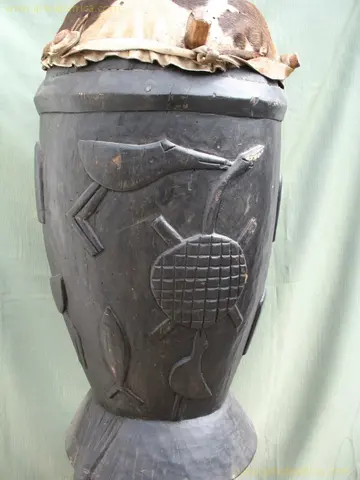
Drum held by a woman sitting on a stool.
MEMB-2
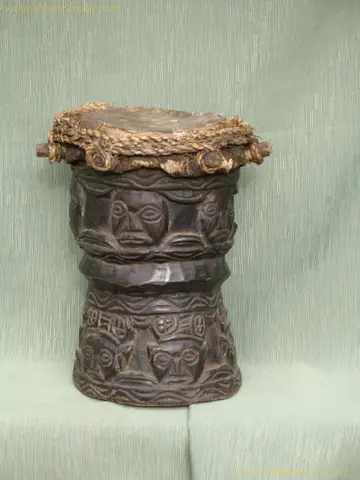
Small drum that is used in different types of ceremonies both playful and funeral.
IDIOF-3
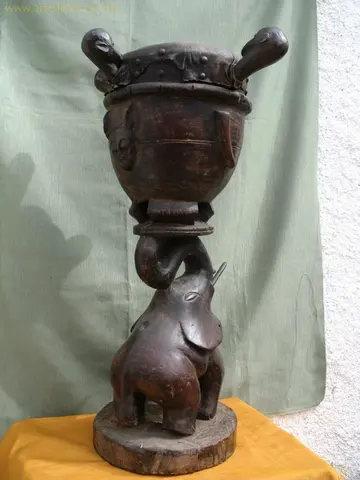
Drum in which the caryatide is an elephant, symbol of Ivory Coast.
MEMB-3
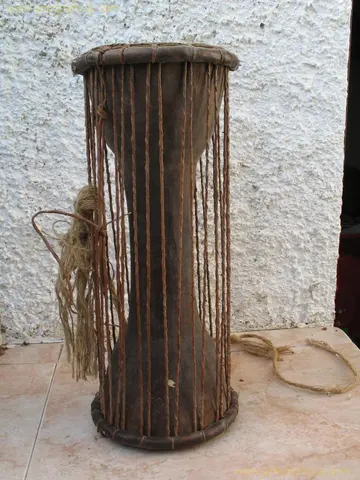
Mid-century drum XX.
IDIOF-4
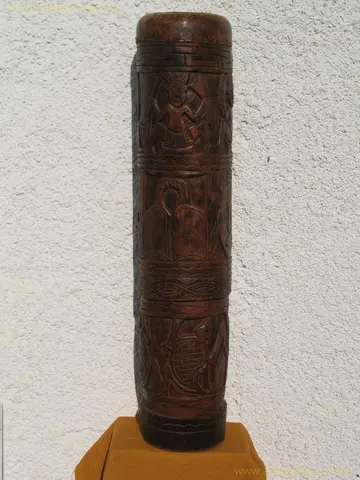
Tam elongated tam, honey color, with engravings of animals, turtle and elephant, and warriors throughout its perimeter.
IDIOF-5
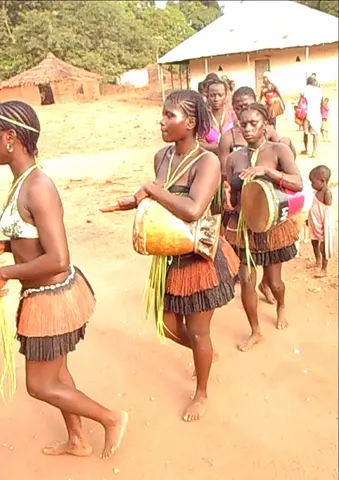
For the Bidjogos, more than for many other peoples of Africa, the drum is the most direct means of communicating with the…
MEMB-4


