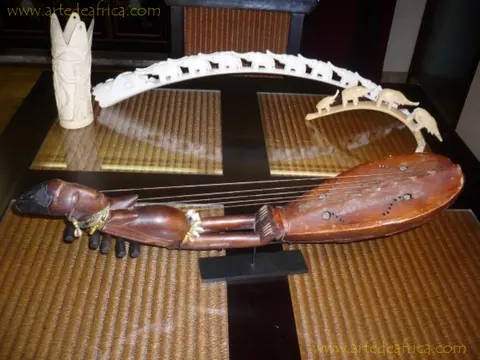
Arpa Nemudu
Most of the mangbetu objects are carved in light wood that are further skated dominating the honey color.
CORD-1

List of the historical catalogue
Text and organisation of the original catalogue · Jesús Arrimadas Saavedra
CORDOPHONS.- String instruments, harps, liras. The sound is produced by the vibration of the rope. DONZO, N’GNI OR LAUD AFRICAN Melodic instrument of strings, traditional in the countries of West Africa. Half a dried and empty pumpkin, spherical or elongated, covered in goat’s skin, will serve as a resonance box. From this pumpkin part the wooden arm at whose end are inserted the keys in which the ropes are fixed, stretched by a small wooden easel. From this installation will come the characteristic sound of the N’goni. Originally, it is thought that it had only one string and was used by the Peul shepherds. Two types of N’goni are easily distinguished: – The donzo n’ goni, composed of six strings and traditionally reserved for hunters and the – Kamele n’goni, composed of eight strings and which can be used by anyone. When N’goni gets put on 21 Strings becomes a Cora, an African string instrument par excellence. Music, or even better, rhythm, is something inherent in the African, as inseparable as the music of the word is. In fact most of the languages of West Africa are very musical. Any object capable of percussion serves to set the pace and for those who hear it to start to mark it. Musical instruments accompany all manifestations of social and religious life. Funeral ceremonies, rites of initiation, fertility of the land or of the woman, mourning uprisings or exits of masks are not conceived without the accompaniment of the instruments that correspond to each occasion, with the permanent presence of the tam tam or drum. The drums speak, transmit messages and establish a dialogue between them. It is drum is associated with the person. Bells and bells, koras and balafones, harps of ropes and of sheets or sanzas, scrapers or awakos and the infinite variety of drums, metal, wood and leather, slotted wood, mobile, fixed, arm, etc., not to mention the numerous flutes, whistles, horns, tubes and olifantes. Some of these instruments such as bells, sonajeros and iron drums have, in addition, as a function, to mark the rhythms and pauses of the divinatory processes. The musical instruments accompanied the griots to sing or narrate the praises to their masters, tell stories or describe genealogies, were part of the teachings to the members of the community, participated in all kinds of ceremonies and served to send messages and communicate with both the world of the living and the ancestors and supernatural forces. As in the rest of the daily activities also in the elaboration of these instruments is manifested the aesthetic feeling of the African soul. Without attempting to manufacture art objects, this concept was unknown to Africans until the arrival of Europeans, they like to surround themselves with the beautiful. They don’t know art by art and therefore artistic feeling, but they live, however, deeply aesthetic feeling.
10 objects · page 1 of 1
Most of the mangbetu objects are carved in light wood that are further skated dominating the honey color.
CORD-1
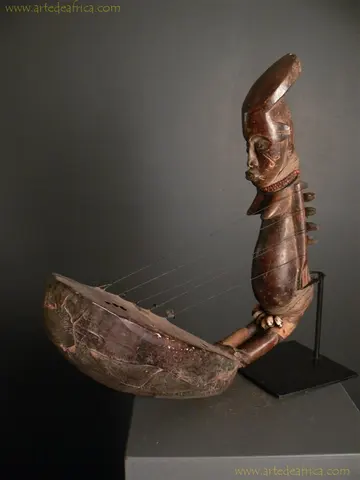
The resonance box is made of wood covered with antelope leather and the arm is formed by the figure of a woman…
CORD-3
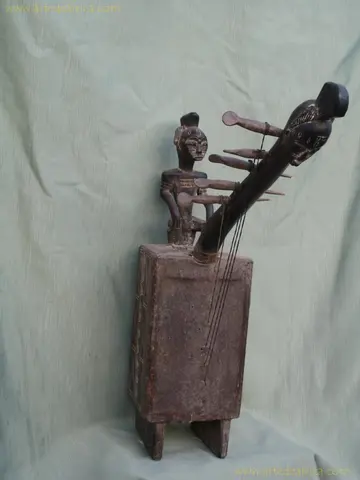
The figure who presides over the pins of the strings represents the first female ancestor, mother of all things, Disumba.
CORD-4
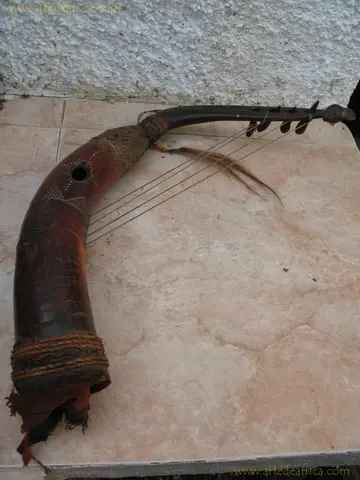
Four stringed harp built on an ox horn. The mango, dark brown patina, is topped with an anthropomorphic head.
CORD-5
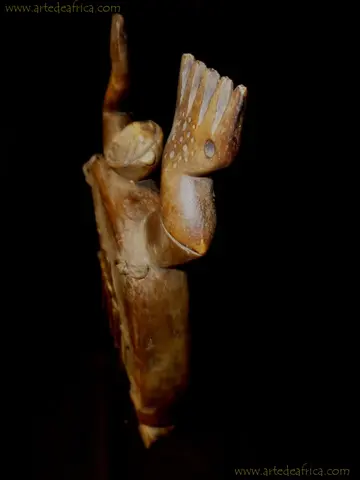
AFRICAN LAW ON THE CREATION OF THE WORLD There was God, and also the imagination, who was asleep in a corner of…
-15
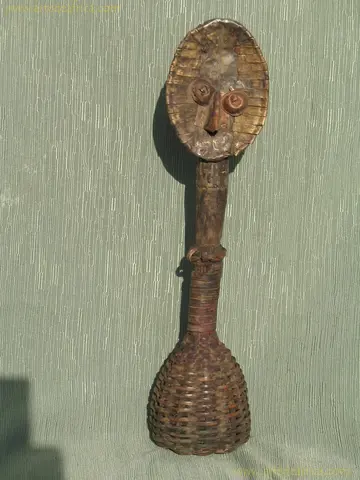
Maraca topped with a head reminiscent of masks Sangu. Used in playful and religious ceremonies and also to mark divinatory rhythms.
IDIOF-12
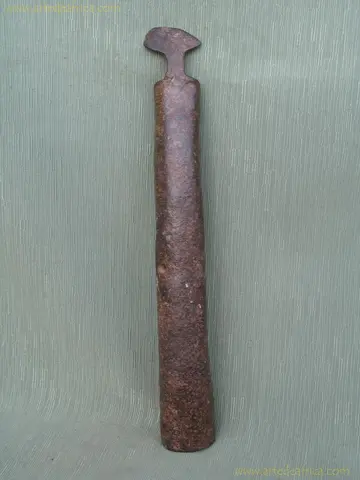
Bells and bells, both metallic and wooden, besides having their use in playful and religious ceremonies are a valuable instrument used by…
IDIOF-14
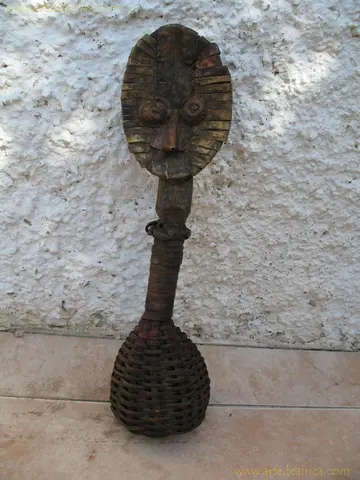
Maraca topped with a kota sanghu head.
IDIOF-19
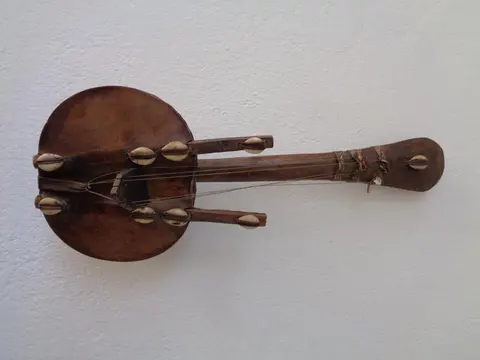
Guitar acquired in the mid-1960s in Abidjan.
CORD-10
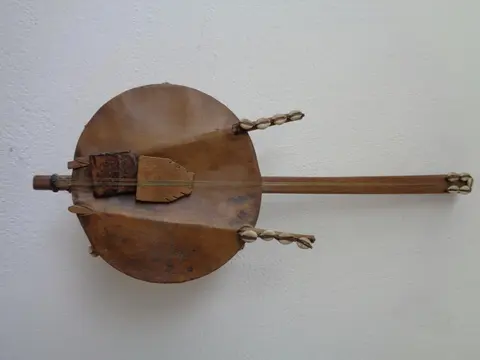
Guitar acquired in the mid-1960s in Abidjan. It is formed by the bark of half pumpkin, covered in lambskin, wood and cauries.
CORD-11


