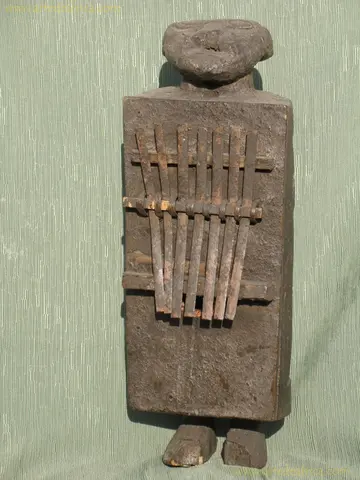
Arpa Sanza
Music, or even better, rhythm, is something inherent in the African, as inseparable as the music of the word is.
INM-2

List of the historical catalogue
Text and organisation of the original catalogue · Jesús Arrimadas Saavedra
Anthropomorphic lamelophone. Six fine bamboo sheets fixed in the belly produce the notes that will accompany dances at parties and funerals. The body of the figure is made of resonance. Several ropes on the harp and several sheets of wood or metal on the sledge. As in most African objects, both instruments are often artistically decorated. They are the instruments most used by the “griot” or by the musicians who assist him to play and accompany his different songs and ballads. Music, or even better, rhythm, is something inherent in the African, as inseparable as the music of the word is. In fact most of the languages of West Africa are very musical. Any object capable of percussion serves to set the pace and for those who hear it to start to mark it. Musical instruments accompany all manifestations of social and religious life. Funeral ceremonies, initiation rites, fertility of the land or of the woman, mourning uprisings or outings of masks are not conceived without the accompaniment of the instruments corresponding to each occasion, with the permanent presence of the tam tam or drum. The drums speak, transmit messages and establish a dialogue between them. It is drum is associated with the person. Bells and bells, koras and balafones, harps of ropes and of sheets or sanzas, scrapers or awakos and the infinite variety of drums, metal, wood and leather, slotted wood, mobile, fixed, arm, etc., not to mention the numerous flutes, whistles, horns, trunks and olifantes. Some of these instruments such as bells, sonajeros and iron drums have, in addition, as a function, to mark the rhythms and pauses of the divinatory processes. The musical instruments accompanied the griots to sing or narrate the praises to their masters, tell stories or describe genealogies, were part of the teachings to the members of the community, participated in all kinds of ceremonies and served to send messages and communicate with both the world of the living and the ancestors and supernatural forces. As in the rest of the daily activities also in the elaboration of these instruments is manifested the aesthetic feeling of the African soul. Without attempting to manufacture art objects, this concept was unknown to Africans until the arrival of Europeans, they like to surround themselves with the beautiful. They don’t know art by art and therefore artistic feeling, but they live, however, deeply aesthetic feeling.
3 objects · page 1 of 1
Music, or even better, rhythm, is something inherent in the African, as inseparable as the music of the word is.
INM-2
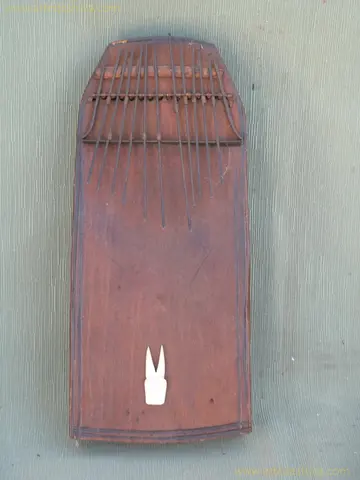
There was God, and also the imagination, who was asleep in a corner of his head...
CORD-2
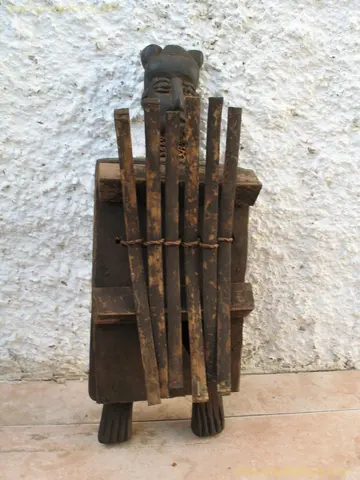
Sanza anthropomorpha. Instrument widely used in many African societies.
-14


