
Mwaash A-Mbooy Soil Mask
Implemented in the Democratic Republic of the Congo, Kasaï Southern Africa, Kuba have always shown through their art the meaning of the…
MSO-3

Text of the original catalogue · Jesús Arrimadas Saavedra
In the section corresponding to the "Black-African Artistic Ethnography" (see tab above to the right) we develop a broad chapter on the nature of the mask, its origins and its functions. To avoid repetitions we will refer, in the sections corresponding to the masks of this first part of the Catalogue, exclusively to the masks treated in each section, with a brief comment. It is common, in different ethnic groups, to talk about real masks. It is not that the mask is the king, but that it is masks intended to be worn at ceremonies held in the royal setting. Some masks are real because only the king can own them, as is the case with the beads masks of the Bamileké Others because they represent the king, which is the most frequent case. The same thing happens with boss masks. Griot masks are frequent, mainly in the West African, often important court figure, familiar with genealogies, singer, poet, historian and rapsode, which can also exalt a king who defamates a monarchy to destroy it. The so-called masks of war, with a terrifying aspect, are intended not only to frighten the enemy but to enkindle its fighters during the struggle. They are the same masks that intervene to seal the peace agreements.
639 objects · page 2 of 27
Implemented in the Democratic Republic of the Congo, Kasaï Southern Africa, Kuba have always shown through their art the meaning of the…
MSO-3

This mask of hypothragous antelope, stylized, with giraffe neck, comes from the region of Arbinda, Burkina Faso.
MFG-6

This mask of hypothragous antelope, stylized, with giraffe neck, comes from the region of Arbinda, Burkina Faso.
MFG-7

Curious stylization of this dog mask typically MambilaA pronounced jaw that keeps thinking about the crocodile's jaws.
MFZ-1

The dog mask, in its different varieties, is one of the most representative of the Mambila.
MFAZ-1

Stylized dog mask in which the top of the face has been able to respect the heart shape of the typical face…
MFAZ-2

Curious hare mask, which leaves the line of dog head masks, ovoid face on which stands out a raised Greek "Y" that…
MFZ-2

Buffalo mask whose helmet consists of a braided straw basket hat.
MFZ-3

Large wooden mask, dedicated to the festivities of the N’Tomo related to male youth initiation.
MFG-8

Honey-coloured mask with geometric headdress and a face of marked influence bambara.
MPS-1

This mask would have been sculpted in honor of a famous Queen of Kolokanione of the seven circles in which the region…
MFAZ-4

This mask would have been sculpted in honor of a famous Queen of Kolokanione of the seven circles in which the region…
MFAZ-5

This mask embodies a masculine spirit that dispenses power and wealth.
MSOAL-1

This mask, of dominant black polychrome and dark brown, has eyes in the form of coffee beans.
MFANT-15

Under the appearance of a young woman represents Pwothe ancestral mother who watches over the fertility of her descendants.
MFANT-16

Under the appearance of a young woman represents Pwothe ancestral mother who watches over the fertility of her descendants.
MFAZ-6

This mask embodies a masculine spirit that dispenses power and wealth.
MFANT-17

A scimer mask representing a stylized cow. Interestingly, it carries three horns, ignoring what the central horn can respond to.
MFZ-46
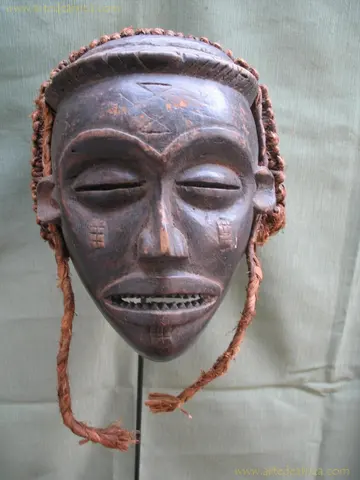
This mask embodies a masculine spirit that dispenses power and wealth.
MFANT-19

Kpelié mask with a cove pecking over the head.
BR-11

The word Zaulí designates both the mask and the traditional dance of the country.
MFANT-137

It is a mask of a male secret society used in a dance held during a ceremony in honor of the young…
MFANT-88

It belongs to the group of masks Wabelé. It is a buffalo mask.
MFG-45

It is the best known mask of the baga. Also called d’mba, in vernacular.
MHB-2


