
Royal mask
This mask represents a boss and is used in funeral rites intended for chiefs and notables.
MYL-5

Text of the original catalogue · Jesús Arrimadas Saavedra
In the section corresponding to the "Black-African Artistic Ethnography" (see tab above to the right) we develop a broad chapter on the nature of the mask, its origins and its functions. To avoid repetitions we will refer, in the sections corresponding to the masks of this first part of the Catalogue, exclusively to the masks treated in each section, with a brief comment. It is common, in different ethnic groups, to talk about real masks. It is not that the mask is the king, but that it is masks intended to be worn at ceremonies held in the royal setting. Some masks are real because only the king can own them, as is the case with the beads masks of the Bamileké Others because they represent the king, which is the most frequent case. The same thing happens with boss masks. Griot masks are frequent, mainly in the West African, often important court figure, familiar with genealogies, singer, poet, historian and rapsode, which can also exalt a king who defamates a monarchy to destroy it. The so-called masks of war, with a terrifying aspect, are intended not only to frighten the enemy but to enkindle its fighters during the struggle. They are the same masks that intervene to seal the peace agreements.
639 objects · page 4 of 27
This mask represents a boss and is used in funeral rites intended for chiefs and notables.
MYL-5

Representation of family mask made in miniature by the procedure of lost wax.
MPS-2

Mask of war.
MFG-11

Expression of serenity in this morecra that perfectly respects the artistic canons of the ethnic group.
MFAZ-10

Contrary to the visuality of art Kuba this mask presents a great sobriety.
MFAZ-11
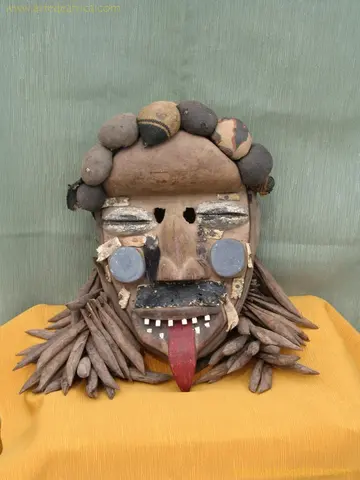
It's a Kpepogla mask, it's gueré masks with tubular eyes. At first they were masks of war.
MFANT-35

It is the mask of the beggar.
MFANT-36

Kholula masks are the masks of the initiates.
MFG-12

The Ijo they are implanted next to the Niger delta, in a forest area, traditionally dedicated to the production of palm oil.
MFANT-37

Cover mask by members of society Kidumu at weddings, funeral ceremonies of important members or at the reception of personalities and at…
MFANT-39

Mask used in initiation and circumcision ceremonies.
MFANT-40
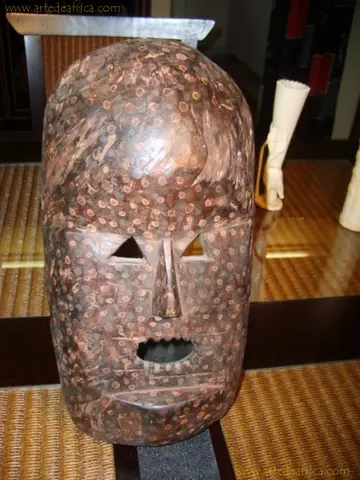
Mask from the north of the Kivu region, which takes its name from Lake Kivu. west of Congo.
MFANT-41
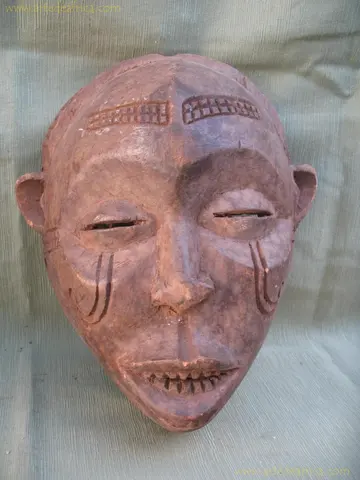
Pale burgundy mask.It has an oval figure, narrower at the bottom.
MFANT-42

The Lengola are part of the big family Mbole and like them, they are installed on the left bank of the Zaire…
MFANT-43

They are quite rare masks, highlighting an elongated mouth mask and rounded eyes in the middle of concave eye orbits that resemble…
MFANT-44

The Lega They have different types of masks, some are worn by the head or shoulder, or hand masks or on the…
MFANT-45

N’TomoIt is the masculine spirit that protects children from the male sex before their integration into the adult world and society.
MFANT-46

Natural color wooden passport mask with patina of time. The Bambara treat their masks as if they were people.
MPS-3

The Bambara treat their masks as if they were people.
MFG-14

The Bambara treat their masks as if they were people.
MFAZ-12
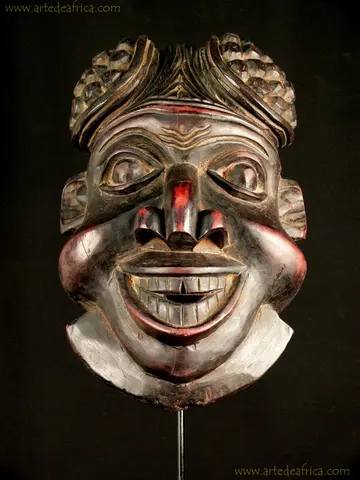
It belongs to the secret troh society, presided over by a council of nine notables.
MFANT-47
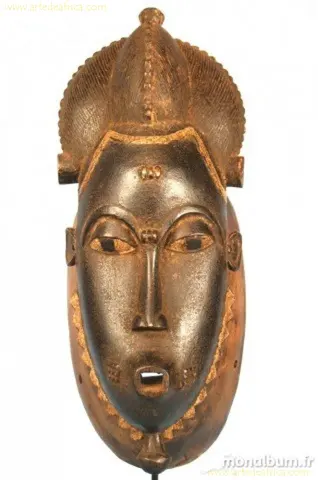
Mask from the Yamusukro region, which respects the artistic canons of the ethnic group.
MFANT-48
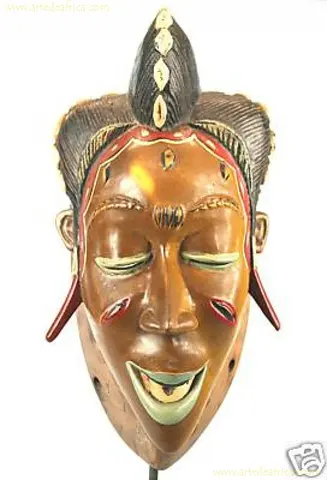
Baulé mask of the so-called "colon". Fine sculpture that is undoubtedly due to a great sculptor of influence Guro.
MFANT-49

It's a mask belonging to the griots. Sing the praises of the boss’s family only.
MFANT-50


