
Mbangu illness face mask
Face mask with ochre tones with the usual symbology of this category of masks.
MFE-1

Text of the original catalogue · Jesús Arrimadas Saavedra
In the section corresponding to the "Black-African Artistic Ethnography" (see tab above to the right) we develop a broad chapter on the nature of the mask, its origins and its functions. To avoid repetitions we will refer, in the sections corresponding to the masks of this first part of the Catalogue, exclusively to the masks treated in each section, with a brief comment. It is common, in different ethnic groups, to talk about real masks. It is not that the mask is the king, but that it is masks intended to be worn at ceremonies held in the royal setting. Some masks are real because only the king can own them, as is the case with the beads masks of the Bamileké Others because they represent the king, which is the most frequent case. The same thing happens with boss masks. Griot masks are frequent, mainly in the West African, often important court figure, familiar with genealogies, singer, poet, historian and rapsode, which can also exalt a king who defamates a monarchy to destroy it. The so-called masks of war, with a terrifying aspect, are intended not only to frighten the enemy but to enkindle its fighters during the struggle. They are the same masks that intervene to seal the peace agreements.
639 objects · page 1 of 27
Face mask with ochre tones with the usual symbology of this category of masks.
MFE-1

There are several villages that present in their masks the aesthetics of the disformity, of the ugliness, like this mask that represents…
MFE-4

It has the same symbolism as the mask. Mbangu.
MFE-2

It is the name that this mask of sickness or sick receives in the Congo.
MFE-3

Former mask hangs from the Democratic Republic of the Congo, Zaire for many years.
MFC-5

Mbuya masks are characterized by their triangular face. Highlights the polychrome, red, black and white.
MFANT-4

This mask is a female mask, representing the flirting of women.
MFANT-6

Black female mask.
MFANT-7

Mask that faithfully respects the canons of the ethnic group, facing bulging and prominent, triangular nose and pointed and white rectangular…
MFANT-8

The Salampasu are a town formed by some 60,000 people mainly located west of the Kasaï River, next to the border of…
MFANT-9

Curious mask that even breaking the salampasu schemes respects, investing them, the general lines.
MMN-1

Pointed head with extensive linear scarifications, in some of which remains the remains of a soft reddish pigmentation.
MFANT-10

Former Kifwebé female mask equipped with a beautiful dark patina and light wood.
MFANT-11

Used by society Bwadi Bwa Kifwebé is the best known mask, in its male and female versions.
MFANT-12

Used by society Bwadi Bwa Kifwebé is the best known mask, in its male and female versions.
MFANT-13

Female mask of secret society Bukishi, characterized by the absence of crest on the forehead and head.
MFANT-14

Large mask belonging to the secret society Msop who intervenes during the king’s enthronement ceremony (Fo) This great mask Tsesah or Tsemabu…
MFG-1

Mask formed by a head on a kind of inverted “U” wood that serves as a base and would constitute the trunk…
MHB-1

The mask called Kanaga has his face and forehead carved into windbreaks.
MFG-2

The mask called Kanaga has his face and forehead carved into windbreaks.
MFG-3

The mask called Kanaga has his face and forehead carved into windbreaks.
MFG-4

Civilization Igbo-Ukwu is developed in eastern Nigeria, mainly during the centuries IX and X.
MFG-5

This one mask Kongo soil It belongs to the category of masks without eyes and is not intended to be front but…
MSO-1
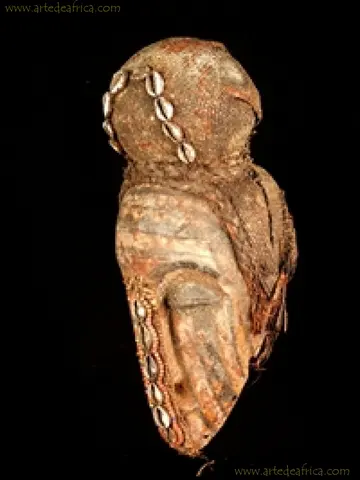
Implemented in the Democratic Republic of the Congo, Kasaï Southern Africa, Kuba have always shown through their art the meaning of the…
MSO-2


