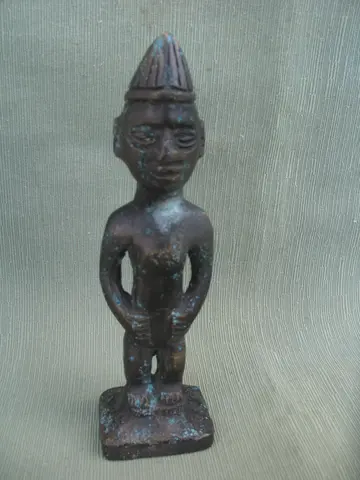
Votive Figure
The statues, offerings, votive figures and exvotes are not in Africa an offering dedicated to God or to the gods for a…
BRN-123

Text of the original catalogue
The technique of bronze smelting reaches its maximum splendor in Ife and Benin, whose sculpted heads were thought by the first anthropologists who were the work of the Greek and Roman civilizations. The bronze plates of Benin are famous, with cutting scenes, covering walls and columns of the royal palace looted in 1885 This metal was attributed to a benefactor force capable of warding off evil. The bracelets and slaves of many peoples of Africa are very often bronze as are many amulets. . If there is a technique that can characterize the work of metals and especially of bronze it is that of lost wax. This process of manufacturing small, and not so small, bronze sculptures has been practiced in almost all of Africa, mainly in coastal areas for having greater ease in obtaining raw materials. Different procedures are used, the simplest is the following: The artist sculpts or works a small wax figure, until the desired shape is achieved. At the top, several wax ducts are also attached; the artist covers the interior and the exterior with damp refractory clay or mud and tries to make the outer layer thicker, to give greater solidity to the whole. It is allowed to dry in the sun or in an oven, depending on the degree of technique achieved by the artist. When it has dried well, heat the part to melt the wax and there remains a vacuum into which the metal is introduced into melting. There are those who do not previously remove the wax because it will melt and come out through the ejecting nozzles as the molten metal is poured. In some places, the artist places his head in such a way that the molten metal spreads first over his face, as a delicate model had more chances of being successfully realized. The metal extends to occupy all the reveques of the mold. Two holes are practiced, one through which the bronze or molten metal is drawn and the other through which the wax escapes, which will be covered at the right time allowing, then, to cool the mold. Once cold the mold is broken and the figure obtained will be finished with chisel or other incisors instruments. For the most important pieces the artist models a figure, hollow, of wax of approximately one centimeter thick covering with a layer of clay both the outside and the interior, but the interior will then be filled with wood and charcoal, being more or less the same the rest of the procedure. Many of the objects made with this procedure were more or less realistic portraits of the chiefs, kings and great characters. Some informants say that these portraits were made after the model's death. They were placed on family altars and received family offerings. Some of these figures represent the Ony of Ife, spiritual leader of all Yoruba. The so-called “African bronze”, given its composition, is closer to brass than to the European bronze concept, contains no zinc. The bronzes of some Akan ethnic groups, such as the Ashantis and the Anyis, contain a small percentage of gold.
143 objects · page 6 of 6
The statues, offerings, votive figures and exvotes are not in Africa an offering dedicated to God or to the gods for a…
BRN-123
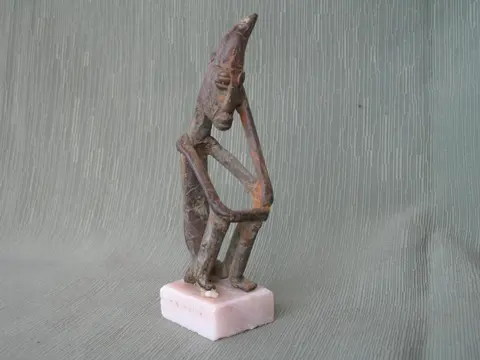
Small figure depicting a man sitting on the ground, resting his arms on his knees and his left hand on his head…
BRN-125
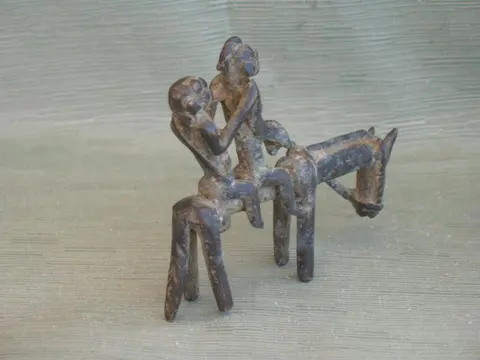
Curiosity bronze figurine of a woman carried the reins of horse while the man goes in the group holding the shoulders of…
BRN-126
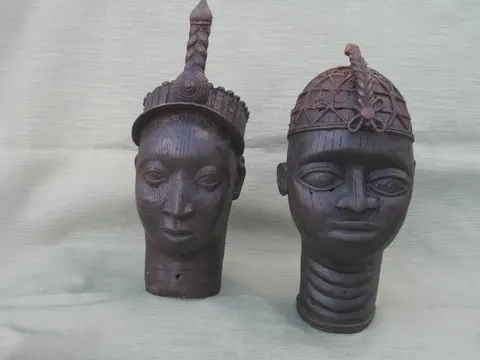
A reduced head of an Oni, king of ife, with its characteristic crown on the head on whose forehead stands a plume.
BRN-127
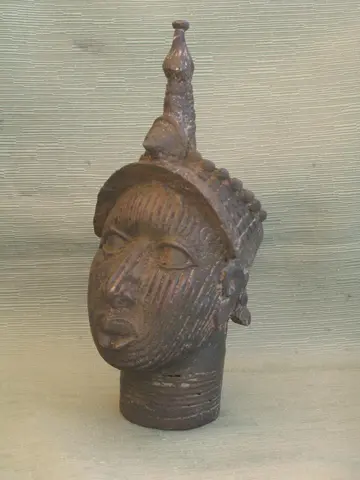
Ife's art is characterized by the beauty and balance of its lines and by a penetrating realism and a swrenity that seems…
BRN-128
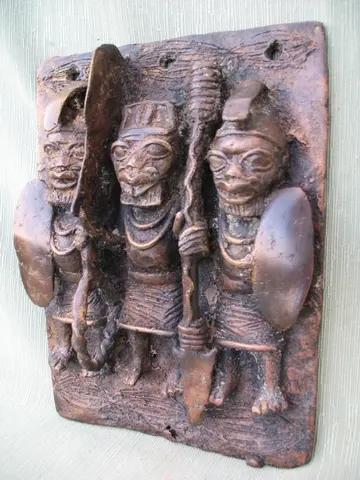
This plaque represents a remarkable warrior's dress flanked by two servers, at the top, of which only the torso and head appear.
BRN-129
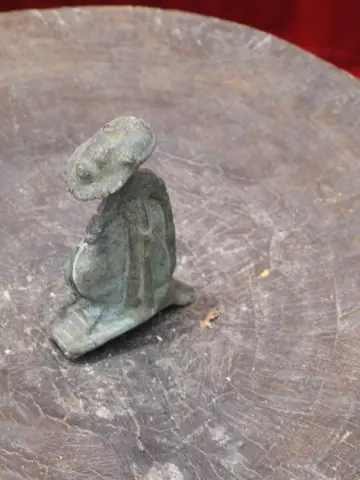
It was common throughout the Niger Delta region, using this type of small bronze figures and the custom of placing them as…
BRN-132
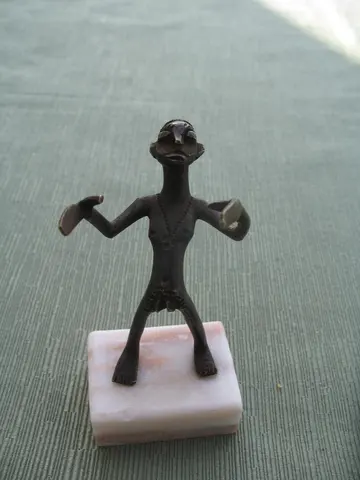
Small character with big hands in clap actud and body leaning back.
BRN-133
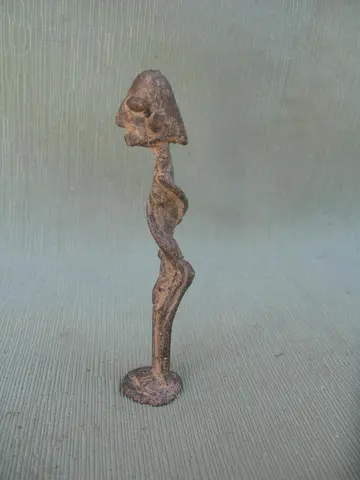
Small piece depicting a character are the twisted arms along the body, as if they were snakes.
BRN-134
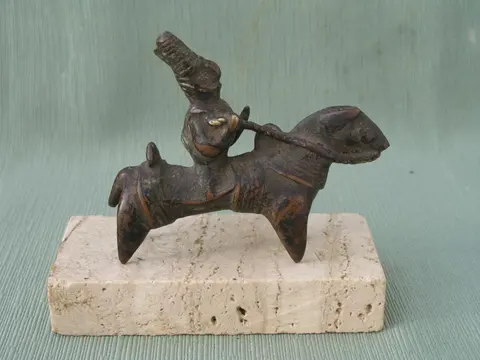
Figures Sao In fact, they were made by their descendants the Sokoto, established mainly in the Lake Tchad basin, who inherited from…
BRN-135
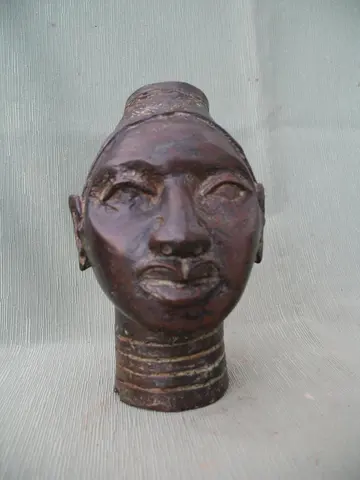
These heads representing Queen Mother Oba were the replica of the owner's face, in a size equivalent to about two thirds of…
BRN-136
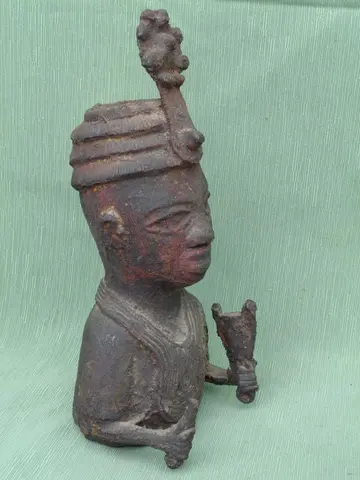
Oba Bust dating hard to define. It is a very rusty piece with some small cast defects.
BRN-140
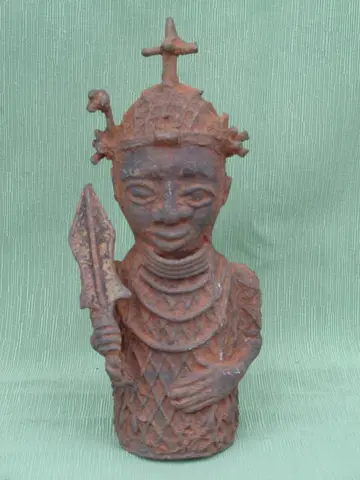
It is a bust of Oba or king of Benin that is difficult to define.
BRN-141
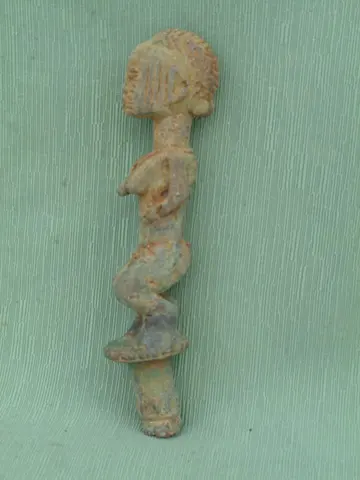
A woman initiated as shown by her scarifications, standing on a stool with her hands in her belly as a sign of…
BRN-142
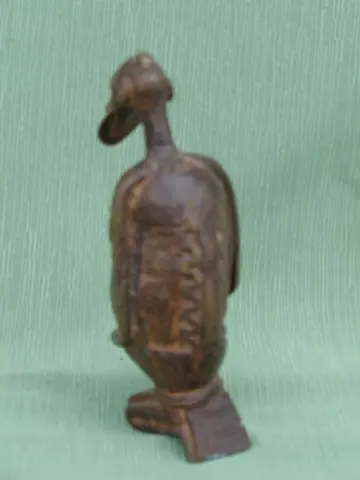
Curious figure of an old man kneeling and sitting on his heels, with his hands in his belly, a torso totally disproportionate…
BRN-143
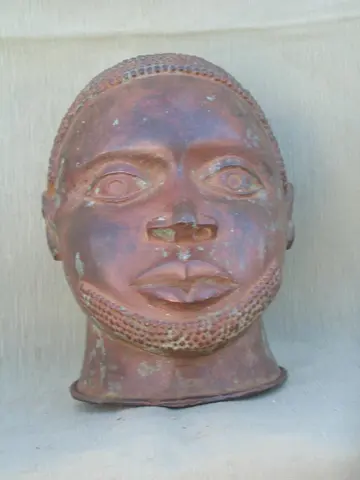
Head commemorating a dwarf of the court of the king of Benin.
BRN-144
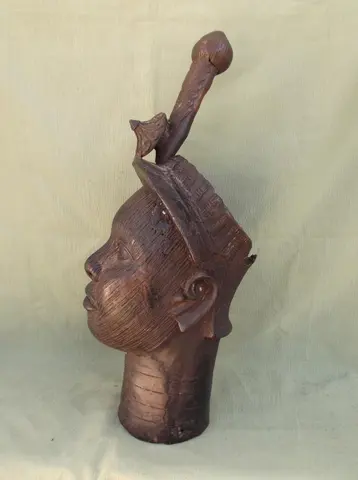
For many years it was thought that the figures of Ife and Benin were of Roman, Greek or Phoenician origin, given their…
BRN-145
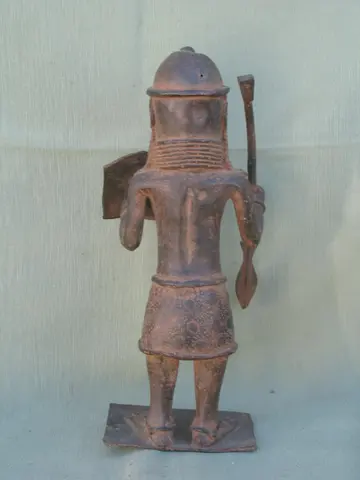
Artists in Binin City They were organized into corporations that lived in opposite neighborhoods.
BRN-146
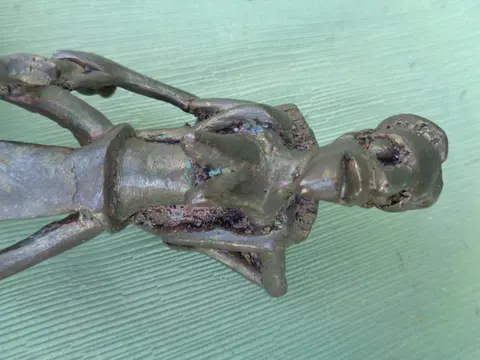
Small figure representing a tiller with the hoe in his hand and basket on his back.
BRN-147
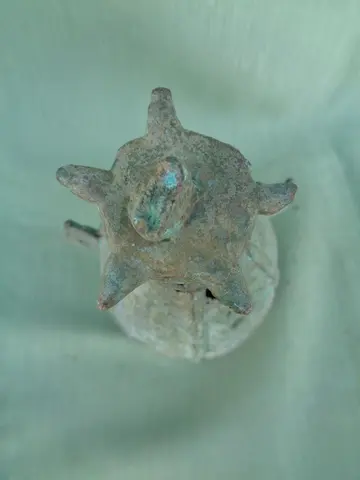
Former head that departs from the usual norm of the Bibi-Edo Yorubas, represents a geenium of nature.
BRN-148
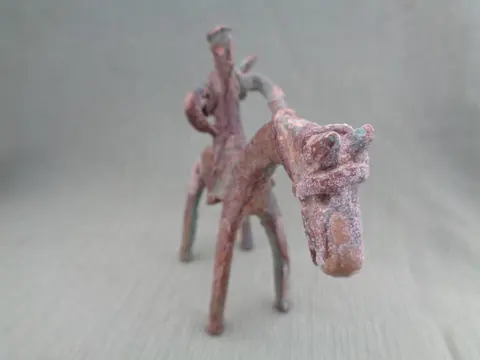
Figures Sao In fact, they were made by their descendants the Sokoto, established mainly in the Lake Tchad basin, who inherited from…
BRN-149
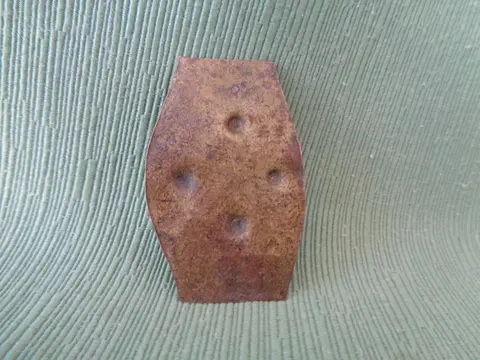
Brass sheet that is given to a friend by shaking his hand to indicate that his friendship is indefensible.
BRN-150

Former piece found in an excavation several tens of years ago.
BRN-151


