
Hare Mask
The masks that represent animals are in almost all ethnic hunter masks or masks that celebrate the most important agricultural festivities.
MFAZ-112

Text of the original catalogue
The name “Dogon“ It is a name given by themselves. Their neighbors, the PeulMuslims, they call them “Habé.” This word means unfaithful people, disbeliefed people, because they were located near Timbuktu, the intellectual and spiritual city of West Africa. The Dogon They have always been separated from the Islamic movement, perhaps partly because of their geographical isolation, as their country is nestled in the centre of the Niger meander, south of Timbuktu, between Bandiagará and Hombori. They are thought to have been in this region for several centuries. From there they have seen how Islam was occupying almost all of West Africa. They have remained faithful to animism and have protected their civilization from the influence of Mahometism. Islam, by allowing converts, contrary to Christianity, to continue with their animistic beliefs and practices whenever they were respectful servants of Islamic law, spread through Africa with incredible speed. Some researchers and ethnologists who worked in the region of the Bandiagará ravines estimate that another town, the Tellem, occupied the area before the DogonThere are also those who think that the Tellems would be the ancestors of the Dogonand a third thesis argues that it would be two completely different peoples. But the Dogon They say they are descended from the Tellems. In any case, they are an Ayoritarian peasant people. They mainly cultivate millet, in small plantations hanging from the walls of the ravines. Many of these small fields are supported by dry clay stones. In addition to these small fields, they grow others, in the valleys, at the foot of the ravines. Also their houses and barns are hung or built on the walls. Rustic wooden or rope scales allow them access. Artistic production of the Dogon The dogon artist uses very often, for his masks, a hard wood, resistant that looks like stone, commonly known as iron wood. Although the real “iron wood” is the “bibingen” or “bubinga” frequently used by Bamun and the BamilekéBut hard to find in dogon country. The work of sculpting ritual masks is reserved, as in other societies, to the caste of blacksmiths. They also sculpt statues, doors, barn windows and various objects. Masks made of bark or braided fibers adorned with cauris can also be found. Oral traditions tell that these masks would be very old The Cauri, small shell native to the eastern countries, besides being a traditional ornament in Africa has served as a currency in many cultures of the Continent, over centuries. It has therefore been, and until a few decades ago, a symbol of wealth and employed in numerous divinatory practices. It is a symbol of woman's fertility given her female form. It enters into the making of numerous amulets. The hunter binds a thin band of fabric inserted of cauris around the butt of his weapon to get good hunting and be protected against dangers. It is an indispensable ornament of numerous masks and ceremonial garments. It is in any case one of the positive symbols par excellence of African civilizations. The artistic characteristics of many of the dogon masks could be part of the Cubist school if we stick to the flat expression of the face. The wooden masks are carved in a vertical plane, with a painted decoration based on stains, or where black, red and white triangles are also found. These colors are obtained from red soil, white kaolin and vegetable juices, roots or barks and crushed leaves. The brown color is obtained from the alheña, exotic shrub whose leaves produce a yellow or red dye that is also used to give color to the hair. North African women use it to perform their tattoos. Many of the masks wear triangular or square openings to facilitate vision during their bearing. The nose is usually represented by a very thin, elongated plate on the vertical plane of the face, which is practically divided into two parts. Its characteristic ending in the form of an arrow is a distinctive sign of dogon art. The mouth, when it appears, is always a bump. The smaller masks, such as the hare or leopard mask, are maintained by means of a cross-sectional wooden rod, on the inner face, which the carrier holds between the teeth. The Baule and the Guroamong many other peoples, they also use this system. Dogon masks perform various functions: 1.- They represent the various social types, mask of the old, of the old woman, mask of the hunter, mask of the shoemaker, mask of the bandit, and, curious thing, mask of the young Peul. 2.- In addition, they have a series of zoomorfa masks that represent the most frequent animals in their environment: Black monkey, white monkey, crocodile, antelope, hyena, hare. 3.- A third series of masks represents the forest geniuses. 4Some very rare masks are portraits of ancestors. 5.- And finally, there are the masks called “floors”. Informers tell us that these masks are quite recent compared to bark masks. The floor masks are carved in a single tree, some of them measuring five meters. The wearer of these masks, in addition to having great physical strength, must be a true acrobat, for if he falls and the mask breaks, a misfortune can happen to him, to his dance society and to his ethnic group. The mask called “Kanaga” has its face and forehead carved into windbreaks. It always has triangular or rectangular openings to appear in the eyes. The transverse arms are formed by two additional tablets tied in equal dimensions. The top can be topped with two small statuettes. All the masks we have just listed are attributes of the secret societies of men and intervene in male funerals and mourning uprisings, which always take place two or three years after the death of an important character. In addition, the mask plays an important role in planting; is placed in the fields to prevent the theft of the fruits and defend the crops of evil spirits that may roam the village. After the ritual harvest, the masks are removed; the Dogon They keep them in the shelter of the rocks and in the holes of the walls of their ravines, away from the eyes of women. There is another mask, even larger than the floor masks, than the Dogon they call the “mother of masks.” It can reach a total height of ten meters, with a huge human face. It's the most sacred mask of all the dogon masks and it's never cover. Its color is ash grey, red in some parts, but by receiving the blood from animals it acquires a dark and quarted appearance. When an old man, a dignitary of the society of men, dies, the “mother of masks” is placed on his terrace for the celebration of evening ceremonies. Legend has it that the first men did not die; When they reached an advanced age, they became geniuses or snakes to gain access to a world in which another language was spoken other than that of humans. And this language should never be used in front of humans. An old man spoke and punished his infraction: This old man was the first human corpse, to appease the resentment of the dead with regard to the living. Dogon he sculpted the first mask called “mother of masks”. This great mask, according to legend, is the image of the serpent in which the old man could have become. For this reason, collected in myths of different ethnicities, many Africans do not eat snake and many of them have made it their totemic animal. To appease the resentment of the dead with regard to the living Dogon he sculpted the first mask called “mother of masks”. This great mask, according to legend, is the image of the serpent in which the old man could have become. For this reason, collected in myths of different ethnicities, many Africans do not eat snake and many of them have made it their totemic animal. Among the various dances organized during the ceremonies of mourning are dances that tell this legend.
138 objects · page 6 of 6
The masks that represent animals are in almost all ethnic hunter masks or masks that celebrate the most important agricultural festivities.
MFAZ-112

Statue of a woman kneeling with a large cup of offerings that she holds with her hands.
EFM-132
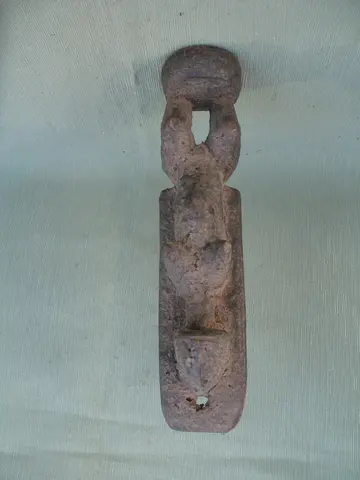
Although they are not represented in an explicit way, this figure represents a woman with her arms up.
EFM-133

As in most African maternity homes, it is a question of highlighting the fiction of the mother, the child always appears on…
MTR-70

The Ogo Banya are known as “Hogon Cups”, which would be their translation into some dialects.
RCPT-33
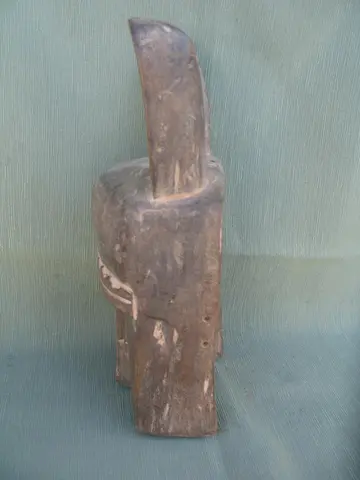
The masks that represent animals are in almost all ethnic hunter masks or masks that celebrate the most important agricultural festivities.
MFZ-58

Small glass of cooked clay intended to contain medicinal ointments for healings, magical substances for ritual celebrations or cosmetic…
TRRC-82

It was common throughout the Niger Delta region, using this type of small bronze figures and the custom of placing them as…
BRN-132

Small piece depicting a character are the twisted arms along the body, as if they were snakes.
BRN-134
Curious figure of an old man kneeling and sitting on his heels, with his hands in his belly, a torso totally disproportionate…
BRN-143

They are statues dedicated to the cult of ancestors. Raised arms go to Amma, God of heaven, asking for rain.
PAR-23

Mask belonging to a society of hunters, carries a bird on his head, certainly a calao.
MFAZ-122

Box used to contain medicinal ointments or ingredines or intended for ritual sacrifices.
RCPT-38
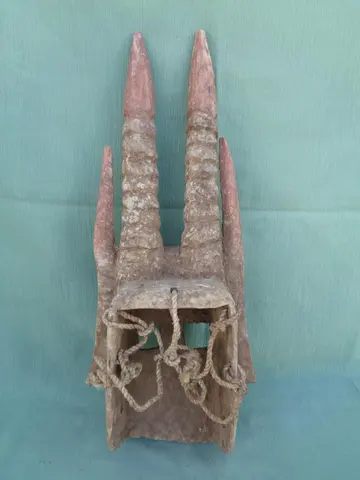
Walu is the mystical dogon antelope commissioned by the creator god Amma to protect the sun from the lulls of Yurugu, the…
MFZ-65

Representation of an ancestor in an imprecatory position, on her knees with her hands on her thighs.
EFM-141

The rider or knight in his saddle is a redundant theme in dogon art.
FEC-26

Old and rare dogon door, definitely corresponding to a collective barn given its size, since usually the barn doors are relatively small,…
PRYCR-25

Among the dogon masks are rare those depicting portraits of ancestors.
MFANT-231


