
Guitar
Guitar acquired in the mid-1960s in Abidjan. It is formed by the bark of half pumpkin, covered in lambskin, wood and cauries.
223

Text of the original catalogue
According to legend, at the end of the century XVIIIan Akan group, related to the Anyis, led by Queen Abla Pokou, niece of King Ashanti OsaiTutu, flees Ghana and tries to take refuge in Ivory Coast. He went to the death of the monarch when a war broke out over the succession to the throne between Abla and his brother Dako. Persecuted by Dako's troops, Abla is forced to flee to the neighbouring territory of Côte d'Ivoire as far as the river Comoé, infested with crocodile, west of Abenguru. Braking in their flight by this raging river and following the advice of their fortune-teller, the queen did not hesitate, to save her people and to be able to cross the river, to sacrifice her newborn son in order to obtain the help of the gods. Holding his son with both arms and lifting him over his head he threw him into the river shouting “baouli” (the child has died), thus giving a new name to his people. The crocodiles pelotated to get a part of the dam forming a compact and solid surface that allowed them to cross the river to their people. And this is how the people were born on this other shore of the Comore. BauléThe Baulé are located in the centre of Ivory Coast, in its capital Yamusukro and in the cities of Tiebisú, Tumodi, Dimbokro, Beumí and Sikasso, considered the moral capital of the Baulé, where legend tells that Queen Poku came with her people from Gana. They have ruled the country for forty years in the second half of the century XX. They learned, apparently, to carve the wood of the gourd and the aesthetic feeling that emerges from their masks and statues is unparalleled. For them, at birth, each individual leaves a family in the other world. In adulthood jealousy comes to the couple, instilled by the spouse of the afterlife. That is why the fortune teller orders to make a statue, as beautiful as possible, that will be welcomed as if the husband or wife of the other world came to reconcile with the spouse of the earth. After a ceremony, sort of a wedding, the statue will be kept in the bridal chamber, decorated and fed regularly. Blolo Bian is the husband and Blolo Blah the wife of the hereafter, our origin and our destiny. Therefore for I baulé their statues more than in relation to the world of ancestors are with the realm of divination. The Asian usu represent the spirits or geniuses of nature. They are intermediate divinities that can be favorable or harmful. In order to be favorable, the fortune-teller orders to carve an effigy as beautiful as possible, so that the genius will be at ease in his new cabin. He is usually depicted as a bearded man, of beautiful factions, sitting on a throne. Akan, often with an egg in hand, symbol of the universe. He will receive sacrifices and libations from families or from those possessed who will thus obtain his favors and protection. These statues will be transmitted from generation to generation to ensure the well-being of families.
608 objects · page 21 of 26
Guitar acquired in the mid-1960s in Abidjan. It is formed by the bark of half pumpkin, covered in lambskin, wood and cauries.
223

Guitar acquired in the mid-1960s in Abidjan. It is formed by the bark of half pumpkin, covered in lambskin, wood and cauries.
CORD-11

Important control stick of a notable normally used in important ceremonies and festivities.
BST-53

Simple five-barbed baulé comb. Old patina for use.
PNS-38

Receptacle destined for the rites of propitiation of ancestors and which can also be used to offer tail nuts to the visitor,…
RCPT-35

According to Susan Vogel, who has studied in depth the customs and traditions of BauléThe Goli is a show that lasts for…
MFZ-62

The rooster, a domestic animal, is present in many cultures, religions, traditions and literary works in many countries.
VAR-36

It is the geniuses or spirits of nature that can intervene in the world of humans by granting them their favors or…
-47

The Baulélike other peoples in Africa, they believe that everyone has a husband or wife in the other world and that they…
-48

A remarkable and initiated woman who has a cup of offerings in her hands.
EFM-140

Ring with a thick sphere of cut filigree, hollow inside. Three parallel circular lines delimit you in four zones.
ANLL-14

Metal of difficult cataloguing that has been attached to a stone of good size, ovoid pointed form, of those known as amazonite…
ANLL-17

Ring whose row appears to simulate two snake heads. Golden patina.
ANLL-23

Pin used by the women of Baulé and also of other ethnic groups to hold the hair.
CYA-23

Pendant that imitates the ornaments that are used in the caps of apparatus not only of the baulé area but throughout the…
226

Adorn used mainly in ceremonial hats, in some footwear and which was also used as currency and weight to weigh gold.
CYA-24

Pendant imitating the ornaments of the group’s ceremonial hats Akan.
CYA-25

Adorn used mainly in ceremonial hats, in some footwear and which was also used as currency and weight to weigh gold.
CYA-26

Adorn used mainly in the ode ceremony hats the group Akan, in some shoes and which was also used as currency and…
CYA-27
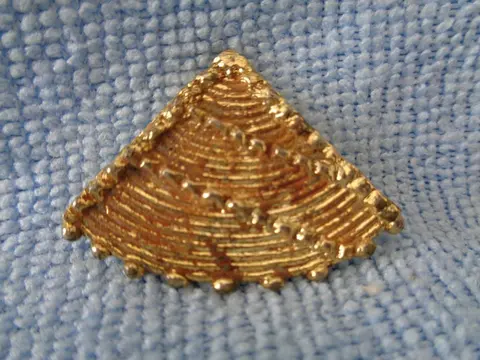
Mainly used ornament in the men’s group’s ceremonial hats Akan, in some shoes and which was also used as currency and weight…
CYA-28

Mainly used ornament in the men’s group’s ceremonial hats Akan, in some shoes and which was also used as currency and weight…
CYA-29

Adorn used mainly in the ode ceremony hats the group Akan, in some shoes and which was also used as currency and…
CYA-30

Adorn used mainly in the ode ceremony hats the group Akan, in some shoes and which was also used as currency and…
CYA-31

Adorn used mainly in the ode ceremony hats the group Akan, in some shoes and which was also used as currency and…
CYA-32


