
Stool with Cariatide
Given its former owner, a minister of one of Cameroon's first governments, everything suggests that this stool is from the end or…
TAB-1

Text of the original catalogue
TABURETES, TRONS AND SEATS Three terms that, in large part of the African peoples, are used interchangeably. In most cases they are not meant to sit on them, as in almost all of Black Africa one sits directly on the ground. They are prestigious objects, they denote the rank of their owner. Sitting in Africa is a privilege, a sign of distinction. The guest will be immediately offered a seat. But no one will dare to sit in a seat belonging to a higher rank or in another person's seat without permission. The seat of a chief is sacred. There are stools of common use, daily, more sober, and there are ceremonials, artistically decorated, with representations that are but symbols of their cultures with meanings that are unknown to us in most cases. A deep respect presides over the use of the different seats. No one would commit the offense of occupying a seat that is not his. They are not, as in our cultures, part of the furniture, but rather part of the personality of the owner, a symbol that characterizes him and that will continue to distinguish him after his death and that are therefore associated with his spirit. The use of them over many years will only strengthen this bond, so that at the death of the owner the stool will be placed on the family altar and will serve as an intermediary to communicate with the soul of the deceased. But their different forms and functions characterize not only their owners but through them the cultures from which they come and as material goods are integrated, in the course of time, into the family heritage.
16 objects · page 1 of 1
Given its former owner, a minister of one of Cameroon's first governments, everything suggests that this stool is from the end or…
TAB-1

Small and old reclineheads intended, probably given their small size, to be used in displacements.
TAB-3

Object, coming from the region of Gaona, called interchangeably wedding stool or courtship, since it has a symbolic use during the celebration…
TAB-4

Three terms which, in large part of the African peoples, are used interchangeably.
TAB-5

Three terms which, in large part of the African peoples, are used interchangeably.
TAB-6

Three terms which, in large part of the African peoples, are used interchangeably.
TAB-7

Three terms which, in large part of the African peoples, are used interchangeably.
TAB-9

Three terms which, in large part of the African peoples, are used interchangeably.
TAB-10

Three terms which, in large part of the African peoples, are used interchangeably.
TAB-11
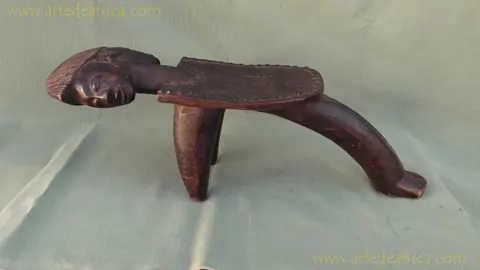
Object, coming from the region of Gaona, called interchangeably wedding stool or courtship, since it has a symbolic use during the celebration…
TAB-12

Old ashanti stool very worn by use.
TAB-13

Small stool with a female figure in a kneeling position, carrying a seat base over his head.
TAB-15

Stool artistically decorated with the four pairs of nomos, like cariatides, which are the origin of everything created.
TAB-16

Luba stools are made up of one or two cariatids.
TAB-17

Chief stool, carved in very heavy wood, representing a saddle.
TAB-18

Important throne belonging to a boss. This type were chairs or thrones were used exclusively in ceremonies and important occasions.
TAB-19


