
Passport Mami Wata De Bronze
The myth of Mami Wata extends over a wide area of the African continent, especially along the Atlantic side.
BR-13

Text of the original catalogue · Jesús Arrimadas Saavedra
In the section corresponding to the "Black-African Artistic Ethnography" (see tab above to the right) we develop a broad chapter on the nature of the mask, its origins and its functions. To avoid repetitions we will refer, in the sections corresponding to the masks of this first part of the Catalogue, exclusively to the masks treated in each section, with a brief comment. It is common, in different ethnic groups, to talk about real masks. It is not that the mask is the king, but that it is masks intended to be worn at ceremonies held in the royal setting. Some masks are real because only the king can own them, as is the case with the beads masks of the Bamileké Others because they represent the king, which is the most frequent case. The same thing happens with boss masks. Griot masks are frequent, mainly in the West African, often important court figure, familiar with genealogies, singer, poet, historian and rapsode, which can also exalt a king who defamates a monarchy to destroy it. The so-called masks of war, with a terrifying aspect, are intended not only to frighten the enemy but to enkindle its fighters during the struggle. They are the same masks that intervene to seal the peace agreements.
639 objects · page 15 of 27
The myth of Mami Wata extends over a wide area of the African continent, especially along the Atlantic side.
BR-13
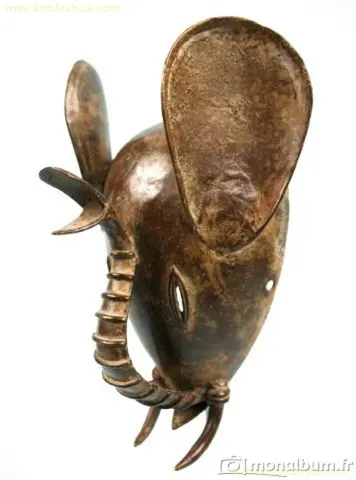
Mask representing an elephant, an emblamatic animal from Côte d'Ivoire, performed by the procedure of lost wax.
BR-14

Most of its masks have a relationship with the sea, shark, sawfish or hammerfish, often associating two animals such as ray and…
MFR-1

The mask Waniugobring a small glass to which the Senufo call “wa“ This cup contains a magic substance that can keep witches…
MFG-49

The hawk or owl mask and butterfly mask are very similar both in shape and size.
MFG-50

Human face with antelope horns. They represent an important event overcame a member of the clan.
MFAZ-75

Mask of corvo beaked bird that tends to represent the calao, mythical bird of the SenufoThese masks are manifested mainly in the…
MFZ-29

KoréIt is the spirit of the waters.
MFAZ-76

It is a front mask that is worn during ceremonies, organized by Kabaro society, passing between two classes of age.
MFR-2

This large, flat, triangular-headed snake with round eyes and wavy body with geometric drawings that plot its body with triangles represents…
MFG-51

People famed for their sculptures and weavers. They are a group of more than forty tribes, formed by families of patriots.
MFAZ-77

Mask belonging to a secret society of hunters.
MFZ-28

It is a mask of the San ethnic group of Mossi.
MFG-52

It is a male mask.
MFANT-145

The Kran are found mainly in southwestern Ivory Coast in the border area with Liberia where there are also some groups KranThey…
MFZ-30
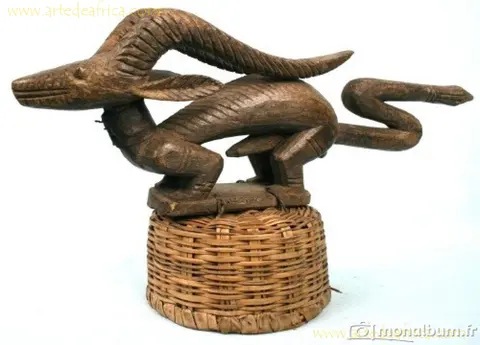
Tyi Wara means the work of the wild animal. Tyi means work and wild animal Wara.
MFG-53

Male masks are mainly war masks, difficult to differentiate from the masks of their neighbours the Krus of Ivory Coast.
MPR-2

They belong to the society of the same name. They are white and elongated, with a heart-shaped face.
MFANT-146

It is characterized by a large and flat forehead, thick triangular nose and rectangular, white mouth, ajar showing the two rows of…
MFANT-147

Used by society Bwadi Bwa Kifwebé is the best known mask, in its male and female versions.
MFANT-148

The people Eket It is formed by a caste society, being the most important Amamala.
MFANT-149

Portrait masks or “double” masks, ndomathey are supposed to be the “double” of the person whose face is represented.
MFANT-150

This mask is from the Moagha group of the familyMossiIt represents a hawk with wings deployed in flight position and evokes death.
MFZ-31

Family masks are not intended for dance or participation in religious, funeral or playful ceremonies.
MFANT-151


