
Hanging Passport
Passport mask elaborated by the procedure of lost wax, with profusion of details.
BR-12

Text of the original catalogue · Jesús Arrimadas Saavedra
In the section corresponding to the "Black-African Artistic Ethnography" (see tab above to the right) we develop a broad chapter on the nature of the mask, its origins and its functions. To avoid repetitions we will refer, in the sections corresponding to the masks of this first part of the Catalogue, exclusively to the masks treated in each section, with a brief comment. It is common, in different ethnic groups, to talk about real masks. It is not that the mask is the king, but that it is masks intended to be worn at ceremonies held in the royal setting. Some masks are real because only the king can own them, as is the case with the beads masks of the Bamileké Others because they represent the king, which is the most frequent case. The same thing happens with boss masks. Griot masks are frequent, mainly in the West African, often important court figure, familiar with genealogies, singer, poet, historian and rapsode, which can also exalt a king who defamates a monarchy to destroy it. The so-called masks of war, with a terrifying aspect, are intended not only to frighten the enemy but to enkindle its fighters during the struggle. They are the same masks that intervene to seal the peace agreements.
639 objects · page 14 of 27
Passport mask elaborated by the procedure of lost wax, with profusion of details.
BR-12

They represent spiritual power or “Yu”. Their artistic canons are quite similar to those of their neighbors.
MFAZ-68
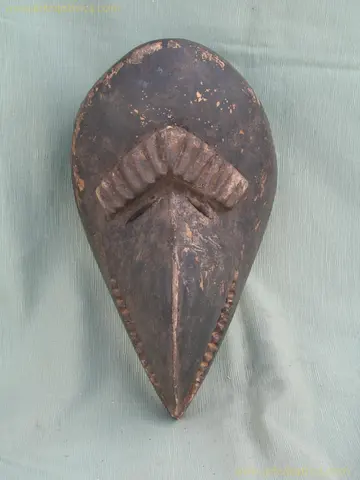
The Kran are located in southern Liberia and border to the south-west of Ivory Coast, in fact Gueréof the latter country, belong…
MFZ-25

KoréIt is the spirit of the waters.
MFAZ-69

The mask Mwaash A-Mbooy or Moshambwooy, represents sister and wife of Woot, ancestor from whom the great family comes KubaThey were called.
MFANT-138

The mask, called Loniaké, is made from a wooden plate, away from the eyes of young women and young women, as well…
MFG-46
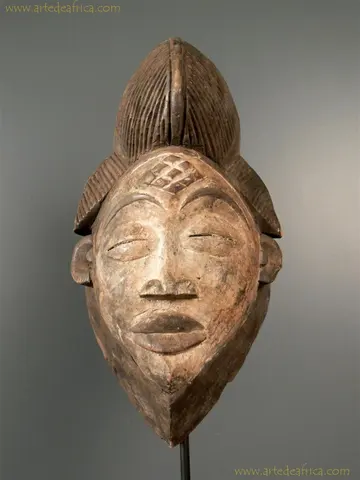
It's a mask that represents the female face of a young woman.
MFANT-139
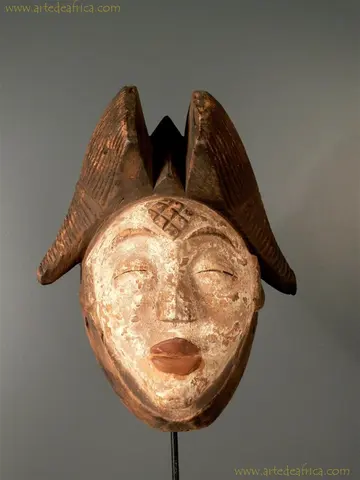
It's a mask that represents the female face of a young woman.
MFANT-140

The Wawa are a small ethnic group, neighbors and relatives of Igbomainly in the north of the capital of Nigeria, Abudja, on…
MFG-47

Belly or ventral masks are used by different ethnic groups to represent motherhood.
MVT-4

The altar masks do not dance or participate in dances, they are sacred masks that are kept in the sanctuary.
MSOAL-9

Related to the Kota They live in the north of the People's Republic of Congo.
MFAZ-70

Curious mask hangs very realistic and different from those usually used by Pende.
MFANT-141

The Luba mask is very similar to the Kifwebé female mask of the Songyé, but more rounded, although the male mask also…
MFANT-142
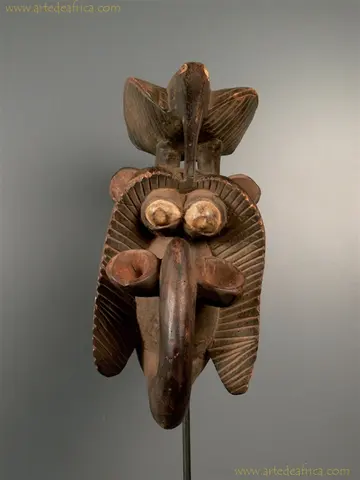
Small ethnic group with only 30.000 persons along the Cameroonian border with Nigeria, occupying the Donga.
MFZ-26

The word Zaulí designates both the mask and the traditional dance of the country.
MFAZ-71

Passport mask that mimics the style of the mask zamblé. It's a stylized war-related antelope mask.
MPS-34

Passport masks are usually reproduction of large masks. In this case we are facing the reproduction of a mask dan mahou.
MPS-35

Small passport mask that reproduces a ventral mask. Belly or ventral masks are used by different ethnic groups to represent motherhood.
MPS-36

It's a mask that represents the female face of a young woman.
MFANT-144

They represent spiritual power or “Yu”. Their artistic canons are quite similar to those of their neighbors.
MFAZ-72

They represent spiritual power or “Yu”. Their artistic canons are quite similar to those of their neighbors.
MFAZ-73

The word Zaulí designates both the mask and the traditional dance of the country.
MFAZ-74

Mask depicting the stylized figure of the head of a facocero or wart boar.
MFZ-27


