
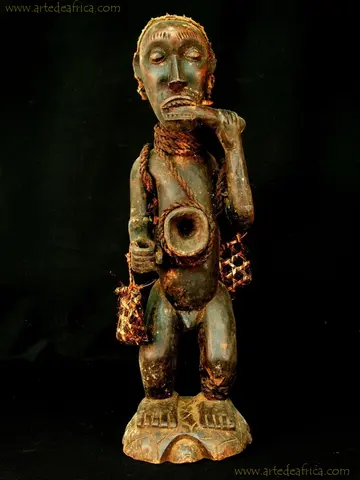
Soothsayer
Few manifestations of the statuary chamba are known, usually simple figures and devoid of any ornamentation.
FET-3

Text of the original catalogue
The force that is handled in the practice of magic is supernatural but not sacred. It requires a technique and a ritual. Geniuses of nature, the spirits of ancestors, supernatural powers and different divinities are continually manifested to men, but it is necessary that they know how to interpret these manifestations. Spirits can know the mysteries of the supernatural world and as there are many things that escape the knowledge of the common mortals and it is not possible to dialogue with the spirits or ask them the right questions and even less to establish a contact with them, the diviners will be commissioned to perform these tasks in their name, for they are prepared and know the techniques that allow them to establish a contact with beings and forces of the hereafter. The techniques employed are numerous and very different. From oracles of all kinds and ordeals to divination by means of small bones of animals, small sticks or seeds which according to the disposition they acquire on the ground or board when thrown by fortune teller will render the relevant interpretation. Yoruba boards become true works of art. Known are the oracles baulé of mice and divination by means of the footprints left on the sand by the pale fox of the dogon. The fortune teller has drawn on the sand a complicated board with a series of cabalistic signs arranged according to an established order. Attracted by bait, the raven will trample the sand at night leaving traces that will be interpreted by the soothsayer. Reading the entrails of animals or the signs produced by tail nuts or cauris arranged on the different divinatory trays or the movements of a candle flame are some of the many forms of geomance that are commonly used among traditional African societies. The fortune teller knows the technique that allows him to ask the right questions so that he can read and interpret the answers properly. The fortune teller is an important character in traditional, feared and respected societies who earn a living from his work. It is usually independent despite being very close to the court of some kings. They will come to him for all kinds of consultations concerning life and death, the health of animals as well as of people, the fertility of fields as of mothers, about travel, wars, wealth and poverty, all issues that may affect man or nature are within their competence. He is a deep psychologist, a connoisseur of the nature and medicinal virtues of plants, of astrology and especially of mythology. It enjoys great prestige.
51 objects · page 1 of 3
Few manifestations of the statuary chamba are known, usually simple figures and devoid of any ornamentation.
FET-3

This steatite known as Mbigou stone is extracted in the quarries of the town of the same name, in the province of…
FEC-17

It seems that the horse was introduced to Africa, especially to the south of the Sahara, according to archaeological excavations and some…
FEC-18

The Yoruba statues of cup bearers are related to divination, serving for a part of a cup of offerings and welcome cup…
EFM-17

A woman kneeling with her hands on her thighs, near the rhodollas, in a position to pray.
EFM-18

The Gelede cult, practiced mainly by the Yoruba Westerners, it is a cult in honor of living or deceased elderly women.
MYA-11

Ancient iron piece from northern Togo depicting or kneeling character in offering position.
FET-11

Reliquary intended for ritarian uses within the cult of ancestors.
RLC-17
the iboga is a potent drug that is extracted from a root and exerts a great influence on the social life of…
FET-33

This mask belongs to the secret society Ndunga that exercises a political function and is responsible for maintaining social order.
MFANT-116

Rare baulé sorcerer mask.
MSOAL-4

Important, ancient and powerful fetish used exclusively by sorcerers for the practice of the various rites surrounding the Voodu.
FET-39

Ancient, rare and powerful fetish used exclusively by the sorcerer in the rites accompanying the Vudu.
FET-40

The fortune teller, the babalawoPut sixteen palm nuts on the tray to proceed to the divinatory rite.
MYA-9

Finely braided recipient with raffia that is used by the sorcerer in the ceremonies of magic and divination.
MYA-10

The Nkissi statues of the Kongolike all Nkissi, they are protective figures that acquire their strength and power after being loaded by…
MYA-12

The Nkissi statues of the Kongolike all Nkissi, they are protective figures that acquire their strength and power after being loaded by…
MYA-21

For the BIDJIOGO everything sacred is called “iran”, whether it is an altar, a statue or a seat, and they are respected…
MYA-14

Mask with monkey head used by sorcerer baulé in divination rites and in ceremonies intended to fight against spells.
MYA-15

Ethnic protection fetish Bulu, south of Camerun.
FET-49

Called a box of spirits is meant to keep the relics of ancestors.
RCPT-11

Cantimplora built from a species of African pumpkins. Used to conserve and transport drinking water.
VAR-9

Little piedar figure depicting a monkey covering his eyes. It is used in divinatory practices.
MYA-16

Cut stone, rather flattened, with two faces opposite the skull and two faces on the lower flat, one on each side.
MYA-17


