
Colone
Colonus with red painted face as well as the pole carrying white moles.
COL-3

Text of the original catalogue
The term “colon” is applied in African art to small statues that take their origin in colonial times, the most significant being those of the Baulé ethnic group in Ivory Coast. These statuettes usually represent characters of all kinds and conditions of European society of that time, both men and women. This can be found from magistrates, doctors or military to footballers, rockers or ordinary people dressed in street clothes, wearing shorts, long pants or work monkeys, as well as wearing shirts and shoes of all kinds. The arms are usually extended along the body, in other cases with the hands in the pockets in an unwrapped attitude. The uncovered face and body parts are painted red, a colour with which Africans describe the European. A humorous nuance surrounds these figures that are nothing but a satire of the colonial population. Africans working for Europeans, in the army, in the administration or in hospitals have also been represented. It is common to find figures representing African maternity homes, healers and even African-style European characters. An important feature of these figures is their colour, most of them painted with all kinds of colors, including red, black, blue, white and yellow. What has earned them the humorous name of “Ripolin figures”, the name of a well-known brand of painting sold throughout the West Africa.
39 objects · page 1 of 2
Colonus with red painted face as well as the pole carrying white moles.
COL-3

Character with short blue pants, just like the hat. White shirt with wide blue band at the bottom.
COL-4
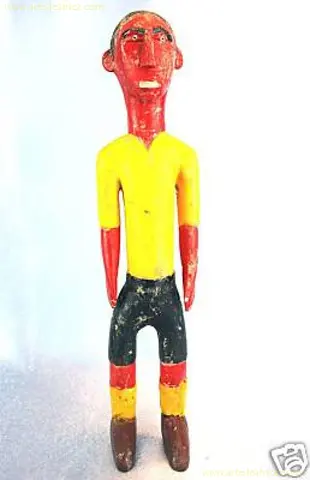
Figure that represents a football player from the 1960s or 1970s.
COL-5

Female figure, which appears to be a representation of ancestor, as it has been venerated as shown by the different projections it…
COL-6

It is a fine sculpture as shown by the numerous sizes, hairstyle, earrings, necklace.
COL-7

Rare female statue of the settler style of the Agni.
COL-8
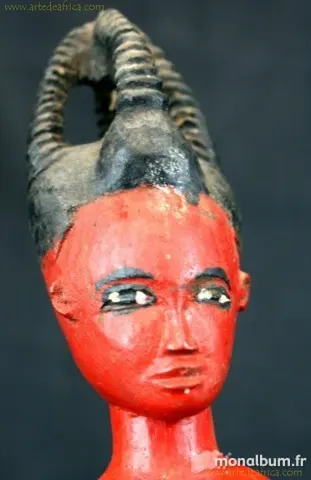
Beautiful face of pregnant woman with a sophisticated style of ceremonies that appears very rarely in statues and baulé masks.
COL-9
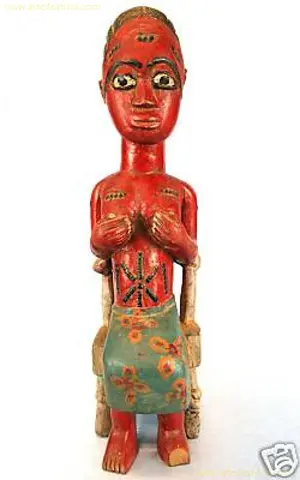
Statue of woman seated of extraordinary dimensions within the settler style.
COL-10

Woman in swimsuit.
COL-11

Representation of a settler of Nedra race bearing the colonial helmet of the first epoch.
COL-12

Former piece from a village of Baulé.
COL-15

Rare settler-style piece in dense wood.
COL-16
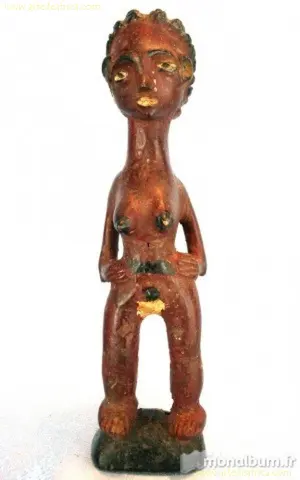
It represents an African woman, quite light in colour, in a rare position in this type of statuery, the hands resting on…
COL-17
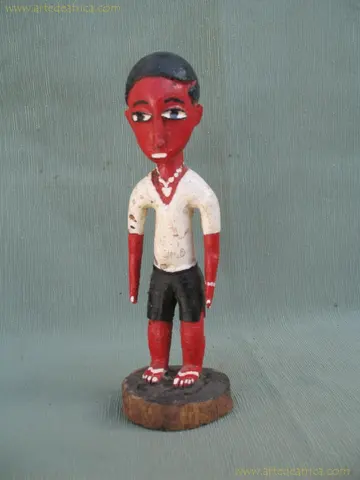
Typical representation of a settler boy, with arms down and separated from the body.
COL-18

A settler-style woman with European and African elements.
COL-19

Representation of a settler in the classic carefree attitude, the left hand in a pocket and the right arm extended along the…
COL-20

The myth of Mamy Wata extends over a wide area of the African continent, especially along the Atlantic side.
COL-21

Delicate sculpture of a settler style woman, with facial scarifications, wood color with beautiful patina.
COL-22

Woman sitting on a stool Akan, with generous naked breasts, carrying a cup of offerings, of those destined to contain kola nuts.
COL-23

Representation of a man of law, surely a judge of the colonial era with robe and birete, in thoughtful attitude and hands…
COL-24
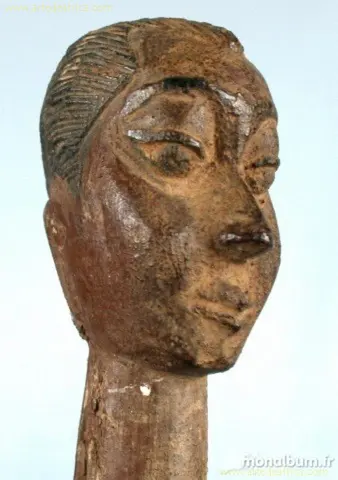
Although a large part of the Baulé statues of the so-called "colonial style", with a red body, which is the color they…
COL-25
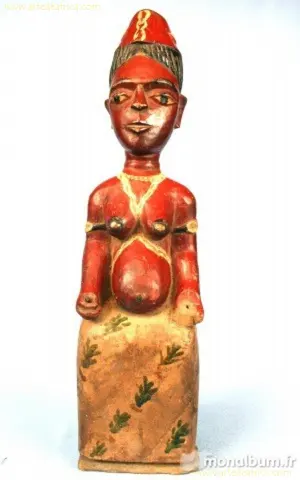
Animist sculpture of the settler style.
COL-26

Spoon whose handle represents a settler, easily identifiable by the colonial case.
COL-29

Figure of woman covering her nakedness with a small black panties.
COL-31


