
Woman with the Hand in the Back
Both the masks and the statues show the cranial elongation of the Mangbetu.
EFM-22

Text of the original catalogue
The Mangbetu in the Democratic Republic of the Congo, former Zaire and formerly Belgian Congo, since the mid-century XVIII From Sudan. Men are engaged in hunting and fishing and women are engaged in agriculture. Its traditional social organization is monarchical. The kingdom is divided into provinces and these into districts that comprise different villages. After the king who is invested with supreme power, it is his sons who distribute the power of the provinces. Like most monarchist peoples, Mangbetu art is essentially a cutting art. The first contact the Western explorers had with the Mangbetu It was in 1870 And they called this town elegant and aristocratic. The women practice the deformation of the skull by coquettery from birth, adorning it with those showy hairstyles that profile offer an elongated figure ending in a plate-shaped auction. Men's hairstyle is eggoid. They practice pottery with a unique style in Africa that has lasted a short period of time, from the end of the century XIX at the beginning of the century XX. It is a prestigious pottery, without any utilitarian function.
24 objects · page 1 of 1
Both the masks and the statues show the cranial elongation of the Mangbetu.
EFM-22

They have no ritual meaning and therefore do not participate in any religious ceremony.
MFANT-65

Most of the mangbetu objects are carved in light wood that are further skated dominating the honey color.
CORD-1

Trompa intended to produce musical sounds during court ceremonies.
MRF-6

Pipe made of light wood, like most mangbetu objects.
PIP-2

Bracelet intended to be worn by women on the ankle, in the manner of the former slaves, although in this case in…
PYB-1

The male genitals and incipient breasts show that this is the case with an androgynous-looking female statue.
TRRC-15

Artistic clay jar cooked with dark brown pigmentation profusely decorated.
TRRC-16

Maternity sitting on a stool with the child on the lap.
MTR-17

Male character sitting on a stool. She is part of a maternity couple.
PRJ-6

Male character sitting in an offering attitude, with a glass of offerings between his hands.
TRRC-34

Anthropomorphic pitcher depicting a mother with her son riding on top, judging by the typical female and male hairstyles respectively.
TRRC-35

Anthropomorphic pitcher that, judging by the hairstyle, represents a woman, with her arms and legs folded.
TRRC-36

Female character with incipient breasts that by facial scarifications and necklaces and bracelets he wears on neck, arms and legs, as well…
TRRC-37
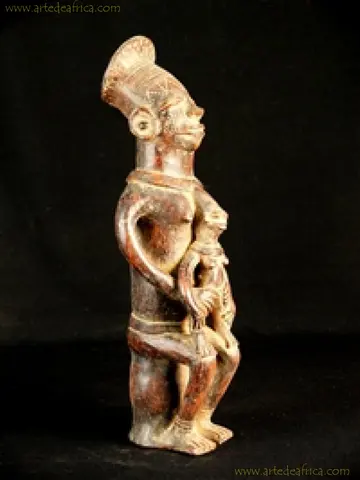
Maternity with the child sitting on the mother's lap. It gathers all the characteristics of magnbetu pottery.
MTR-19

The pipe is a prestigious object, essentially masculine, that indicates the rank of its owner.
PIP-4

beautiful motherhood in dark clay.
MTR-22

The resonance box is made of wood covered with antelope leather and the arm is formed by the figure of a woman…
CORD-3

Four stringed harp built on an ox horn. The mango, dark brown patina, is topped with an anthropomorphic head.
CORD-5

The Mangbetu They had a very hierarchical social structure, and the towns depended on a provincial chief who in turn depended on…
TRRC-57

Male figure sitting on a stool, with one arm on the other in a resting attitude.
TRRC-59

The figure of motherhood is one of the oldest and most representative in Africa.
MTR-59

Figure of a character sitting on a stool with a scepter shaped like a thick arrow in his hands.
TRRC-66

Point or spear astile intended to be set on a handle. These spears were destined for war, defense and hunting.
ARM-63


