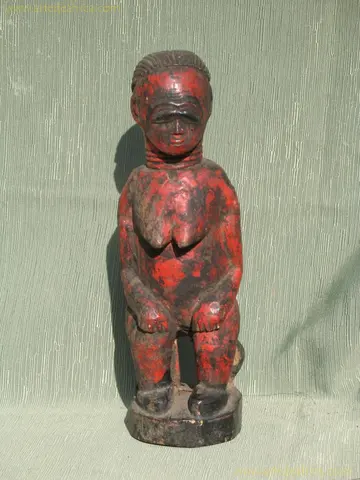
Sitting Woman
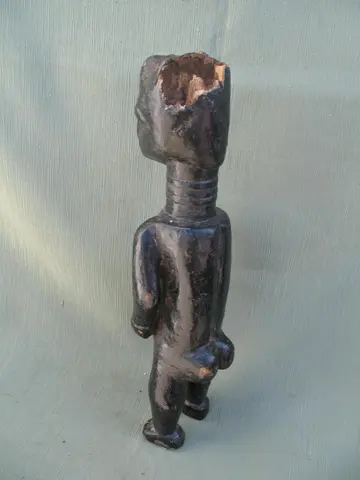
Rare female statue of the settler style of the Agni.
COL-8

Text of the original catalogue
In the century XVII different factions Akan, coming from Dankyira, in struggle against their sovereign they flee Ghana and settle in Ivory Coast, one in the area that receives the name of Agnibilekro and another extends in the south occupying the coast and settling in the small kingdoms of Ndenyé, Bettié, Moronu and mainly creating the powerful kingdom of Sanwi and its capital Krinjabo, seat of the king, although Aboisso was the cradle of this powerful and ancient kingdom, the most important and ancient of Ivory Coast. The administrative organization of the kingdom is based on the cantons whose chiefs are directly dependent on the king and under whose command there are different village chiefs. But both canton and village leaders enjoy broad autonomy. Also important was the kingdom of Ndenyé whose main city is Abenguru. Like many other animistic peoples, they think that the ancestor can reincarnate in the newborn child, but that the soul of the child can also come from the village of souls where he has left a family to come to earth. It will count on the protection of its spiritual mother until through initiation it is definitively incorporated into the human community. You can also make her die to return to her, so the Earth mother if she wants to lose her child will have to observe a whole series of ritual prohibitions starting with suppressing during pregnancy foods that can be harmful to the right evolution of the fetus. On the seventh day after birth, after a period of isolation of the mother and son, a ceremony will be held to remove the influences of the afterlife, for which he will be covered with all kinds of bracelets and necklaces, tied to his body, to retain him in this world. An elderly woman in the family will rub the child's forehead with kaolin and his lips with lemon, while giving him a name, usually composed in which is included the day of the week on which he was born and that of the person or genius embodied in the child. Like most peoples AkanThey have a great relationship with gold. They were the first to establish their use as a payment currency. In addition to the Festival of the Ñame, which they introduced in Ivory Coast and which is the basis of food, they celebrate the Feast of the Gold, the day on which the families expose before their doors all the objects made with this precious metal, necklaces, bracelets, weights, sticks or statues. The descendants of each family must increase this heritage. The Feast of the Ñame has a great solemnity, it is the moment of intense communication with the spirit of the ancestors and with the land that offers its fruits to feed man. The Feast begins by worshiping the royal chair symbol of the sovereignty of the Sanwi people. After the libations proceed to the ritual bath of the king who later, wearing his best galas, will be brought in triumph to the village while the Komians, priestesses, dressed in white will purify the village with libations of kaolin. The celebrations will end with offerings and yam dishes that will be offered first to ancestors and fetishes. Also known as Anyi have mainly produced terracotta figures made in honor and memory of high-ranking ancestors. Faces are usually very naturalistic, rather cylindrical bodies and ringed necks. They worship these images, in the sanctuaries, for they are persuaded that the souls of their deceased reside in them. They are known as terracottas of Krinjabo. For the Agnis of the kingdom of Sanwi the ancestors are elevated to the rank of divinity with the name of mà, name that also receive the small terracotta statues that represent them. As in most African Animist peoples, the human being does not die, only his body returns to the land from which it originates and the spirit passes into another dimension, but for some Agnis his spirit is reincarnated into an ethnic woman. And it is also a woman, the sorceress, who modeled these more or representation of the deceased. In other times, a weekly holiday was celebrated in honor of the living dead or the dead. These statuettes were placed on the tombs or laid in a place far from the village and received food and drink and blood from victims of the sacrifices to safeguard the lives of the women who had made them. They were washed once a year. When a sovereign died numerous human victims were sacrificed, in addition to their wives and concubines, slaves and slaves to serve him in the afterlife. The women were dedicated to the cult of the ancestors by being the receptacle of the spirit of the divinized ancestor. They were modeled in front of the body present of the deceased accompanied by the wailings of the wailings. The children were piled up and fed on the day of the weekly feast. These customs as well as the bloody sacrifices ceased in the year 1901. According to specialist B. Hello the different information available on the subject are quite contradictory. These figures have appeared in different places in the ancient kingdom of Krinjabo, near Aboisso. They seem to date from the centuries. XVI a XIXMostly only heads have appeared with signs that the bodies have been broken. In other cases they were, in their time, deliberately separated from the body. There are very few pieces that have been preserved whole and many of them with breaks or flakes. We are faced with a more elegant bill acquired in Abidjan in the mid-sixties of the last century. The children occupy a central place, as the adage agni says, “feed your child until his teeth come out so that he will feed you when you have lost yours.”
15 objects · page 1 of 1
Rare female statue of the settler style of the Agni.
COL-8
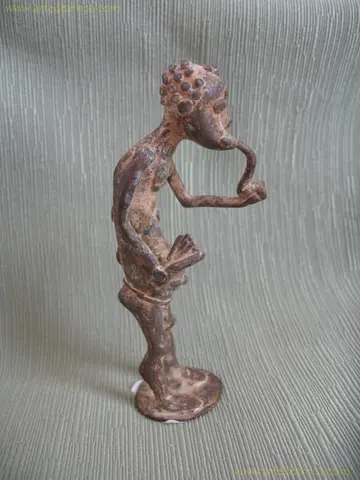
Little old bronze figure to the lost wax representing a man smoking the pipe.
BRN-54
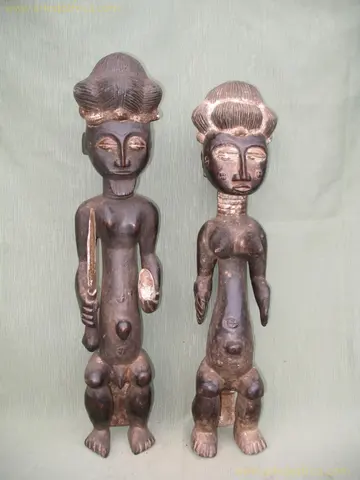
Probably a real couple or at least high rank as shown by their hairstyles and the fact of sitting on an akan…
PAR-5
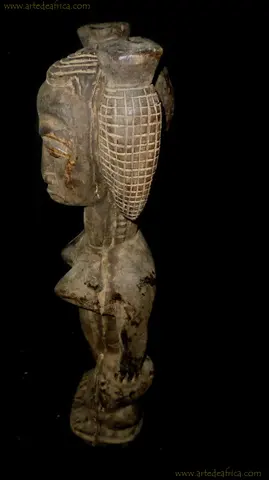
A figure of an ancestor with her hands on her thighs in an attitude of seriousness and meditation, her hairstyle, rare in…
EFM-89
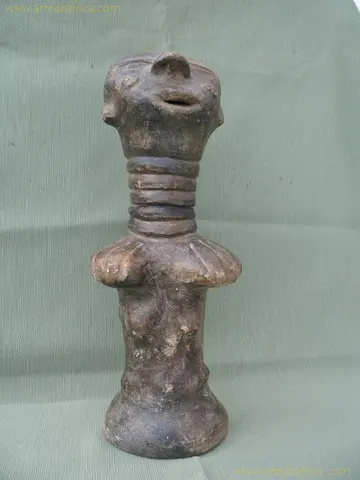
1 For the Agnis of the Kingdom of Sanwi the ancestors are elevated to the rank of divinity by the name of…
TRRC-56
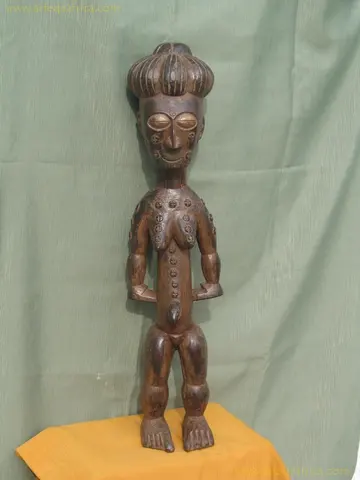
Beautiful statue of agni woman with all the characteristics of ethnicity, such as hairstyle.
EFM-102
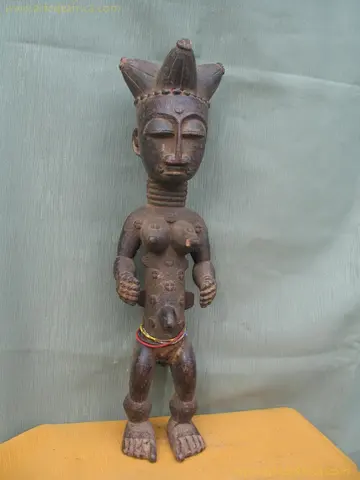
The figure of motherhood is one of the oldest and most representative in Africa.
MTR-58
Small doll-shaped pendant Akwaba. Eused by women and young women as greygrey or protective amulet.
CYA-17
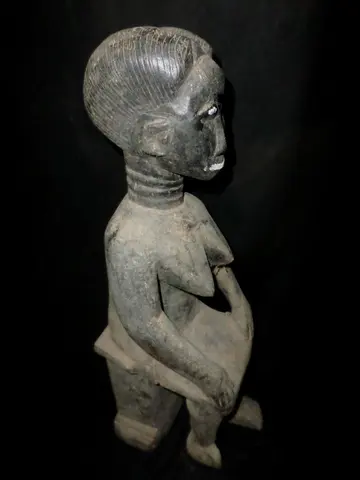
Maternity that appears sitting on a stool indicating a high-ranking woman.
MTR-65
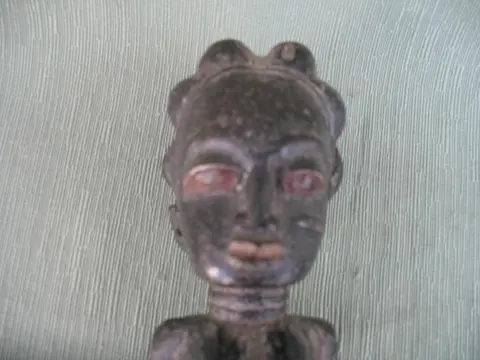
Young initiated as demonstrated by her facial scarification.
EFM-112
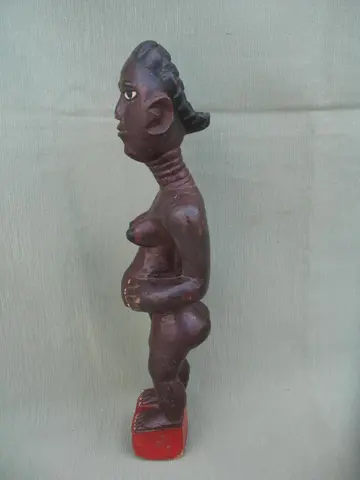
The term “colon” applies in African art to small statues that take their origin in the colonial era, the most significant being…
COL-47
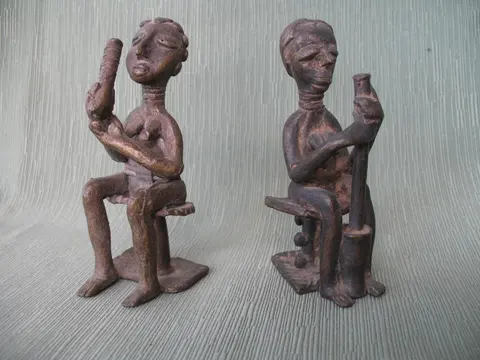
Piece acquired in Abidjan in the mid-sixties of the last century.
BRN-118
Women Agni They have a secret matriarchal society whose power to communicate with spirits is important.
EFM-121
The figure of motherhood is one of the oldest and most representative in Africa.
ESFE-8

She is a young Agni woman with a classic ringed neck, serene face, small upright breasts and flat belly, which shows that…
MTR-77


