
Baston De Commando
Elegant cane with a curled snake and the head of the woman of a boss or a remarkable.
BST-26

List of the historical catalogue
Text and organisation of the original catalogue · Jesús Arrimadas Saavedra
In most African countries, canes of ceremony are objects that involve great solemnity. With more or less rigor the pomp and the boat always accompany these objects. They are an external sign of power. They are used by the king, the chief of canton, the chief of village or by the notables. The richness of its ornamentation will indicate the range of its owner, from wooden-carved sticks to rich gold-plated art works, as is common in Akan countries. They are not standard use sticks, the normal use sticks are simpler. Royalties are the material symbols representative of the head’s authority. They are the main symbols of power and dignity and can only be carried and possessed by those who wield power. Ceremony swords, flyflies, scepters and command sticks are part of the royalties. Only kings can carry scepters and batons of command. The scepter is, par excellence, the symbol of royal power, to such an extent that even in the absence of the king, honor and pleitesy are given to it. They are usually delicately sculpted and richly decorated, whether made of wood, bronze or gold-plated as in the Akan country. The flycar is a symbol of power or prestige. They are used by kings and notables. There are from true works of art to a simple stick with four hairs of the tail of an animal or four herbs. By the artistic quality and richness of its realization is known the rank of the owner. Most sculpted pieces are finished by anthropomorphic figures. According to what they represent they can be linked to proverbs, for example about the inconstance of fortune. As a symbol of power, for the BauléSometimes it can evoke a proverb. It is named after nandwa blawa.
51 objects · page 2 of 3
Elegant cane with a curled snake and the head of the woman of a boss or a remarkable.
BST-26
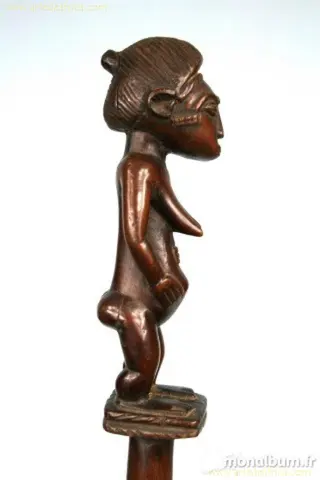
Baton that presents a beautiful dark patina due to its antiquity.
BST-27

Scepter representing a sitting woman. Scarified body, with remains of akan gold bread.
BST-28

Scepter in the form of a European-inspired rifle, chiseled with fine geometrical angles akan.
BST-29

Curious scepter that has the shape of the zuelas used by the sculptors.
BST-31

Axe of ceremony with artistic mango carved in the form of a pipe.
BST-32
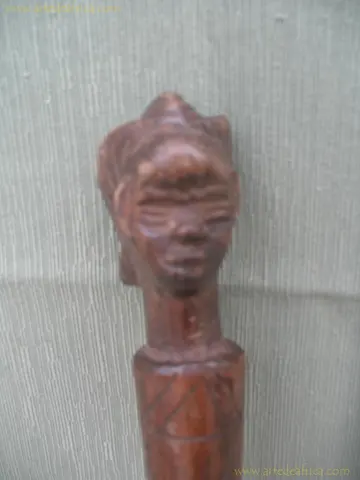
Azuela mango of ceremony or prestige with a baulé head as an auction that faithfully translates the aesthetic canons of the ethnic…
BST-33

It is a cane or axe of ceremony used during worship to the god of Thunder Shango, fourth Yoruba king who was…
BST-34
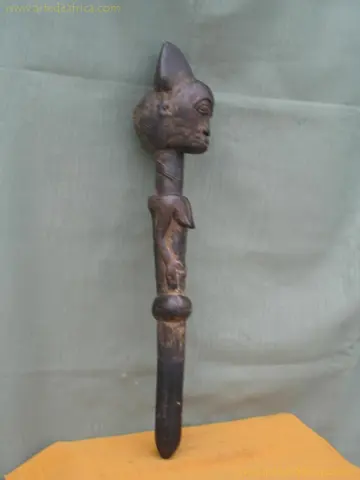
Scepter representing a woman with a severe face. This scepter seems to come from Sikasso.
BST-35

Curious scepter representing a priestess with her ceremonial apron and a spoon for the administration or elaboration of some magical or healing…
BST-36

Heavy solid bronze scepter in the form of hoe, belonging to an important dignitary.
BST-37

Baton used by notables as a symbol of dignity.
BST-38

Royalties are the material symbols representative of the head's authority.
BST-39

Baton used by notables as a symbol of dignity.
BST-40
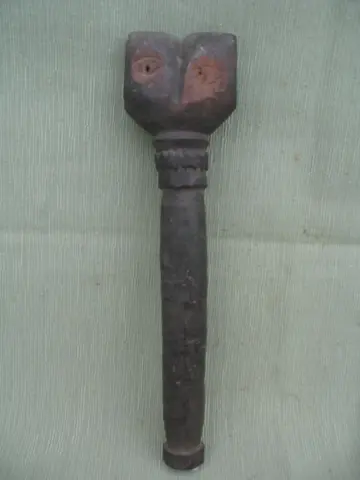
It is a cane or axe of ceremony used during the cult of the god of Thunder Shango, fourth Yoruba king who…
BST-41

The flycar is a symbol of power or prestige. They are used by kings and notables.
ESP-1

Fine bullflies handle carved with knife with akan motifs and gold to the golden bread.
ESP-2

It's scary fly topped with the head of a remarkable bamileké.
ESP-4

The flycar is finished off with a dan head and cauris.
ESP-7

Fine flyflies with honey patina.
ESP-8

Baton used by young neophytes in the processions of male initiation.
VAR-33

Baton used by young neophytes in the processions of male initiation.
BST-44

Baton used by young neophytes in the processions of male initiation.
BST-45

Baton used by young neophytes in the processions of male initiation.
BST-47


