
Shoulder Mask
Mask formed by a head on a kind of inverted “U” wood that serves as a base and would constitute the trunk…
MHB-1

List of the historical catalogue
Text and organisation of the original catalogue · Jesús Arrimadas Saavedra
FOR ENLARGEMENT SEE “NEGRO-AFRICA ARTISTICAL EthOGRAPHY”, upper right tab. FUNERARY AND CULTURE MASCARAS TO THE BACKGROUND. All the masks that participate in the cult of ancestors and that accompany their dances at burials are sacred masks. Sacred masks are the incarnation of divinities, nature geniuses or ancestors. The cult of ancestors should not be confused with cults or funeral rites. The latter occur on the occasion of the death of a person. The liturgical celebrations by the notables and elders are of a special character. Rites vary according to ethnicity. The most common are funerals, which are held shortly after death. In some places the wafers accompany the deceased with their cries and prayers while he is present and the masks, on the day of the burial, accompany the deceased until his last abode. In some cultures the corpse is exposed on a high pyre and cremated within two to three days. Another important funeral ceremony is the lifting of mourning, which, although usually around the forty days of burial, also varies according to the peoples. Usually masks do not participate in this rite. Although there are commemorative ceremonies for the deceased, they should not be confused with the cult of ancestors, as the ancestor and the deceased cannot be identified. Not all the deceased become ancestors, as we have explained elsewhere in this Catalogue, there are differences that manifest themselves even in the statues that represent them, offering those of the ancestors a more perfect finish. The cult of ancestors can be summed up in the word “everything” because, in animistic societies, everything worships ancestors. The ancestor is the central figure, he is present in all the activities of the village, he presides over the life of the peoples. No decision shall be made or any project undertaken without consultation, through the priests, the corn, oracles or rites. There are different categories of forefather masks: those that embody his spirit, which are the most sacred, those that he has left as an inheritance, those whose realization he has inspired in some dream or those that exclusively dance in his honor.
129 objects · page 1 of 6
Mask formed by a head on a kind of inverted “U” wood that serves as a base and would constitute the trunk…
MHB-1

Old helmet mask with remains of crusty patina.
MCYC-1

The mask called Kanaga has his face and forehead carved into windbreaks.
MFG-2

Mask of the village Okoum. It represents the spirit of a deceased young woman.
MCYC-2

The NgonTang mask is a helmet that belongs to the secret society of the same name.
MYL-2

The mask called Kanaga has his face and forehead carved into windbreaks.
MFG-3

Mask of the village Okoum. It represents the spirit of a deceased young woman.
MCYC-3

An anthropomorphic helmet mask. A chameleon, tailed backwards, bells on a human head.
MYL-4

Under the appearance of a young woman represents Pwothe ancestral mother who watches over the fertility of her descendants.
MFAZ-6

It is believed that the origin of the Geledé cult occurs on the occasion of the mythical passage from matriarchal society to…
MYL-7
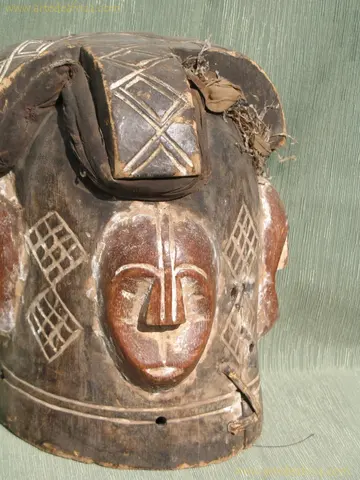
The NgonTang mask is a helmet that belongs to the secret society of the same name.
MYL-8

On a rectangular head, similar to that of the mask Kanaga, stands the elevated silhouette of a woman with arms raised, folded…
MFG-9

The Gelede cult, practiced mainly by the Yoruba Westerners, it is a cult in honor of living or deceased elderly women.
MCYC-9

These masks represent the principal Orishas, incarnation of the attributes of Olorum, the supreme and distant God of men.
MYL-9

It's one of the big dogon masks, known as the "story house." The facial part of this mask resembles that of the…
MFG-10

The Bambara treat their masks as if they were people.
MFG-14

Small Njabi scimer of great beauty of lines and dark honey color.
MCYC-17

Gelede society practices the cult that gives its name to older women, “our mothers” (awon sya wa) who can use their powers…
MCYC-18

It is believed that the origin of the Geledé cult occurs on the occasion of the mythical passage from matriarchal society to…
MCYC-20

It is believed that the origin of the Geledé cult occurs on the occasion of the mythical passage from matriarchal society to…
MCYC-24

It is a mask of the Senufo group called “Kiembara” of the Korhogo region.
MFG-26

The Yatenga masks are iron masks, which carry a female statue carved in one piece and are called "karan wemba".
MFG-27

Mask belonging to the group Kponiugo or WaniugoWhich in turn is one of the five types of Wabelé masks.
MCYC-27

Mask of the purest style yaohuré with a strong attack of the xylophages.
MFAZ-30


