
Knight Mbigou
This steatite known as Mbigou stone is extracted in the quarries of the town of the same name, in the province of…
FEC-17

List of the historical catalogue
Text and organisation of the original catalogue · Jesús Arrimadas Saavedra
The geniuses of nature, the spirits of ancestors, the supernatural powers and the different divinities are continually manifested to men, but it is necessary that they know how to interpret these manifestations. Spirits can know the mysteries of the supernatural world and as there are many things that escape the knowledge of the common mortals and it is not possible to dialogue with the spirits or ask them the right questions and even less to establish a contact with them, the diviners will be commissioned to perform these tasks in their name, for they are prepared and know the techniques that allow them to establish a contact with beings and forces of the hereafter. The techniques employed are numerous and very different. From oracles of all kinds and ordeals to divination by means of small bones of animals, small sticks or seeds which according to the disposition they acquire on the ground or board when thrown by fortune teller will render the relevant interpretation. Yoruba boards become true works of art. Known are the oracles baulé of mice and divination by means of the footprints left on the sand by the pale fox of the dogon. The fortune teller has drawn on the sand a complicated board with a series of cabalistic signs arranged according to an established order. Attracted by bait, the raven will trample the sand at night leaving traces that will be interpreted by the soothsayer. Reading the entrails of animals or the signs produced by tail nuts or cauris arranged on the different divinatory trays or the movements of a candle flame are some of the many forms of geomance that are commonly used among traditional African societies. The fortune teller knows the technique that allows him to ask the right questions so that he can read and interpret the answers properly. The fortune teller is an important character in traditional, feared and respected societies who earn a living from his work. It is usually independent despite being very close to the court of some kings. They will come to him for all kinds of consultations concerning life and death, the health of animals as well as of people, the fertility of fields as of mothers, about travel, wars, wealth and poverty, all issues that may affect man or nature are within their competence. He is a deep psychologist, a connoisseur of the nature and medicinal virtues of plants, of astrology and especially of mythology. It enjoys a great prestige. Divination and magic are closely linked, it is difficult to know where one ends and the other begins. The force that is handled in the practice of magic is supernatural but not sacred. It requires a technique and a ritual and as in divination are powers and techniques that are transmitted. For animistic peoples, most things, especially the elements of nature, have a spirit or a soul. These immaterial beings, who participate in divinity, usually intervene in the life of men. Their presence and participation is constant in all the individual and collective activities of society. In order for these forces from beyond to be favorable to humans, it is necessary to turn to intermediaries endowed with certain powers and knowledge and accustomed to dealing with these beings such as diviners, healers or priests, who in most cases are often the blacksmith, a person feared and admired by his great powers. This specialist, priest, doctor or fortune teller, heals the evils of the body and soul, since the diseases of the body are caused by evil spirits and those of the soul are caused by disturbances inflicted by spirits who have not received proper attention. These spiritual beings can exert a beneficial or evil influence on the living according to the attentions or offerings they receive. The soothsayer knows the virtues of plants and their healing powers while he is a specialist in magical-religious practices that will allow him to come into contact with beings from beyond and through the proper rites he will be able to grasp the positive forces of the deceased and the geniuses of nature to heal the diseases of the body or soul or through divinatory practices to find the remedy to the evils of his patient. They usually ask their client to sculpt a statue that has a relationship with the purpose for which their claim is addressed. Once he has been consecrated by proper rites by the soothsayer, he will be protected and will often have to honor it with offerings and sacrifices to maintain its effectiveness and always be propitious to them. HECHICEROS In the sorcerer, the healer, the Nganga or priest specializing in consecrating the fetishes, and in so many other characters, related to the spiritual forces and specialized in contacts with beings from beyond, there is a beneficial force that comes from his person and serves to relieve, heal, or direct or instruct. Protective, therapeutic and divinatory function are the essential characteristics of African magic. These great initiates possess spiritual faculties that allow them, like the Witches, to heal the sick of the body and spirit thanks to their great knowledge of natural remedies and their psychological capacity, to unfold or leave the physical body, to manifest themselves at the same time in two different places, phenomenon of bilocation, to read thought, to interpret with clairvoyance, but always to do good. They are at the disposal of those who seek help and act in the light of day, it is accessible to everyone. However, to speak of witch in Africa is to speak of black magic, of the evil arts to harm and harm someone, of the invocations to the devil and of the practice of satanic rites to achieve their evil ends. They act at night and at treason by demanding a high remuneration from their client or by causing him to remain subject to them for life. In many African ethnic groups, there is a mask to remove the sorcerers from the village. There may be confusion between French and Spanish terminology. Brujo is the “sorcier”, although this word is usually translated into Spanish, wrongly in the case of Francophone Africa, by sorcerer. What we understand in Spanish as “sorcerer” would be rather in French “feticheur”, the term which does not exist in our language and which should be translated as “fetchero”. In Islamic peoples they are called marabout, at the same time wise, holy and healer. Nganga is the term used in much of Africa, especially Central Africa. Nganga is accessed after severe and thorough preparation for several years. The vocation is often awakened by an illumination transmitted by an Nkissi during a dream. His period of formation takes place in the sacred forest, outside the eyes of the curious, guided by his experienced teacher who teaches him to know the properties of plants, the psychology of humans and the behavior of animals. You should know the different compositions of the bilongo (magic loads) according to the application they will have, the rituals and musical sones that will accompany the different ceremonies of healing, magic or divination as well as a deep knowledge of the ethnicity, of their cosmogony and of the prohibitions that may weigh on the tribe. Ceremonies are often quite shrewd, depending on the purpose to be pursued. The Nganga paints his face with the colors red, white and black, as well as the sorcerer masks Bakongo, coated with eye-catching animal skins and covered with cauris, feathers, ropes, padlocks, horns, amulets and anything that might impress the attendees. Normally all these characters endowed with extranatural powers exercise their activity by means of figures normally of wood carrying magical loads and numerous amulets that are called fetishes.
79 objects · page 2 of 4
This steatite known as Mbigou stone is extracted in the quarries of the town of the same name, in the province of…
FEC-17

Reliquary intended for ritarian uses within the cult of ancestors.
RLC-17

Cut stone, rather flattened, with two faces opposite the skull and two faces on the lower flat, one on each side.
MYA-17

A woman kneeling with her hands on her thighs, near the rhodollas, in a position to pray.
EFM-18

Small terracotta used in divinatory practices, on which a figure with an indefinite character sits, whose head could be that of an…
MYA-18

It seems that the horse was introduced to Africa, especially to the south of the Sahara, according to archaeological excavations and some…
FEC-19

Horn of koba or male hypothragus, antelope horse, which carries inside seeds to mark divinatory rhythms.
MYA-19

Snake used in divinatory practices. It is the abundant spitting cobra in the West African.
MYA-20

Curious figure sitting on a small stool, legs folded and crossed, hands resting on thighs in meditation attitude.
EMS-21

Rounded mask like most of the scarce luba masks, with a certain resemblance to the female kifwebé masks, but it seems to…
MCYC-21

The Nkissi statues of the Kongolike all Nkissi, they are protective figures that acquire their strength and power after being loaded by…
MYA-21
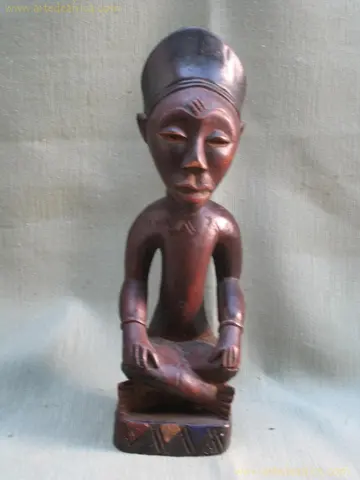
Character in concentrated meditation attitude. Belonging to the family Yombe-Bakongo.
EMS-22

Helmet mask depicting a monkey with some humanized features.
MCYC-22

Woman mounted on a horse ride. Ventral escapes and yellow beads necklace at the waist.
MYA-22

The sacerodotise, like the diviner and the healer or the sorcerer, is responsible for establishing contact with the spiritual forces and beings…
MYA-23
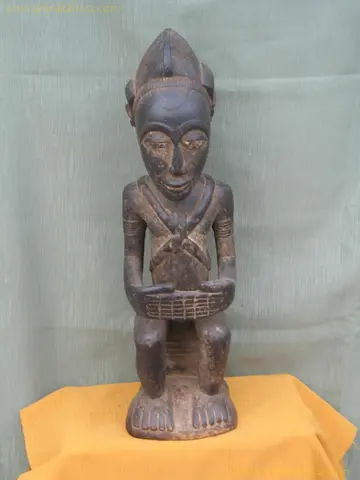
For animistic peoples, most things, especially the elements of nature, have a spirit or a soul.
MYA-24

For animistic peoples, most things, especially the elements of nature, have a spirit or a soul.
MYA-25
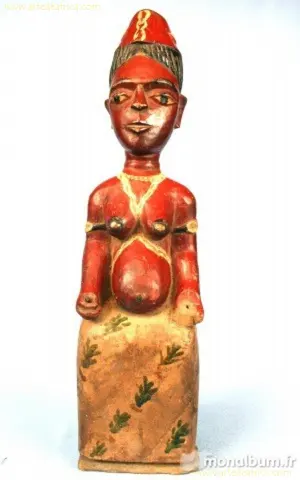
Animist sculpture of the settler style.
COL-26

Statue of a man sitting on a stool. Folded legs.
EMS-31
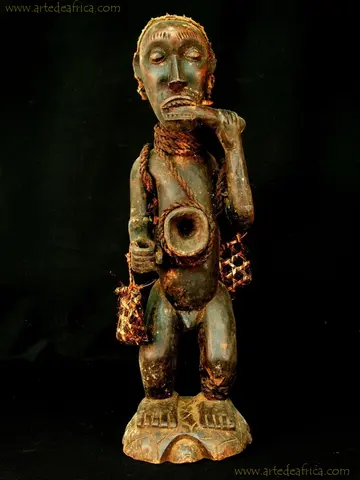
the iboga is a potent drug that is extracted from a root and exerts a great influence on the social life of…
FET-33

Ancient, rare and powerful fetish used exclusively by the sorcerer in the rites accompanying the Vudu.
FET-40

Elegant and artistic figure of sacrificing in charge of making sacrifices destined to the cult of the ancestors and to the different…
EMS-52

The bearers of a cup or a “loose woman’s statues” usually correspond to the well-known style of Buli, the master craftsman who…
EFM-73

The Gelede cult, practiced mainly by the Yoruba Westerners, it is a cult in honor of living or deceased elderly women.
EFM-78


