
Statue of Igalagana
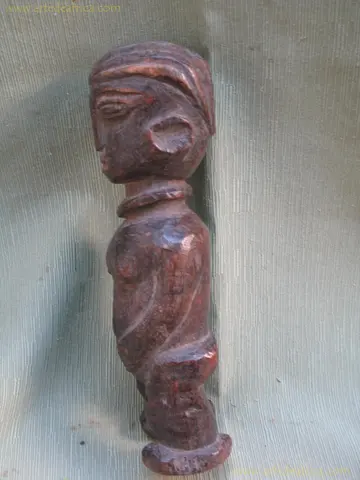
Mumuye blacksmiths sculpt longline, heavy-wood statues of women, called iagalagana they are kept in huts owned by families and entrusted to one…
EFM-94

List of the historical catalogue
Text and organisation of the original catalogue · Jesús Arrimadas Saavedra
OVERVIEWS AND ANTIANS It is the most revered figure in Africa. But forefathers are not the dead. In Africa you do not die, you change your life, you change your dimension. It passes from the land of the living to the world of spirits. The body returns to the land to which humans belong and the spirit goes to the spirit kingdom from where it continues to act according to its qualities either bad or good. But to access the rank of ancestor, certain requirements must be met. Not everyone who takes this world away becomes ancestors. It is essential, during the stay in this world, to have had exemplary conduct in all aspects of social, religious and family life and to have attained the human degree of maturity obtained through marriage and the procreation of an offspring. A single or childless man will never reach the rank of ancestor. Women can also reach this rank. Once they are dead, they need to perform funeral rites and later mourning rites, processes that can sometimes last for several years. If the spirit separates itself from its carnal envelope too quickly, it can stay around the house and disturb its inhabitants, even after the burial. That is why, in addition to the rite of death, another is celebrated, according to the ethnic groups, at forty days, to give the deceased a second chance to enter the world of spirits together with the other ancestors. The ancestor has a real and active presence in the family and in the village. He usually tries to be favorable to his own by intervening in the most important moments of social or religious life, on the condition that they behave well with him, otherwise it could bring them much trouble and misfortune. In order to attract his protection and help, he is offered sacrifices and offerings, and statues are often made, showing great dignity, representing him and venerated in family altars or incarnated in a specific mask during ceremonies. These statues or masks have a deep sacred character and are kept under the shelter of the eyes of the profane. If elders inspire great respect in African societies, for authority and respect are obtained with age and their advice is indispensable for the proper functioning of their various institutions, the ancestors inspire true fervor, accompanied by affection, respect, devotion and fear. The ancestor occupies a higher place than that of the most important but inferior living descendant than that of the secondary gods or geniuses of nature, all of them intermediaries of different rank before the Supreme God or Creator God, to which man cannot, out of respect, address directly. African society teaches us to know the value of the family and to honor and respect the elderly. The African family does not break up. On the contrary, as the children marry, it increases and strengthens with the incorporation of new members, until the parents become elderly. The old man does not retire, he does not leave society as an old or useless mess. He will not be placed in an asylum. He will join the Council of Elders which advises those responsible for the community to take advantage of their advice and experience. The elder is an intermediary between the community and the ancestors. It is the closest step to the world of spirits, for it will soon become an ancestor, if it has had offspring and has been a worthy man adorned with virtues, after the fulfillment of the prescriptive funeral rites. Many of the so-called ancestor figures are actually funeral figures, which have nothing to do with a concrete ancestor, although delimitation in both camps is difficult because in certain ethnic groups small statues were placed in the tombs to represent the ancestor. Normally the figures of ancestors have the best defined features, their size is more precise both in the body and in the hands. Funeral figures are more symbolic and have a less finished appearance and sometimes deteriorated because they have been exposed to the inclementness of time because they have remained on or near the tombs for quite some time. Funeral figures are often naked showing often the sexual organs, which in traditional Africa has no sexual connotation, is simply the symbol of the reproductive capacity that gives life in the case of these funeral figures, of death and rebirth to the new life. The purpose of the statue is to be the support of the ancestor’s immortal double after his death. The object of the mask is the transubstantiation of the ancestor. The statues are the object of offerings and libations as material support of the ancestor. The cult of ancestors is not “a cult of the dead”, it is simply a “cult of the ancestors”. The ancestors are there, present, in another dimension. To die, for Africans, is to take “a step” towards another way of life, just as birth is a “step” from “no life” to life. In many societies in Africa, three “step” or “transit” rites are held. They are like gateways that unite different areas of life: that of birth, initiation, access to adult life, and death, through which, if certain circumstances are fulfilled, the rank of ancestor is accessed.
75 objects · page 3 of 4
Mumuye blacksmiths sculpt longline, heavy-wood statues of women, called iagalagana they are kept in huts owned by families and entrusted to one…
EFM-94

Dogon woman statue sitting on a stool, which proves that it is a woman of a certain rank.
EFM-95
Rustic figure of woman, like all stauas Tagbana. Hands in the belly, like most African statues, in sign of peace.
EFM-96
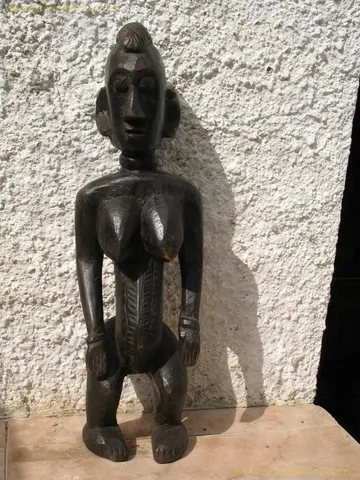
These statues represent the beauty of the woman.
EFM-97

Dogon woman statue with arms up. It represents a Tellem statue, of the calls with raised arms, position to implore the rain.
EFM-98

Great statue of woman with body covered in scarificacies painted with a mixture of kaolin and indigo.
EFM-108

Couple of asie usu.
PAR-3

For the Baulé, at birth we leave another family in the other world, in the blolo, and the spouse we have left…
EFM-27

The Baulélike other peoples in Africa, they believe that everyone has a husband or wife in the other world and that they…
EFM-93

Former ancestor figure showing, mainly at the back, attacks of xylophages and the passage of time.
EFM-110

Beautiful statue fear of very realistic proportions and style.
EFM-111

A figure of rough forefather. The woman, with incipient breasts, sits on a three-legged stool with her hands along the sides.
ESFE-1

He's the most revered figure in Africa, but ancestors aren't the dead.
EFM-114

Figure of ancestor in an attitude of great serenity on his face.
EMS-112

Women Agni They have a secret matriarchal society whose power to communicate with spirits is important.
EFM-121
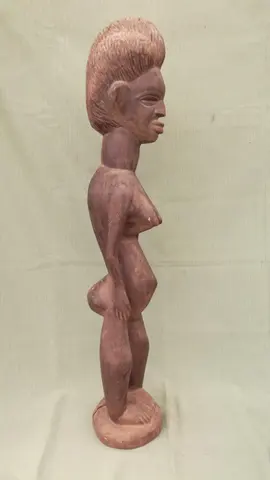
Forefather statue, totally naked, with hands and legs apart.
EFM-122
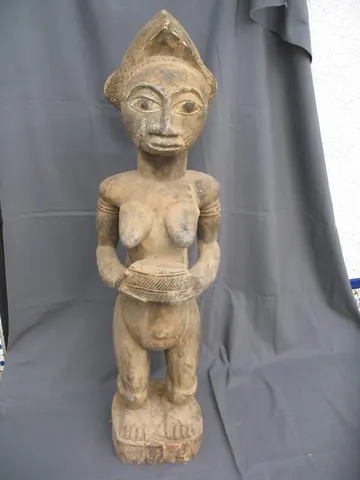
Magnificent carving of a woman holding in her hands a cup of offerings.
EFM-128

It is a figure of ancestor.
EFM-129

Curious piece representing an ancestor. The statue has no arms but robust legs.
EFM-130

Figure of an ancestor sitting on a stool of cariatids re-represented by nommos.
EFM-131

Statue of a woman kneeling with a large cup of offerings that she holds with her hands.
EFM-132
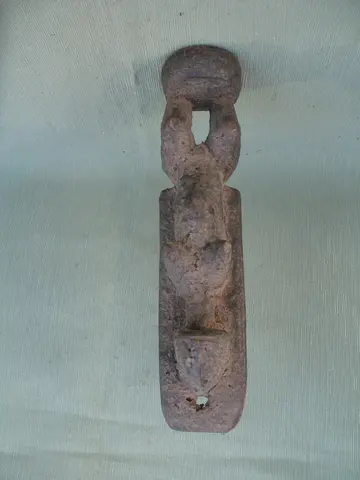
Although they are not represented in an explicit way, this figure represents a woman with her arms up.
EFM-133

Curious piece depicting a bambar ancestor with extremely short legs.
ESFE-7
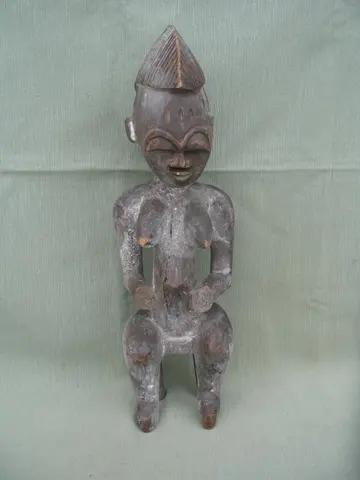
Figure of woman who appears sitting on a stool to enhance the importance of this ancestor.
EFM-136


