
Reliquarium Head Nlo Biery
Reliquary guardian head.
RLC-33

Text of the original catalogue
Located mainly in Gabon, they are also found in Equatorial Guinea and southern Cameroon. They are a people of hunters. Families are organized by clans, depending on their common ancestor, and integrated into different societies, some of the most important being the Ngil and the So. The cult of ancestors occupies a very important place, to the point that each family possesses a reliquary, cylindrical box made with barks, which contains part of the remains of one of the most notable ancestors, the byeri. His sculptures are mainly linked to the Byeri cult. They usually represent men sitting with their legs bent, torso elongated and hands together or holding a cup. These wooden statues are embedded or placed on or on the side of the reliquary, as guardian of the relics. In some celebrations they are strolled in procession through the village to honor the deceased, for which the statue is previously disassembled from its stand and placed on a platform or some angarillas. These statuettes are sometimes decorated with copper foils whose brightness allows the potential enemies and the forces of evil to be removed. To understand the Fang The Mvet and the Ondzabogha concept must be taken into account. During his migration or flight, a man received the revelation of the Mvet, which is, in the first place, a cosmogony that explains the formation of the universe from an initial explosion. Second, it is a fantastic tale of epic adventures of imaginary and mortal characters fighting the immortals to snatch away the secret of immortality from them and also to try to match themselves in courage, strength, intelligence, prosperity and wisdom. In addition to being a mythology, Mvet establishes the norms that govern the relations between the living and the dead, between God and men. The Fang are monotheistic, the supreme creator is Eyoh or the Nommant, that is, the one who in speaking creates. Ondzabogha means adzap. Adzap is a tree of gigantic proportions that represents the determination of the people Fang to overcome the obstacles they encountered in their flight and trying to find the promised land at the confluence of the Woleu and Ntem rivers. MASCARAS NGIL They belong to the society of the same name. They are white and elongated, with a heart-shaped face. The white color represents for the Fang These masks exercise judicial functions and detect and punish those who have committed reprehensible acts against society. They were in charge of persecuting and punishing the sorcerers. To gain access to Ngil society the initiation included a whole series of tests from the moral and physical purification of the neophyte by confessing his faults and suffering a body flogging until overcoming great physical tests and sacrifices. Ngil society was so powerful that it was banned by colonial authorities in 1910A mask from the beginning of the century XX reached in the year 2006 the highest price in the history of African art, six million euros. This type of anthropomorphic mask was used by the Ngil male society that still exists today. This secret society took charge of initiations and fought against sorcery. The Ngil is a rite of purifying fire symbolized by the gorilla and its mask represents the power and strength conferred by the ancestor who embodies it. The wearers of these masks made their appearance in the villages at night, under the light of torches, forming numerous groups. The face is painted with kaoli, color that evokes the power of the ancestors. The white color of each mask embodies the spirit of a deceased. The “Ngil” is a secret society of a judicial nature, therefore the judicial function is one of the most important of the Ngil masks. It is they who are responsible for prosecuting those responsible for the wrongdoing and those responsible for the crimes. Its main objective was to prevent the witches and sorcerers “Beyem” possessed by evil spirits from harming the population. The Ngil are a society Fang which is above all lineages. The initiation into Ngil society included a prior physical and moral purification followed by a flogging and confession of the crimes and the violation of the prohibitions. He participated in an ordalic trial before the relics of the ancestors, contained in the Byeri, to whom sacrifices were offered. It was the symbolic passage from an androgynous state to the sexually defined adult male state. The Ngil had its sacred place in a clearing of the forest called “esam”, where there were large figures lying vaguely human, representing the Ngil and his wife. The neophytes were to repel in front of these effigies by passing over a pit where hidden warriors tried to wound them with their weapons. They were also to be tested for ants. Only men could be initiated into the Ngil, which was also used against evils, poisonings and served as protection for its members. The Ngil always tried to restore the social order and was part of the rituals that regulated the life of the traditional Gabonese peoples.After the trials carried out in the sacred forest, the ritual continued in the square of the village, at dawn or at dusk. Armed with a sabre or a simple truncheon the Ngil was to destroy the houses of the neighbors who were in conflict with other members of society. These enmitys were due to adultery, theft, or debt. The mask bearer had a serious voice that frightened women and children and imposed respect on men. These long-faced white masks were worn by notable members of their society. They are very stylized masks, with fine elongated features that appear on the human face, giving the impression of an elongated heart, characteristic of this ethnic group. His eyes are very little open and his mouth reduced to the simplest expression in order to be deformed and not to recognize his bearer. This society was banned during Colonization, in the year 1910for being the cause of absurd deaths and for opposing colonial authority. MASCARAS NGONTANG They are masks that belong to the secret society Ngontang. They may have two faces, Janus, or four, opposite two to two. They date back to colonial times. The mask wears a fiber necklace and its bearer hides its body under a wide dress. He takes part in various demonstrations organized for funerals, mourning, births or the town's fun parties. They are also white and although they represent a spirit come from the world of the deceased whites they always dance by day. It represents the spirit of a young white woman who means her name, endowed with clairvoyance as indicated by the four faces who look at the same time towards the four cardinal points. The white color refers to the afterlife. The meaning of these multiple faces gives way to imagination, good and evil, day and night, in man and woman, this world and beyond and many other interpretations. RELICARIOUS BYERI Fang, mainly the Betsi, each family has a “byeri” or box of relics where part of the skull and other bones of the most notable ancestors or ancestors are preserved. The relic box is made of bark. These reliquaries were preserved by the Esa, the oldest old man in the family. Fang sculptures are mostly dedicated to the Byeri cult. They usually represent men sitting, or with bent legs and torso elongated, hands together, often holding a cup or horn with magical substances, and with stylized head features. The Byeri is a cult intended for illustrious ancestors to invoke their protection. These sculptures, custodians or guards of reliquary, can be strolled through the village in order to honor the deceased. For this purpose the statue is removed from its support and then installed on a kind of platform or base of braided straw for better transport during ritual wanderings. Outside of ceremonies they are kept in family altars. In many of them a posterior stem allowed the figure to be inserted into the hole practiced in the lid of the relic box, made of barks. These statues, which can be male or female, as well as heads are often subject to anointing with palm oil. Byeri reliquaries also participate in the initiation rites of young people. STATUS EYEMA BYERI Usually called reliquary guardians usually represent men sitting or with slightly bent knees. They are adorned with feathers or metal plates, mainly those of the northern zone. Others are placed or embedded directly in the reliquary. Others byeri are formed only by a head that rests on the reliquary, as a cover. Sometimes the body of the byeri is so small that it is limited to a more or less thick stick that it is inserted into the relic box. Others byeri, only the entire head or body with the hands linked to the belly height, rest on the lid of the locket. Whole body or only head the function of the byeri is to be guardian of the reliquary and guard the bones of the ancestors. The vessel is called “sensakh or byeri” and represents the body of the figure, the statuette that is inserted perpendicularly into the center of the lid of the relic box or container is called “eyema byeri” meaning “head”. RELICARY HEADS OR BYERI NLO In addition to the whole body statues the Fang, also within the Byeri cult they use others in which only the head with the neck, more or less long, appears for their introduction into the box of relics. They are strolled in processions intended to honor the deceased. They often carry copper or brass inlays that give them a bright look and at the same time their brightness drives away potential enemies and evil forces. Sometimes the body of the Byeri is so small that it is limited to a simple stick more or less thick that it is inserted into the reliquary. Head or body its function is to keep the reliquary and guard the bones of ancestors. These heads, like statues, are often anointed with palm oil.
66 objects · page 1 of 3
Reliquary guardian head.
RLC-33

Sculpture of women of high rank as denotes in fact to appear sitting and scarifications, represented by engraved brass plates, in front…
EFM-8

Usually called reliquary guards usually represent men sitting or with slightly bent knees.
EMS-30

The NgonTang mask is a helmet that belongs to the secret society of the same name.
MYL-2
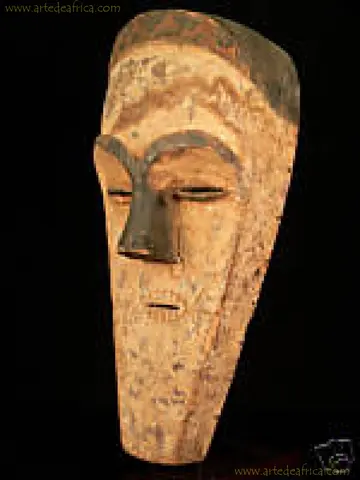
Old mask Fang This type of mask was in use in Gabon and southern Cameroon.
MFANT-22

A dark brown headdress-like cap whose center at the front lowers a stripe of the same color to the fins of the…
MFANT-23

Helmet mask oval shape, with front scarifications and on the cheeks.
MCYC-7

They belong to the society of the same name. They are white and elongated, with a more or less elongated heart-shaped face.
MFANT-24

This type of anthropomorphic mask was used by male society Ngil This secret society was in charge of initiations and fought against…
MFANT-25

Redwood mask as well can be seen in the nose, with dark pigmentation.
MFANT-27

Mask on whose face is perfectly drawn an elongated heart well shaped by the black polychrome that surrounds a face whitened with…
MFANT-28
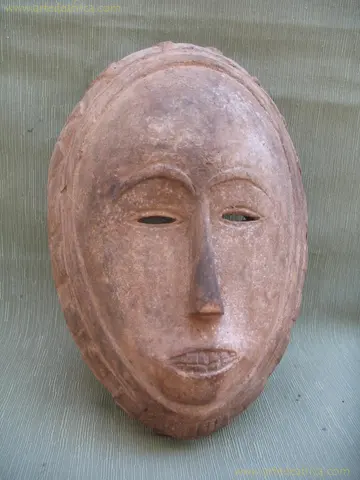
Located mainly in Gabon, the Fang there are also Equatorial Guinea and southern Cameroon.
MFANT-61

Located mainly in Gabon, the Fang there are also Equatorial Guinea and southern Cameroon.
MFANT-62
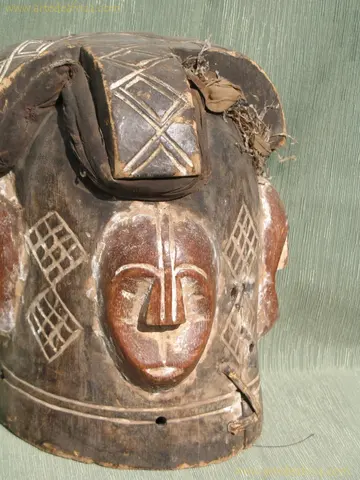
The NgonTang mask is a helmet that belongs to the secret society of the same name.
MYL-8

Stylized mask Fang with a face, painted with kaolin, heart-shaped.
MFANT-118

Reliquary guard sitting, holding the horn of magic substances with both hands.
RLC-22

Among the Fang, village of hunters, each family owns a Byeri or box in which the relics of the most notable ancestors…
RLC-23
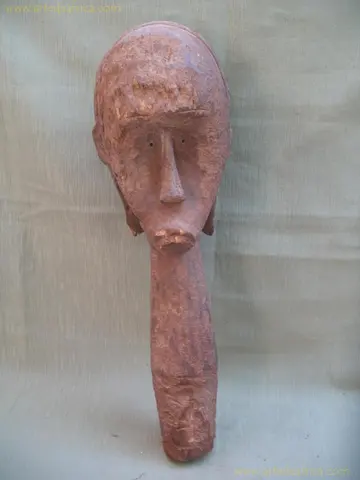
the Byeri He is not or represents the ancestor, he is the guardian who guards his relics, pieces of skull essentially, with…
RLC-24

the Byeri He is not or represents the ancestor, he is the guardian who guards his relics, pieces of skull essentially, with…
RLC-25
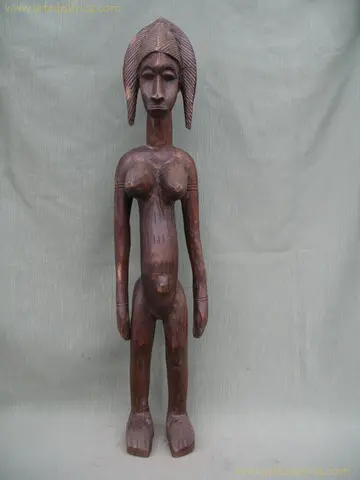
A slender statue that conveys all the beauty of the fang woman.The nakedness of the woman is enhanced by generous breasts, a…
EFM-57

Besides the whole body statues the Fang, also within the Byeri cult they use others in which only the head with the…
RLC-37
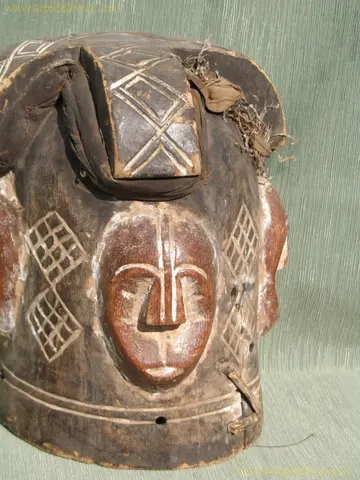
The NgonTang mask is a helmet mask that belongs to the secret society of the same name and that mainly participates in…
MCYC-30

Among the Fang each family has a “byeri“ or box of relics in which part of the skull and other bones of…
RLC-38

They belong to the society of the same name. They are white and elongated, with a heart-shaped face.
MFANT-146


