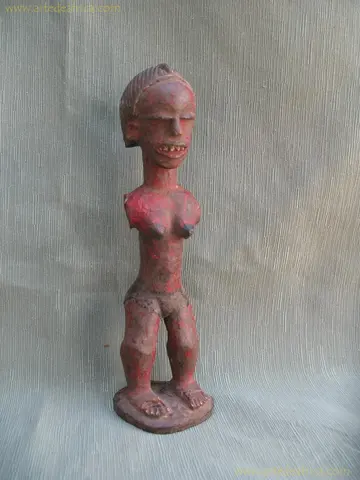
Woman Without Arms
Figure of woman covering her nakedness with a small black panties.
COL-31

Text of the original catalogue
ORIGIN OF HIS MASCARAS: I.- Its origin. Masks are the material form assumed by the geniuses “Kosri”, divine sparks, pure spirits, who have had to adopt human traits and a human appearance to address men. The mask is made in the image of the protective genius that brings health and collective well-being to the group. It is essentially a mask with a male face. Contrary to what happens with other ethnic groups in Côte d’Ivoire, the Webé masks have never represented a female face. His mythical explanation is as follows: In remote times, women and men declared war. Then, one day, the men came to consult the genius Kosri: What can we do to achieve the friendship of women?, they asked. The genius gave them the “Gego” mask and the men returned to the village. Obeying the advice they received from the genius, they took the mask and went to meet the women. After a day's march they came to their village and began to sing: “May God give us courage and also give courage to women to establish a relationship.” Seeing the mask, the head of the women, named Irudekan, shaved her beard, threw the remains to the ground and left, followed by the other women. Then the men began to pursue them, and those who ran the most managed to catch at least twenty women. Those who failed remained single for a lifetime. And since that day, women have no beard. It is an interesting story that makes us understand why many statues of various African ethnicities represent the woman with beard, as is the case with ancient statues. BalubaFor the Yacuba, masks are the laws of nature, given by celestial geniuses to men to facilitate their life on earth. Thus, geniuses dictate their rules of life and organize society. Each mask plays, in a concrete way, a well-defined function derived from the law and all of them play a social role, such as persecuting and punishing sorcerers, protecting family members, administering justice or granting fertility to sterile couples. II.- Manufacture of masks. There are two categories of masks, called by the indigenous Large and Small Masks. The former perform a function of social utility, while the latter are of interest to the individual only on a personal level and serve only to exalt his virile power. Depending on the category to which they belong, their manufacture offers different variants. a.- Manufacture of individual masks These masks are of two types: race masks called Plehesri and dance masks whose name is Tidisri. The manufacturing procedure is common to the Yacuba and Weba populations. Its outer form is sensibly the same and its identical beauty canons. A boy must be circumcised in order to acquire the right to make a mask but must inform and seek the permission of the ancestor of the clan, who will then search for the appropriate tree to carve the object. This tree is called “Kôhu” in webé and “go” or “gueu” in Yacuba dialect. When the elder makes his choice after questioning the gods, the tree becomes a “Kôhu” for the members of the Totemic clan. Women cannot be present and must avoid passing near the place if they do not want to bring on some misfortune. The elder blesses the tree that will be cut down, by circumcised men, at the auspicious moment indicated by the oracles. This is when the circumcised man or young man will be able to extract from the tree the piece that will serve him to make his mask. As in many other regions, only a mask can be made of a tree. The man settles away from the look of women. It breaks its trunk into several pieces and takes the one that best corresponds to the desired dimensions for the mask. With the help of the axe and the traditional azuela, the piece of wood will be scraped and the mask will be carved. It will always start from the inside, which is the closest part to the heart of the tree and the one that will be applied directly on the face. With these tools you will hollow out the inner face and give the necessary curvature to the external one before proceeding to the finer carving. It will polish the inner face with sand to make it smooth. Then he will go by sculpting the other side, that is, the face of the mask, starting with the right eye because it is the one that allows vision to the mask. It will therefore be wider than the left. In addition, by the shape of the eye, you will have a wide plane of horizontal vision, but you will not be able to see your feet. Then he will sculpt the left eye. Then the nose, lips, and mouth. Teeth, which may be human, of animal origin, small metal sheets or nails, may eventually be inserted. Once all its features have been realized, the whole face is polished with sand. At this point the mask has the appearance of a white wood object and that is when the definitive dye has to be applied. Individual masks always receive a black but very characteristic dye. On the contrary, the inner face must keep its natural color. When the mask has completely dried, the craftsman, with a thin iron rod heated to bright red, will make small holes, surrounding the contour of the face and following a contiguous line, which will allow to sew a cloth around the mask. There was a time when these operations ended the making of the mask, but for many decades it has been the custom to add metal circles around the eyes as ornament. Even if the mask is materially finished, it cannot be worn until after receiving the blessing of the oldest of the lineage. The old man will take, perpendicular to him, on his open hands, the mask whose chin will be oriented to the left. The boy or the man who made it will put his hands together by placing his right on the left, with his palms advanced and his fingers crossed, on the face of the mask. It is the time when the elder utters the following prayer: “My beautiful mask, my holy and fortunate mask, I offer you the direction of my family and my people throughout my life.” The mask belongs from this moment on to the person who sculpted it, who will keep it, wrapped in a canvas, inside his own hut. When the owner wishes to wear it, he shall wear a special garment and cover himself with his face carved in wood. The mask is not only the object of wood, it is the whole of the object and its traditional dress. Except for the artist or blacksmith, a normal man makes a single mask throughout his life. He will make it after circumcision and must keep it until his death. Sometimes, looking like he's lost his beauty, he'll sculpt another mask. After this second mask has been blessed, the first one loses all its value, it is deacralized. Only unused masks that have lost their ritual value can be left in strange hands. If the old mask were given before blessing the new one, adds an informer, “... it would be like entrusting his own nature and his country to a stranger... and nothing we did in the future could succeed.” The uncircumcised child is exercised for a long time in the manufacture of masks, until he acquires the necessary skill that will allow him one day to make a mask respecting the established beauty canons. Young people's masks are not black, this color is reserved for men's masks. They always retain the natural color of the wood and its finish is never perfect. Often, as a symbolic joke, they carry a blood stain on their foreheads. A beautiful mask is recognized by the perfection of its forms. Its walls should be very thin, cheekbones marked, and the inner cavity very concave, so that the face of its carrier fits perfectly. Its forehead must be buffed. b.- Manufacture of masks of public utility. A family of specialists transmits from parents to children the responsibility for making masks that will follow exactly the same phases as in the case of individual masks. It will comply with the same rules, but it will not insist on the faithful representation of a human face but on its symbol. Public utility masks are not necessarily black, they are often red. Once finished manufacturing, the face is decorated with kaolin or green paint. Like individual masks, these masks are consecrated during a ceremony. The dress is of considerable importance here. The village chief decides for himself its composition which remains secret and keeps carefully hidden the whole made up of wood face, clothes and attributes. c.- Prohibitions on the mask: what do they consist of? Masks enclose all the power of ancestors. It is a beneficial power that must be preserved otherwise the village and the individual would be abandoned by luck and would fail in all its enterprises. The secret, jealously guarded against strangers and uninitiated, is the safeguarding of their power, their power. This secret must encompass everything that concerns the mask, its origin, the way of being incorporated into an object, its relationship with the world of ancestors and spirits, its attributions, etc. This is one of the reasons why the material that has been used for its manufacture is kept safe from the curious, they must be protected against any indiscretion or external attack possible. Prohibitions affecting strangers and uninitiated persons constitute a means of defending society. But they are also a safeguard of the stranger and the uninitiated who possess no force capable of offering an effective resistance to the immeasurable power of the ancestors. The intensity of this power is so great that it constitutes a considerable danger. The stranger or the uninitiated who had to face this power, would be shattered. These interdicts vary depending on the people or masks considered. They consist essentially of a prohibition on seeing masks, participating in or attending ceremonies in which masks participate, knowing their mythical origin, names, manufacturing procedures, symbolism, singing and functions. In a general way, masks belong to two categories: - those that can't be seen, in any case, by women or strangers, those that can be seen by everyone. Nor can men wear all masks interchangeably. And, even, they will approach with great caution an individual mask of which they are not owners. The most severe prohibitions apply to strangers to the village. They consist of an absolute prohibition on seeing them and, therefore, in no case can they attend their “exit”. There is no exception to this prohibition.
5 objects · page 1 of 1
Figure of woman covering her nakedness with a small black panties.
COL-31
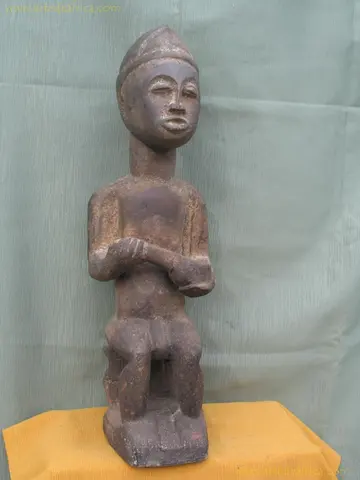
Statue of a man sitting on a stool. Folded legs.
EMS-31
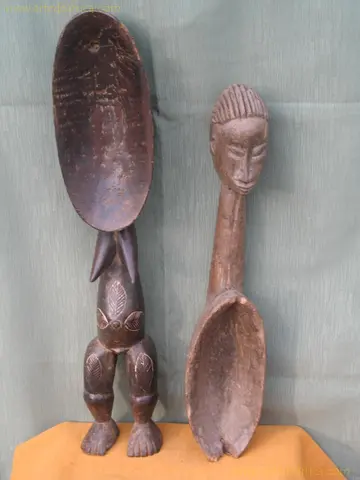
Wa Ke Mia Spoon: It is the festive or ceremonial spoons that honor the hospital woman.
CHR-18
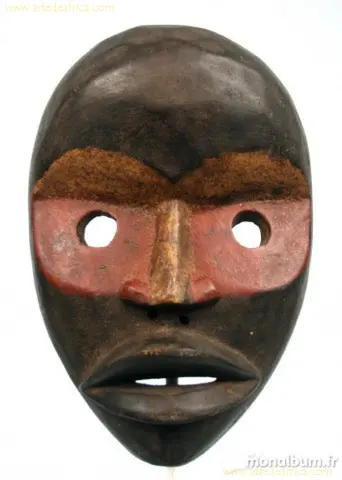
It's a fun mask that appears at popular parties.
MFANT-136
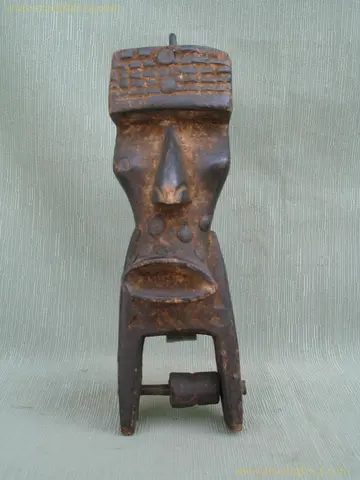
A rough-looking figure that resembles the style of his relatives Kran from Liberia.
PLYTL-31


