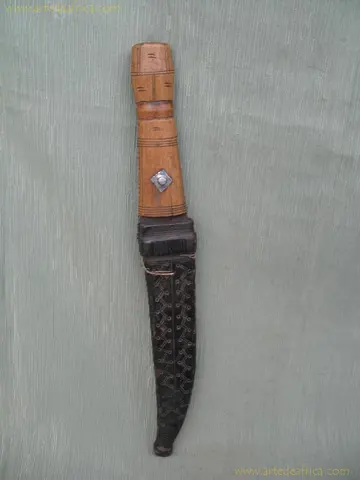
Knife
Knife with blade forged in hot hammers and leather cover with geometric drawings.
ARM-8

Text of the original catalogue
Bambara or Bamana It is not known who gave them this name, it is thought that they were the converts to Islam, who considered them to be infidel populations. The term Bámbara was used by the French to refer to the BamanaWhat is known is that currently more than eighty percent have embraced the Islamic religion and exceed the four million. The largest number of them are concentrated in Mali, they are also in Ivory Coast, Guinea and Senegal. The Bambara of Guinea are named after Maliné, and a fraction is located in northern Ivory Coast. The Djula are also part of the Bambara and are also in Ivory Coast. Djula are merchants, they are mainly engaged in street trade throughout the country. They say that they are descendants of the Mallinké and the Bambara. Forefathers of the present Bambara founded in the Middle Ages the kingdoms of Mali and Ghana. They belong to the language group of the Mandé and speak the “mandeta”. They are of high stature. Statistics show that Bambara is above the average of forest populations. These peoples, except the Djula, are peasants and their social structure is based on castes: Gentlemen, blacksmiths, hunters, griots, etc. They are all closed castes. They continue to practice animism despite having converted to mahometism. Their animistic beliefs such as worship of ancestors and spirits are deeply rooted among Bambara. It is not surprising because the animist religion, which in Africa is a religion, responds to one of the old structures existing throughout Black Africa. Animism among the Bambara is characterized by its secret societies of “N’Tomo” and “Koré”. N’Tomo, it is the masculine spirit that protects children from the male sex before their integration into the adult world and society. It looks after them and strengthens their sense of discipline and solidarity. Koré, it is the spirit of the waters. His brotherhood pursues two objectives: 1.- Return to the human being its original harmony overshadowed by circumcision. 2.- Allow the human being to recover, on the spiritual plane, his primitive femininity, his mystical union with God and the triumph over death. Koré activates the moral and intellectual formation of being. No one can claim any other initiation after having participated in the Koré rituals. The great festival of Koré with the ritual of initiation takes place every two years and the practices and teachings are spread over two periods, every two consecutive years. First time: The immortality to which the being aspires can only be obtained after a symbolic death. It is in this first part that the neophytes are “killed” and initiated. It starts with the full moon and lasts for fifteen days. Second time : It concerns the theomorphosis of being, which takes place twelve months later. The ceremony begins with a ritual theft of the bags with their clothes and belongings, which the neophytes hide in a hidden place and their owners will only be able to recover them by paying for some cauris that the neophytes will deliver to the head of the brotherhood, who in return will introduce a small stone into the bags. After ten sessions of ritual theft and six stones in the bags, the chief announces the date of the next ritual. The ritual theft of their bags is assimilated to the death and reincarnation of humans. The Bambara think that the market square symbolizes the world and the bags or pulls them out of the street vendors symbolize men. The blacksmiths, who work in the manufacture of masks and art objects are called “nummi”. They have a monopoly on forging, sculpture and magic. They work mainly the iron, bronze and soft wood of the ceiba. Many of the wood sculptures are traditionally finished to the burning iron and thus their charred surface gives them their black dye. Numerous pyrogravated incisions are made often tracing geometric lines that offer arabesque designs. Some masks are coated with thin copper or aluminium plates, trimmed and embossed. Sometimes the ensemble is accompanied by a set of cauris. Some masks wear a small mirror and pearls. The masks of Koré and N’Tomo represent human faces but can also be zoomorphs and represent mythical and symbolic animals in this case. The Bambara give the mask the name of “Boli”, which for the members of these two secret societies is a general concept that encompasses all masks inhabited by the spirits of the earth. Usually, masks are kept in the fields, to keep evil spirits away. The Bambara treat their masks as if they were people. They present offerings to them and ritually bury them when they have finished their service. The masks with a human face represent “Faro”, creator and guide of the universe. The Bambara They think it is Faro who gives men the conscience, the sense of order and the feelings of responsibility. Faro watches over all human work and the justice of men. ANTROPOMORFAS MASCARAS In the masks of human face can be counted from two to eight horns and in some of them the horns are adorned by small anthropomorphic figures. Two-horned masks : Human face topped by two spiral-shaped horns with a small statue. This mask symbolizes the antelope man, the animal man who constitutes the very principle of human duality. Three-horn mask : It represents a human face. Their horns are rarely adorned by cauris. They symbolize being, to the extent that it is spirit, impulse and desire. Four-horn mask : Always a human face crowned with four horns and covered with cauris. This mask translates the bodily nature of being, its passivity and its suffering. Five horn mask : Human face topped by five horns. It represents that the human being is obliged to work to live. Six-horn mask : Human face on which six horns appear. Absence of cauris. These masks announce the idea of knowledge and teaching. Seven horn mask : Human face with seven horns topped, covered with cauris on the face but not on the horns. It represents man made of masculinity and femininity but who remains one being. Eight horn mask : Human face crowned by eight horns, fully covered with cauris, even over the body. The horns often end up in a horsetail, and remind us of the principle of “renewal” proper to the human being. N’Tomo’s afona mask: No mouth. It's topped by seven horns but they're cauris ornaments. His absence of mouth indicates the expulsion of the adversary of society and of the other social interests of man. Next to the afona mask there is the pedifone mask of the N’Tomo. He is also masked with seven horns, covered with cauris, and at the height of his cheeks he wears two feet, which serve as a support. It symbolizes the dominion that man must have over his own words. MASCARAS ZOOORFAS : Tywara The best known in the mask “Tywara”. Specialists say that this mask is the symbol of all the BambaraThe mask is the abstract form of the antelope that has been sent by the Creator to teach men the cultivation of cereals. It is the antelope horse or hypothragus. (Hypotragus equinus). This mask ensures the fertility of the earth. The Tywara takes different positions according to the regions : - Style Buguni : It is the vertical position of the antelope. The informants think that the antelope Buguni is older than the others. Its hairs are stylized, in the form of zigzag and the body of the antelope often rests on a chameleon or a horse. - Segú style: Vertical position. Frequently represented with male hairs, forming draughts. The female is devoid of hairs, but her horns are perfectly straight and she carries on her back a berth, imitating the woman who carries her son on her back. - Bamako style : Horizontal shape of the antelope. The horns open wide. His mouth is often very cleft and the tail curled. Its legs are represented in zigzag. These antelopes carry several horns and are decorated with tiny statuettes in the form of women or birds.
76 objects · page 1 of 4
Knife with blade forged in hot hammers and leather cover with geometric drawings.
ARM-8
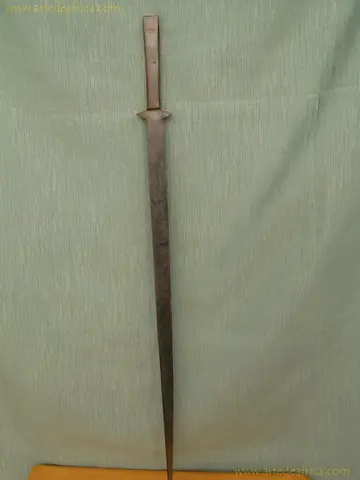
Sword defense. Copper handle.
ARM-24
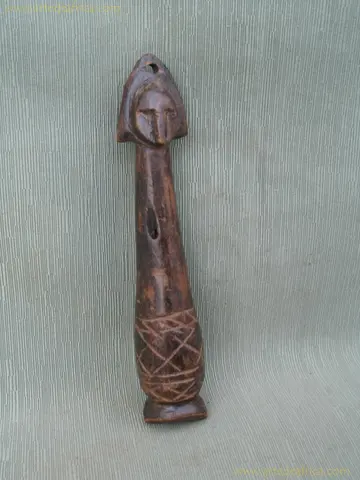
The whistle is for the African hunter as important as his hunting weapons, his bow, spear, or old rustic shotgun made by…
INM-10
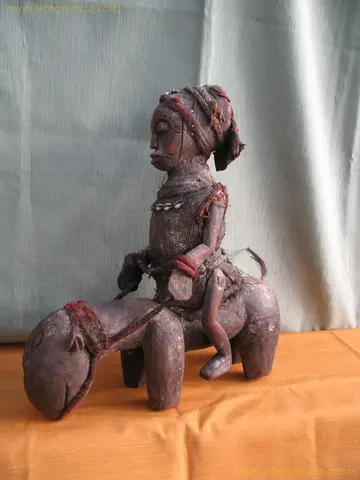
It seems that the horse was introduced to Africa, especially to the south of the Sahara, according to archaeological excavations and some…
FEC-18
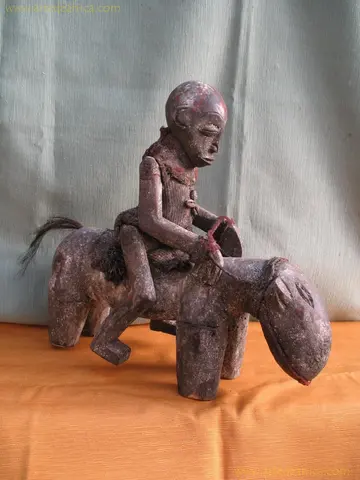
It seems that the horse was introduced to Africa, especially to the south of the Sahara, according to archaeological excavations and some…
FEC-19
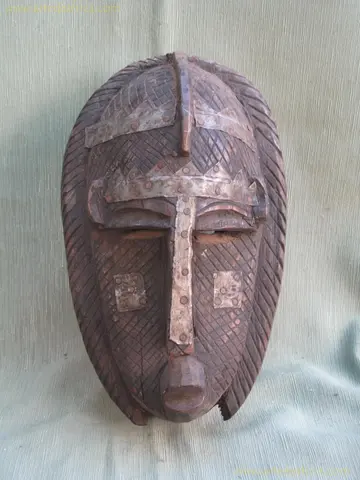
N’TomoIt is the masculine spirit that protects children from the male sex before their integration into the adult world and society.
MFANT-46
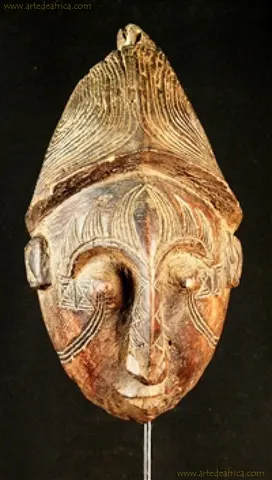
Masks with human faces represent “Lighthouse“ Creator and guide of the universe.
MCYC-8
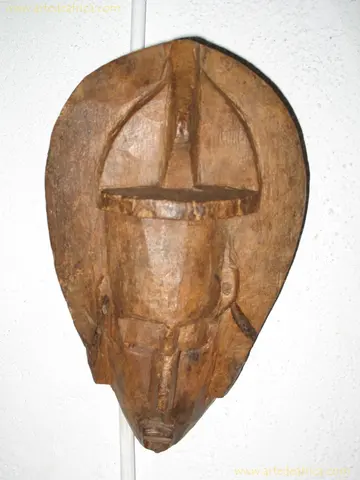
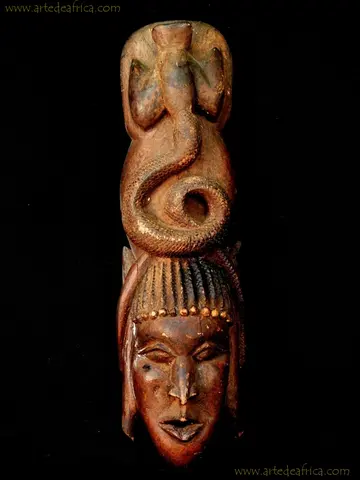
Natural color wooden passport mask with patina of time. The Bambara treat their masks as if they were people.
MPS-3
The Bambara treat their masks as if they were people.
MFG-14
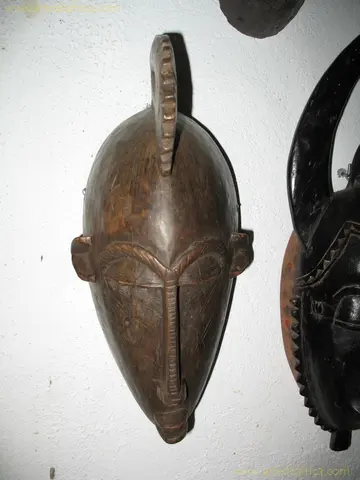
The Bambara treat their masks as if they were people.
MFAZ-12
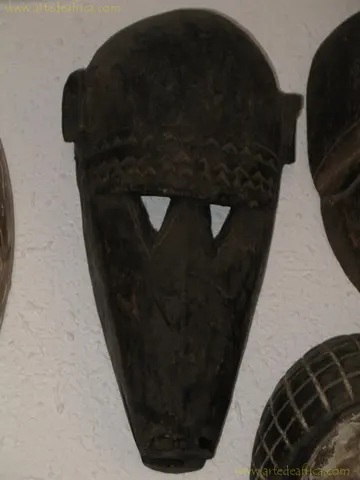
Ape-like zoomorfa mask but an imaginary animal, representing Faro, God the Creator and guide of the Universe and ensuring the development of…
MFZ-8
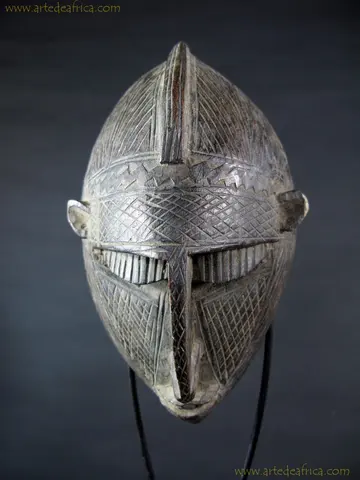
Passport mask of the Segu region. Wood and dark patinas.
MPS-5
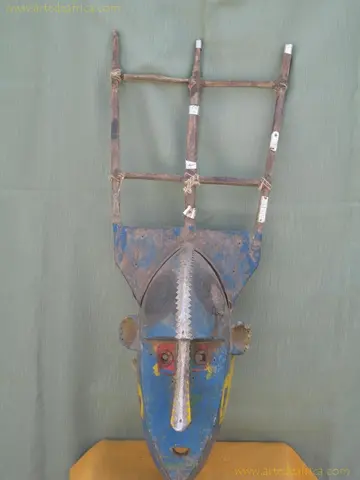
More cover by the \"bilakoro\", boys who have not yet received circumcision and who belong to the youth branch of the society…
MFG-20
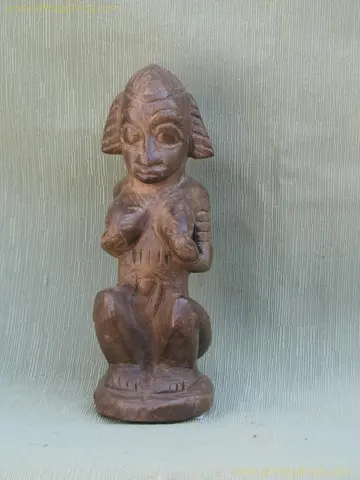
A small votive statue depicting a squatting woman, half kneeling, holding hands.
EFM-41
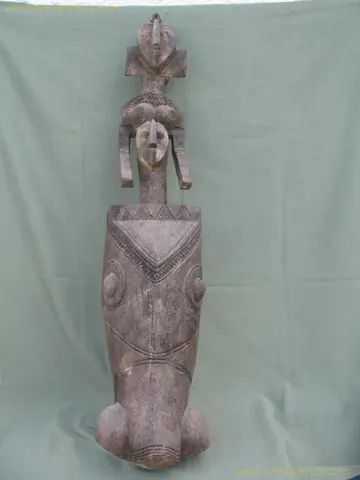
Great female mask depicting a maternity on a horse head.
MFG-43
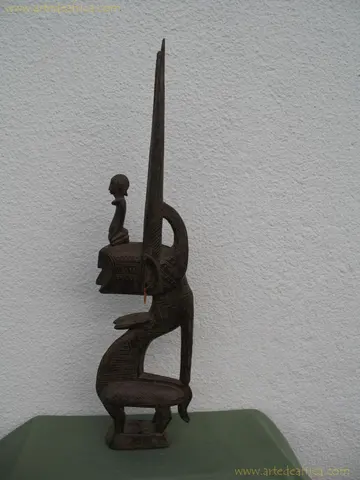
Masked top Bambara Ti Wara depicting a female antelope, hypothragus, wearing a kneeling female figure on her head, double symbol of fertility.
MFG-22
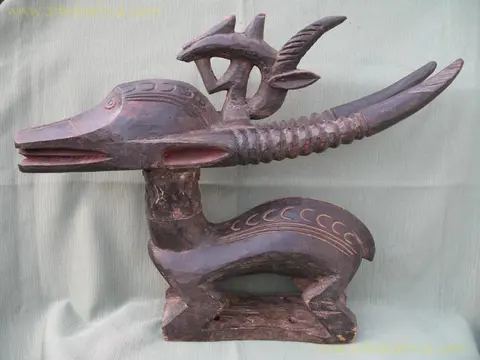
Ti Wara female carrying her child on the basis of her horns, represented simply by a small horn with ears.
MFG-23
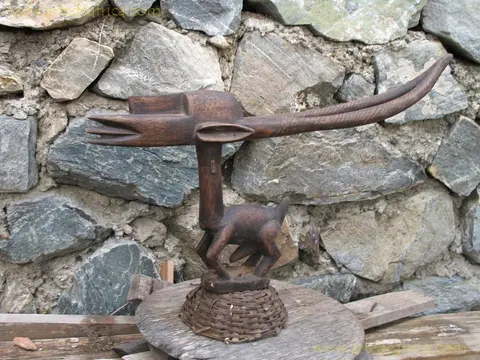
Cimera Ti wara representing the male antelope, attached to the straw headdress that goes over the head of the dancer and subjected…
MFG-24
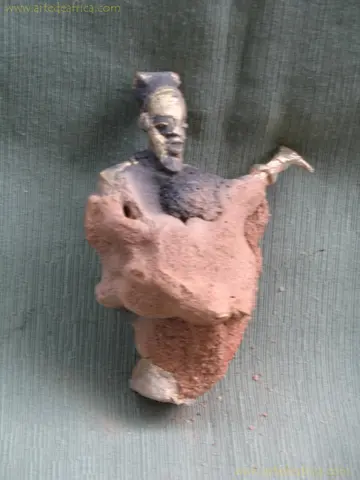
Object manufactured from lost wax still surrounded by refractory clay.
BRN-52
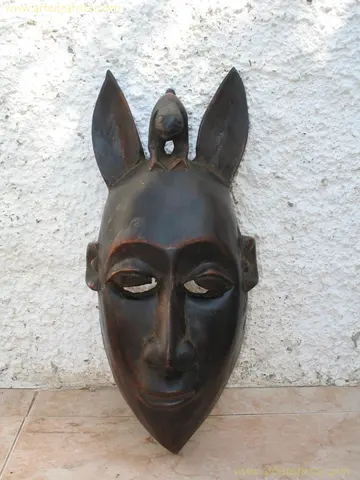
“Koré” is the spirit of the waters.
MFAZ-53
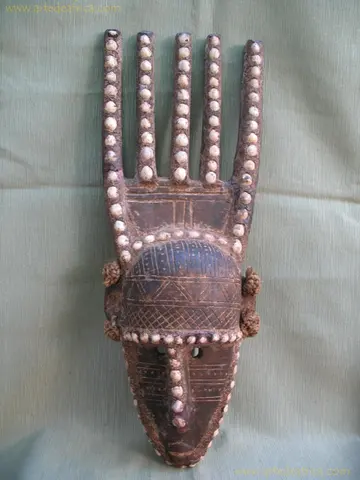
A five-horn mask belonging to the secret society of the Ntomo, which represents that the human being is obliged to work to…
MFAZ-54
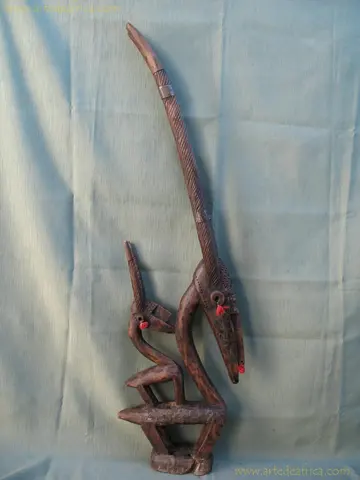
Tyi Wara means the work of the wild animal. Tyi means work and wild animal Wara.
MFG-28
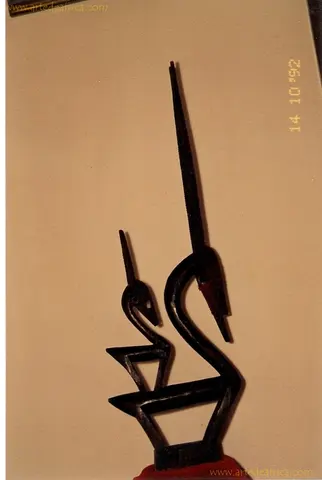
Tyi wara, ty o ti wara, chy, ci o cy wara are multiple names used to name the best known scimer mask…
MFG-29
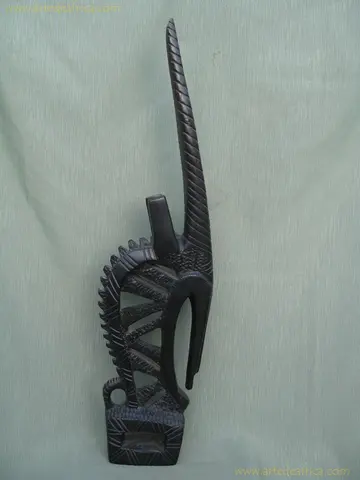
Tyi wara, ty o ti wara, chy, ci o cy wara are multiple names used to name the best known scimer mask…
MFG-30


