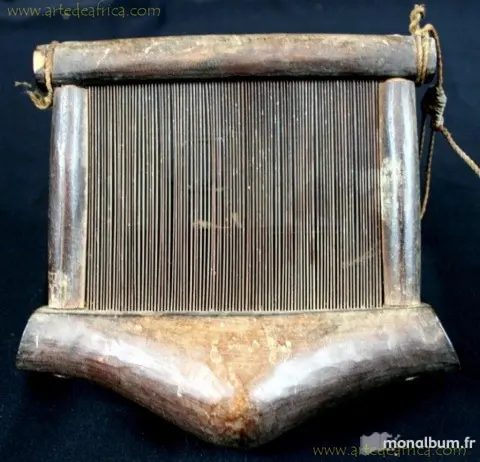
Telar comb
Beautiful patina for use and small strokes due to the artisanal use of the object.
PLYTL-25

Text of the original catalogue
Knitting is a trade reserved for men, as is potting for women. The woman is reeling, spinning, or embroidering. It is almost a sacred office, a craft of creation that requires the prayer of specific prayers. From the movements of the hands of the weaver, from his play with the lizas and the batan, from his harmony between the plot and the warp arise the forms and drawings created by him. These drawings, in many ethnic groups, such as the Asanthi of Ghana and Ivory Coast, represent the social rank of their bearers and no one would dare put on a garment made from a fabric whose drawing does not correspond to their rank. Weaving coils are mainly used in traditional looms of the West African. They are horizontal double loop looms. The coils are suspended from a frame (see dogon looms) All the coils are shaped like “U” inverted and between the legs of the “U” is inserted the axis in whose center is fixed the ribbed reel through which the thread runs. Some coils are true works of art. The art of knitting is evoked in many African poetry. For the dogon the loom is the word and the organizational systems of the world is reflected in the loom. Knitting and procreation is all one for the dogons. The word is the sound produced by the friction between the pulley and the shuttle. Knitting, singing, talking, procreating are the same action. Action of creation and life. It is always woven by day. At night it would be an offence and the weaver would lose sight. The beauty of the trade requires to be accompanied by beautiful tools and working instruments. This is why the stirrups of the pulleys or weaving pins and looms are almost always beautifully decorated, because the contemplation of a beautiful object inspires a beautiful creation. The pulley is the most beautifully decorated part of the loom and is the piece that identifies the weaver. The comb consists of sheets of palm leaves juxtaposed and attached by a wooden frame, through which the threads will pass. In the shuttle, in the shape of a canoe, a coil is inserted that rotates around a wire and on this piece the thread of the plot will be wound. Long fabric bands are weaved and then sewn together. Most of the fabrics obtained are then decorated with a chalamo, brush or tampon, with traditionally natural pigments. procreate are the same action. Action of creation and life. At night it would be an offense and the weaver would lose his sight. The beauty of the trade requires to be accompanied by beautiful tools and working instruments. This is why the stirrups of the pulleys or weaving pins and looms are almost always beautifully decorated, because the contemplation of a beautiful object inspires a beautiful creation. The pulley is the most beautifully decorated part of the loom and is the piece that identifies the weaver. It denotes its good taste as it unites aesthetic pleasure to work. The comb consists of sheets of palm leaves juxtaposed and attached by a wooden frame, through which the threads will pass. In the shuttle, in the shape of a canoe, a coil is inserted that rotates around a wire and on this piece the thread of the plot will be wound. Long fabric bands are weaved and then sewn together. Most of the fabrics obtained are then decorated with a chalamo, brush or tampon, with traditionally natural pigments. In Dogon mythology, the ethnologist Génévieuve Calame Griaule relates in “The Word of the Dogon”, the loom is a metaphor of the primordial word: “The teeth evoke the comb and tongue, which goes and comes without ceasing in the mouth; the shuttle and pulley from which the characteristic squeaks of the loom come correspond to the throat and, more specifically, to the place of the larynx where the sounds are formed; the loom lizas are represented by the bell that goes up and down when speaking; the words are the son that the weaver transforms into tissue.” On the loom, built in the image and likeness of the universe, the pulley is in the center and is situated on the horizon line of the weaver, in front of it. Most looms refer to masks or represent stylized silhouettes, heads of animals or heads and finely worked human figures that constitute true works of art. Looms like pulleys are a distinctive cultural symbol of many African ethnicities. The looms weave relatively narrow bands, between 15 and 20 centimetres with the greatest frequency that are then sewn along with each other until forming the desired canvas, which can be used to make the garments. Previously they will be decorated with motifs made with brush, pen, calamum or tampon. Legend has it that if under one roof many pulleys gather together, they will join forces to fight the weaver.
38 objects · page 2 of 2
Beautiful patina for use and small strokes due to the artisanal use of the object.
PLYTL-25
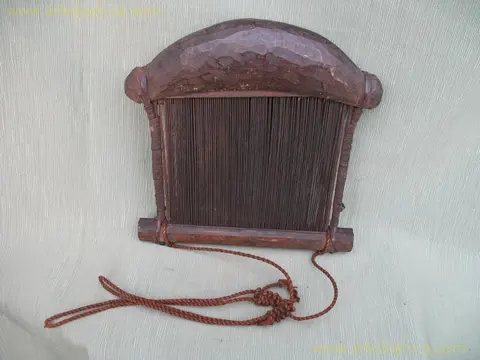
Comb or guide loom threads used in the center and north of Ivory Coast, mainly by the baulé and senufo.
PLYTL-26
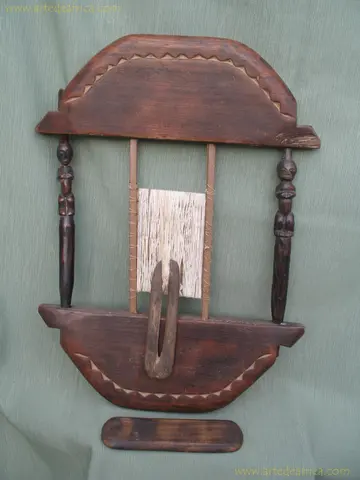
Full fabric with your comb.The narrow fabric bands obtained are sewn juxtaposed to form the cloth.
PLYTL-27
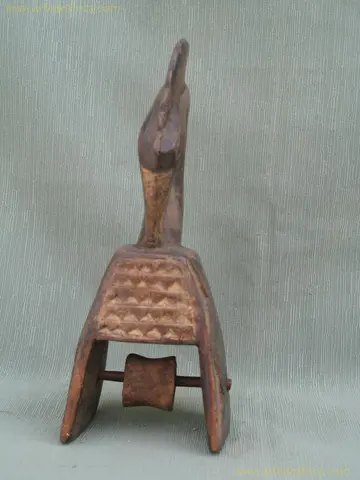
It represents a stylized kalao.
PLYTL-28
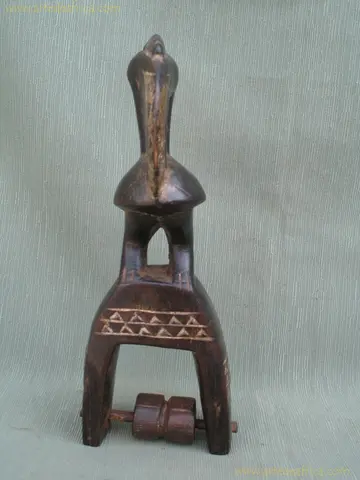
The m handle of the pulley represents a mythical bird kalao in most ethnicities of Ivory Coast.
PLYTL-29
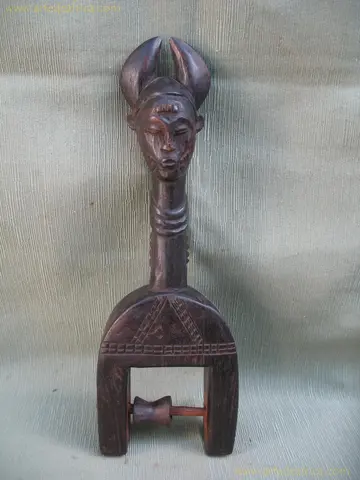
The pulley handle features the face of an initiatedijiminiAs the ritual scarifications of the face show.
PLYTL-30
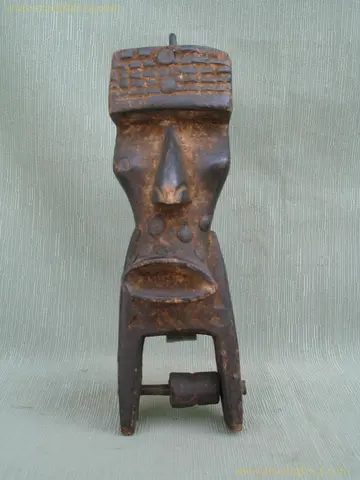
A rough-looking figure that resembles the style of his relatives Kran from Liberia.
PLYTL-31
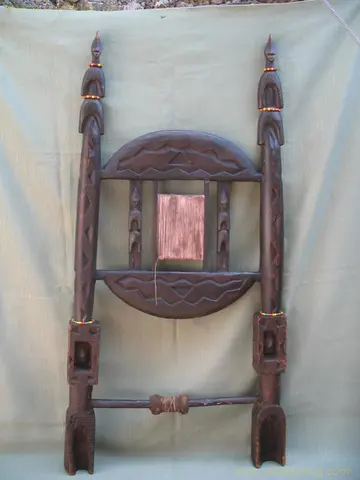
Typical loom Namji with ethnic figures in the vertical columns.
PLYTL-33
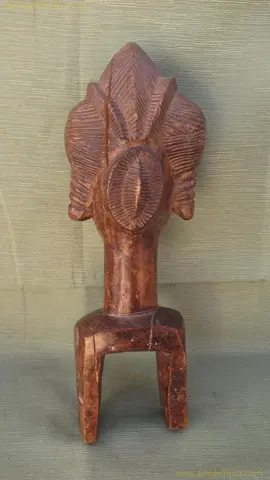
Beautiful pair of baulé pulleys acquired in Abidjan in the mid-sixties of the last century.
PLYTL-34
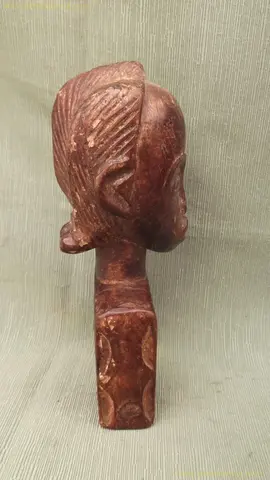
Weaving is a trade reserved for men in most African societies, as is potting for women.
PLYTL-35
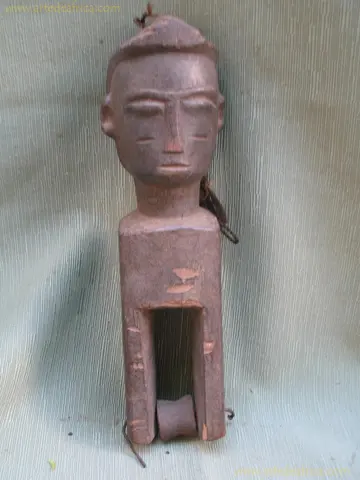
Old pulley with realistic face, very rustic that resembles the style of the Tagbana so it must come from an area close…
PLYTL-36
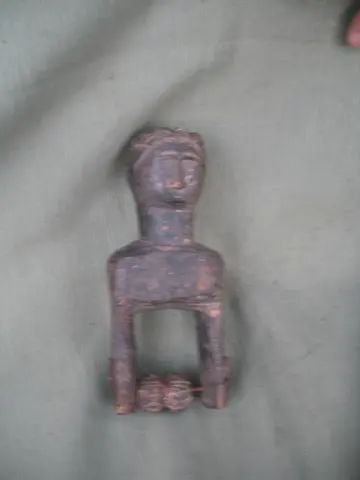
Small rudimentary-looking pulley stirrup like most of the realizations of the Tagbana.
PLYTL-37
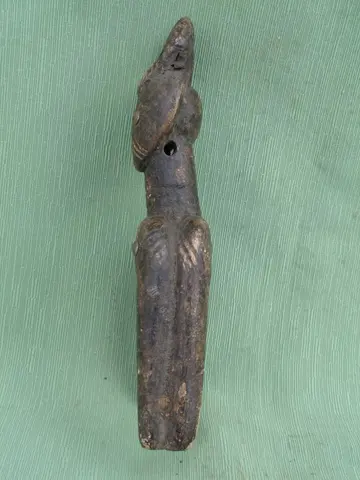
Pulley representing a kple-kple mask of the Goli. They're buffalo masks.
PLYTL-38
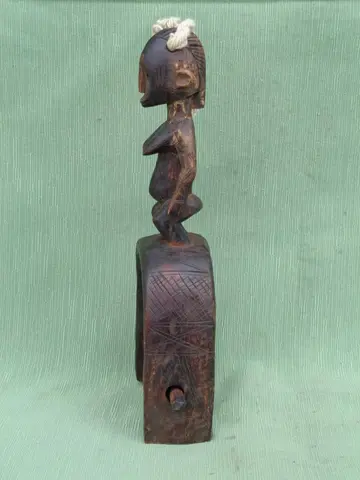
Pulley topped with the figure of a senufo woman with scarifications in her arms and body, which means that she is an…
PLYTL-39


