
Hanging Mask
Among the enormous multiplicity of African ethnic groups few have made metal masks.
BR-26

List of the historical catalogue
Text and organisation of the original catalogue · Jesús Arrimadas Saavedra
Among the enormous multiplicity of African ethnic groups few have made metal masks. Except for the Dogon who have built some iron mask, there is no data on other masks made of the same metal. Although more numerous the manufacture and use of bronze masks is also limited to very few ethnic groups. Although the techniques of casting bronze and lost wax have been dominant for several millennia, as evidenced by the works produced that include an important variety of objects, small figures, exvotes, heads, statues, weights weighing gold, pipes and ornaments, the existence of bronze masks seems to date from much more recent dates, about six to eight decades, except for some of Benin’s old mask. These recent invoice masks have no known ritual value, they are rather prestigious masks intended to show the rank of their owners. Most of it is true works of art that demonstrate the great technique achieved by its castors. Some ethnic groups attribute protective and healing properties to them for what they are venerated in homes.
43 objects · page 2 of 2
Among the enormous multiplicity of African ethnic groups few have made metal masks.
BR-26

Among the enormous multiplicity of African ethnic groups few have made metal masks.
BR-27

Among the enormous multiplicity of African ethnic groups few have made metal masks.
BR-28

It is a Yanyaleleya mask whose front comes out two long peaks, representing the calao and descending to the chin.
BR-29

It is a male mask of remarkable bamileké.
BR-30

Mask female portrait intended to be hung in the home and in which it makes trade of protective mask.
BR-31

Protective mask of the homes where it is hung.
BR-32

Hanging mask representing a griot.
BRN-95

Magnificent bronze helmet mask depicting a calao with a fruit in the mouth.
MCYC-40

Helmet mask depicting an anthropozoomorphic head with holes intended for vision and relief drawings.
CBR-2

Helmet mask with a representation of the kpelié mask. It belongs to the secret society of healers.
CBR-1
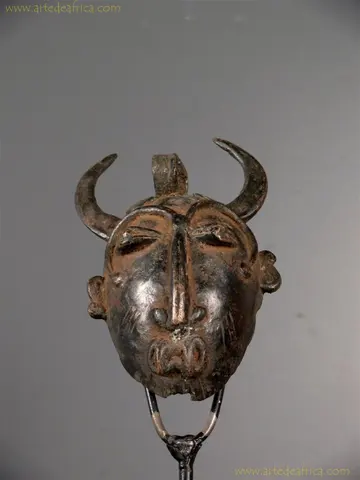
The people Tikar, of Bantu origin, is a village of Grassland, it is formed by 300.000 individuals, established in different population centres…
BRN-60

The people Tikar, of Bantu origin, is a village of Grassland, it is formed by 300.000 individuals, established in different population centres…
BRN-61

Bronze hanging mask that has the same use as passport masks.
BRN-96

Small oval shape passport mask represents the head of a man with facial scarifications.
BRN-97

Small bronze mask whose shape is that of an egg, with a hole in the back.
BRN-98

Protective mask intended to be hung in households. Acquired in Abidjan in the 1960s.
BRN-99

Normally metal masks do not have a ritual value, but the iron masks of the Bambara are masks of funerfals, commissioned to…
BR-33

It represents a woman's face and in the wooden masks the protrusion of the forehead in the center of an "X" or…
BR-40


