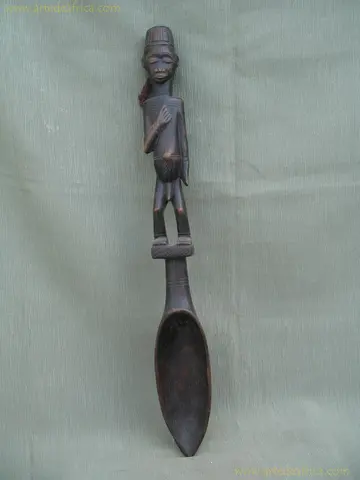
Ritual Spoon
Ceremonial spoon of hardwood from Lagos.
CHR-22

Text of the original catalogue
The former ethnic group Yoruba extends to the southwest of Nigeria and south of Benin, former Dahomey, in the country Fon. In the myth of their origins, the founder of the Odudua ethnic group distributes to his children crowns of glass beads with the command that they be founded, each in his kingdom, away from Ife. Thus are born the various Yoruba kingdoms, whose Obas or kings all descend from Odudua, their common ancestor. The sacred power of the Oba contrasts with the political power exercised by the very important and powerful secret societies, especially the Ogboni society, led by notable elders who are truly responsible for the administration of many States. Ogboni society does not wear masks in its ceremonies. Two other very important societies cover the Yoruba country, the Geledé and the Egungun. The first is present in the soroeste of Nigeria and Benin. Both societies, contrary to Ogboni society, have very important and powerful masks. Geledé society celebrates dances intended for general rejoicing and can be seen all over the world, contrary to those celebrated exclusively among members of society. Almost all masks wear tribal scarifications, three small stripes on the cheeks and sometimes on the forehead. Their masks are very varied, fruit of a great imagination. An essential feature characterizes Nigerian masks: the absence of snake. Reason that is widely used among the Yoruba of Benin, influenced by the Fon in those who worship the serpent.Most of these masks participate in the "epa" ritual feast destined to celebrate human fertility and that of the fields. Egungun society is especially linked to the cult of ancestors. In ceremonies in honor of the notables, the chiefs and founders of the deceased clans, the masks or dancers who carry them embody the soul of the ancestors, who temporarily take possession of their bodies, in such a way that some elders recognize in them, by their way of moving and speaking, certain deceased. The dead that the mask bearers have not met. With the dismemberment of the kingdom of Ife come different kingdoms among which are the Ijebu, whose king is named Awujale, and which occupy part of the Atlantic coast of the 1500 as at 1750It seems that the intense relationship between Ijebu and Ife was due to the fact that the first Awujale was Oduduwa's son. They negotiate with the Portuguese and receive large amounts of bronze that their artists, who have been influenced by Ife and Benin, make valuable objects. The empire of Oyo extends, from 160 a 1830, in the north area, Yoruba tongue. The emperor, the wingman, is invested with the power of supreme judge, but his power is not omnimode, it is countered by the power of the Council, made up of the heads of seven families outside royalty. The knights Oyo undertake great conquests by expanding the territory. Many of the Yoruba equestrian figures and the Epa masks recall these gentlemen.
87 objects · page 2 of 4
Ceremonial spoon of hardwood from Lagos.
CHR-22
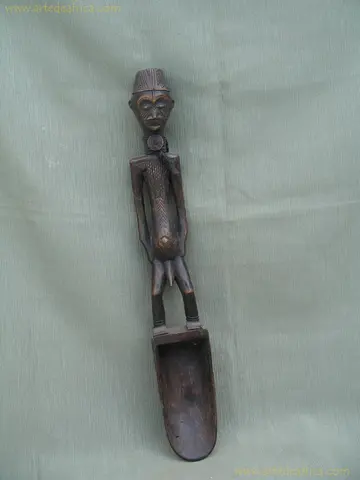
Spoon whose handle is a man touched with a chechia and heart-shaped face.
CHR-23
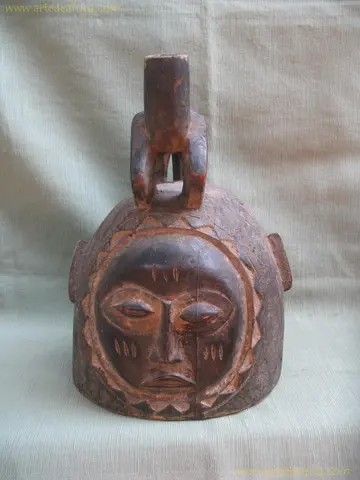
It is believed that the origin of the Geledé cult occurs on the occasion of the mythical passage from matriarchal society to…
MCYC-24
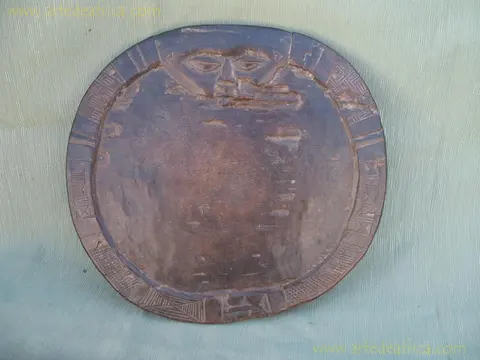
The fortune teller, the babalawoPut sixteen palm nuts on the tray to proceed to the divinatory rite.
MYA-9
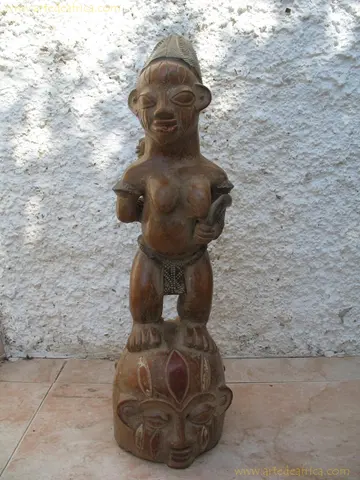
The Gelede cult, practiced mainly by the Yoruba Westerners, it is a cult in honor of living or deceased elderly women.
TRRC-11
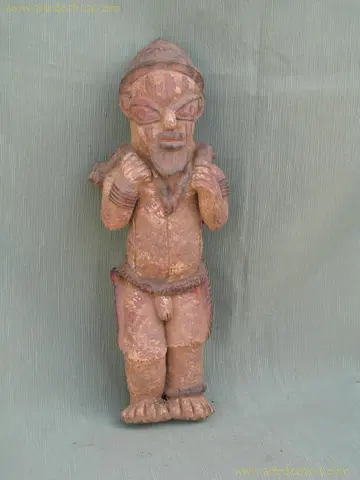
Small polychrome terracotta figure depicting a bearded hunter carrying a small antelope on his shoulders.
1
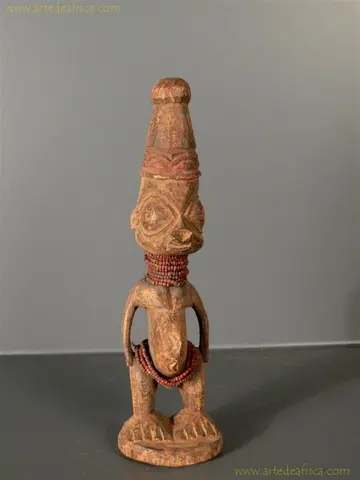
In the case of ”ibeji“ In Yoruba, ” “ibedji” means “twin”, if one or both twins die, the mother, on the advice…
GML-6
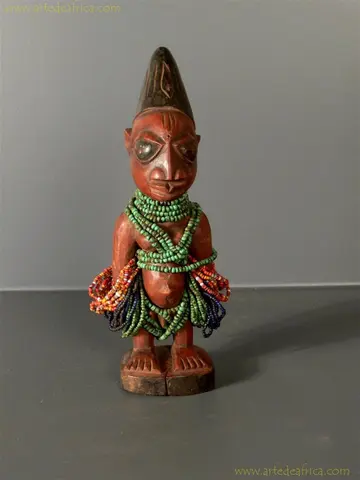
In the case of ”ibeji“ In Yoruba, ” “ibedji” means “twin”, if one or both twins die, the mother, on the advice…
GML-7
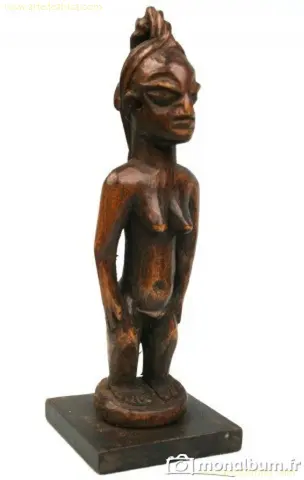
The statues, offerings, votive figures and exvotes are not in Africa an offering dedicated to God or to the gods for a…
FIV-8
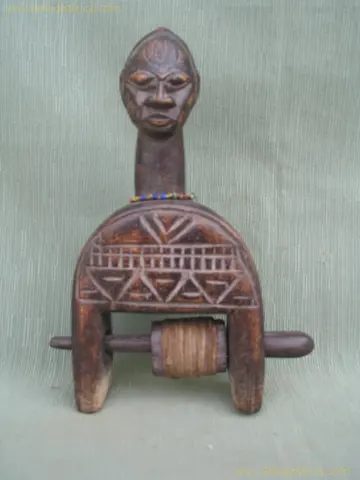
Pulley topped by a Yoruba head.
PLYTL-19
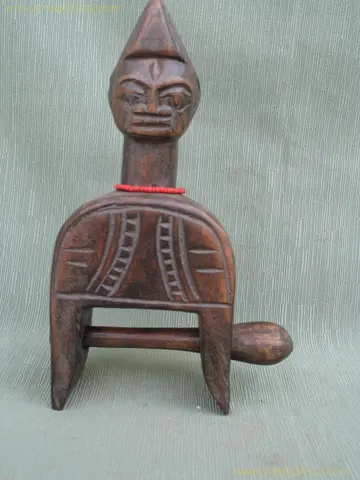
A typically Yoruba head tops the pulley. Ritual scarification on the forehead and a necklace of red ceramic beads around the neck.
PLYTL-20
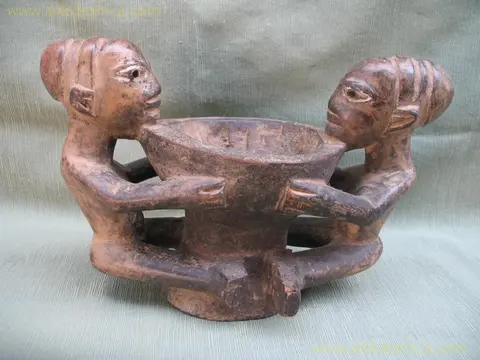
The Yoruba statues of cup bearers are related to divination, serving for a part of a cup of offerings and welcome cup…
RCPT-12

The baton of a remarkable Yoruba. These canes besides being used in divinatory practices are symbols of authority.
BST-3

A remarkable Yoruba cane. These canes, besides serving in divinatory practices, are a symbol of self-restraint.
BST-5
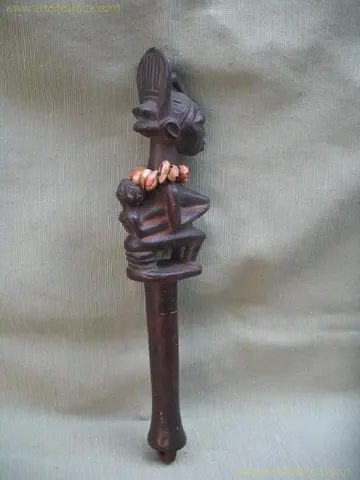
This staff, used in ceremonial dances, depicts a mother with her child on her back in the African manner.
BST-6
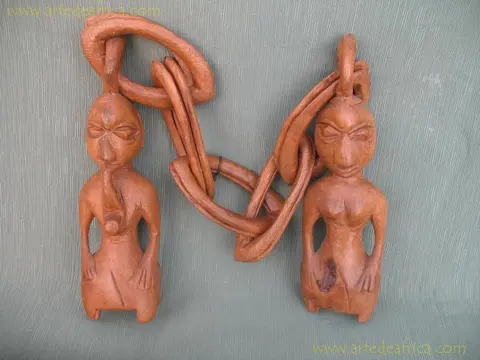
Chain formed by a bonding of links and rings made in a single piece of hard wood. the solidity of the union…
VAR-8
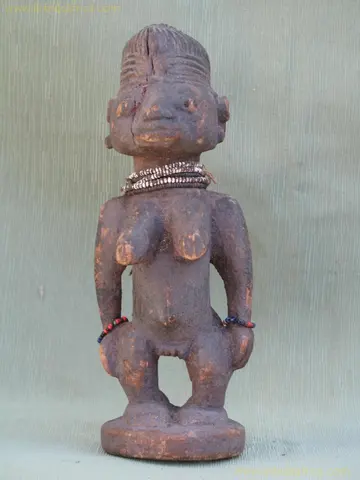
In the case of ”ibeji“ In Yoruba, ” “ibedji” means “twin”, if one or both twins die, the mother, on the advice…
GML-11
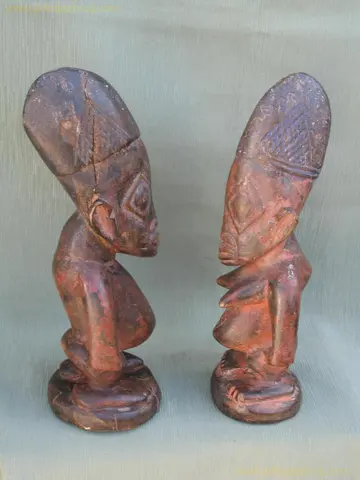
In the case of ”ibeji“ In Yoruba, ” “ibedji” means “twin”, if one or both twins die, the mother, on the advice…
GML-12
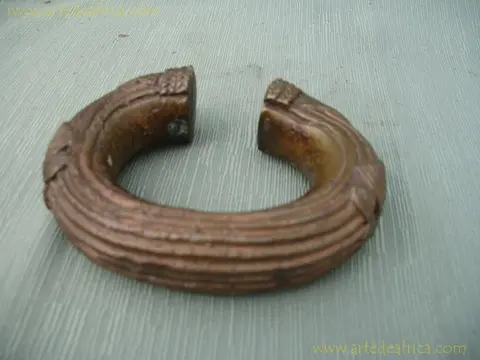
This old, heavy bracelet is surely a wedding gift from a father to his daughter or a man to his wife.
PYB-23
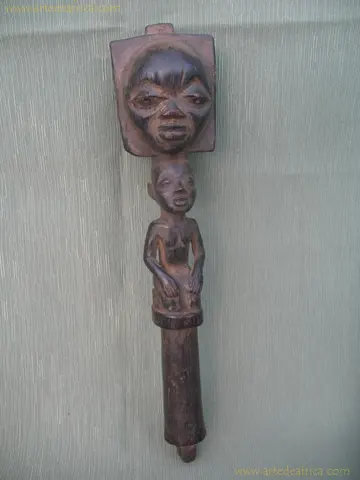
It is a cane or axe of ceremony used during the cult of the god of Thunder Shango, fourth Yoruba king who…
BST-20
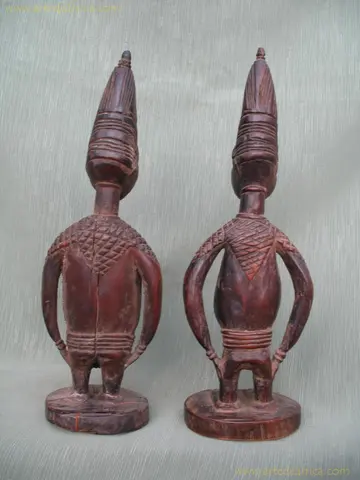
In the case of ”ibeji“ In Yoruba, ” “ibedji” means “twin”, if one or both twins die, the mother, on the advice…
GML-15
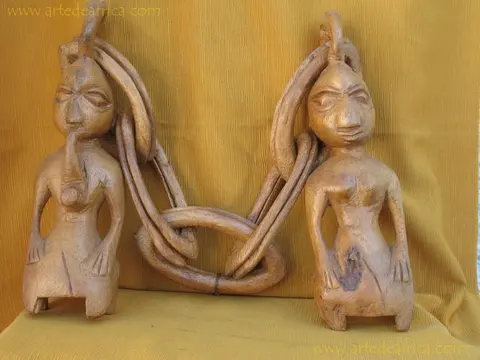
The chains called marriage are a symbol of marriage union. legend says that if the chain breaks, the marriage bond is broken…
VAR-15
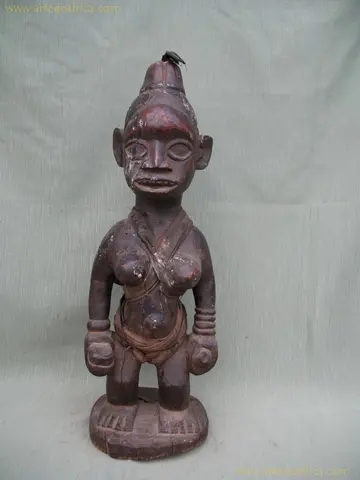
The Gelede cult, practiced mainly by the Yoruba Westerners, it is a cult in honor of living or deceased elderly women.
EFM-78
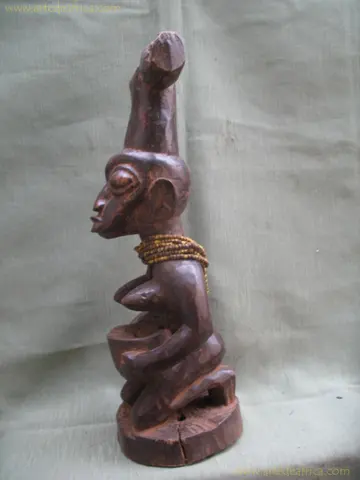
Priestess of the cult to the god of Thunder Shango, fourth Yoruba king who was deified, and in the ceremonies of possession…
EFM-79


