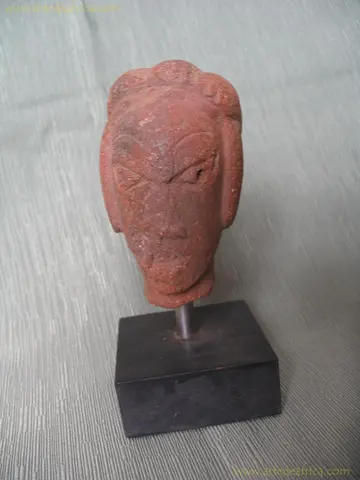
Head of Man
A head that undoubtedly constitutes a fragment of an entire body figure.
TRRC-29

Text of the original catalogue
Nok is not an ethnic group Nok is a small village in northern Nigeria, in the Zaria region, Bauchi plateau, at the confluence of the Niger and Benué rivers. From the century on VII before Christ and until the Century IV of our era in the vicinity of the current mining center of Nok an important culture has developed that has inherited from us a multitude of objects of unquestionable archaeological value, the most important of which seem to date from the first century. Numerous statues and stone figures that have given rise to a true African statuary of mud and terracotta, have been appearing along more than twenty deposits in an area of more than five hundred kilometers that extends from east to west and all the pieces of this wide area, by the similarity of their style, are included under the appeal of earrings NokArchaeologist Bernard Faag found in this region numerous heads of clay soil cooked; The most famous of all was found by a stranger, in Jemad, in a tin mine, two meters deep. Most of these figures are depictions of characters although there are also zoomorph representations, especially the elephant. Faag claimed that there was a direct relationship with the pieces found in Ife and assumed that the inhabitants of Ife would originate from the northern regions. The fact is that the characteristic shapes of the figures are not found in some bronzes of Benin and even in some current gelede masks of the Yoruba, without forgetting those who pretend to find such forms in the productions of many other African cultures such as those of the Senufos, the Bagas or the Bembes. But according to ethnologist William Faag this kinship between the art of Nok And ife's is logical to be the sculpture Nok However, this thesis would only be valid in the case of terracottas, since in the Nok No bronze has been found. Nok have been dated, mostly, between the centuries IV A.C. a II D.C. Different styles have appeared but the data necessary to know whether they correspond to one or several cultures are not available, as they have been found almost interchangeably in the different excavation centers. This great diversity of styles suggests that they have been able to devote themselves to different purposes, funeral or cult. But the Nok they have not worked only mud and stone. They have perfectly mastered the techniques of iron smelting. They have been found since the 1st century IV before Christ weapons, agricultural tools and other artifacts. It seems that in the village of Taruga, archaeologists have found more than a dozen cast furnaces. CLASSIC STYLE NOK STATUS They are the most important in size, almost natural proportions. Elongated figures, very elaborate invoice and quite polished surface. Triangular eyes, the larger side, the upper arch-shaped, and incised pupils. By the garments as well as by the jewels they carry denote an evolved society. SOKOTO STYLE Less refined than the so-called classic and less dress and body ornamentation. The eyes are distinguished by a large upper eyelid that falls heavily on the eye. Most of the statues have come fragmented to this day. His body could be conical, like a phallus, so they could be destined to honor fertility. From the thermoluminescence analyses carried out, they seem to come from the century IV before Christ. STYLE KATSINA Looks like a later style than the previous ones, from the first century after Christ to IV The heads are elongated, with jewels and elaborate hairstyles. Eyes, half closed, quite large and globular but triangular with incised pupils and raised eyebrow. Similar to the classic style of the same period.
8 objects · page 1 of 1
A head that undoubtedly constitutes a fragment of an entire body figure.
TRRC-29
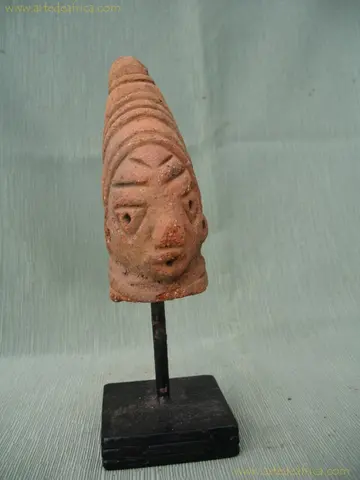
Touched head of an elongated hairstyle in conical form. No doubt fragment of a larger figure.
TRRC-38
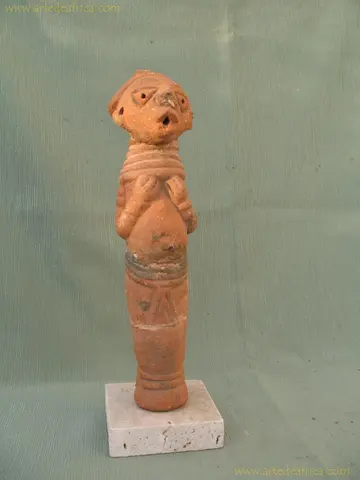
terracotta figure that looks feminine given its appearance and ornaments.
TRRC-39
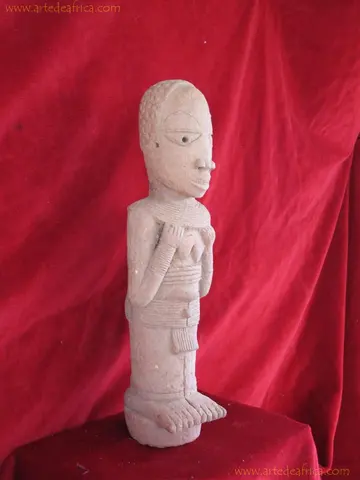
The terracottas Nok have been dated, mostly, between the centuries IV A.C. a II D.C.
TRRC-42
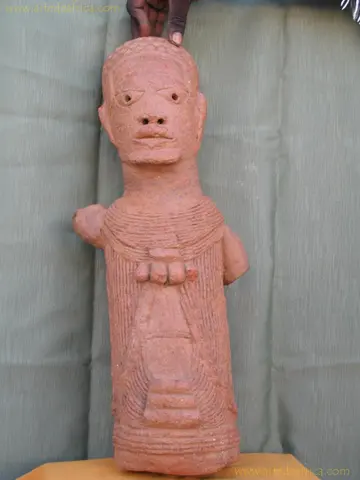
The configuration of the eyes and eyebrows as well as perforations of the eyes, noses and ears is a common feature of…
TRRC-58
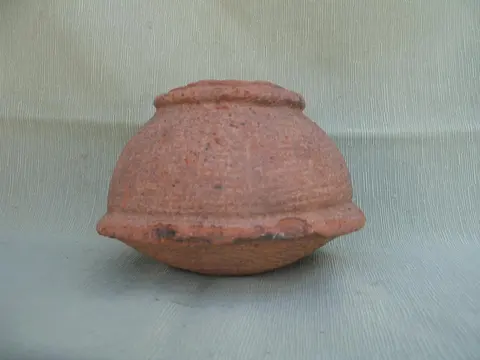
The terracottas Nok have been dated, mostly, between the centuries IV A.C. a II D.C.
TRRC-81
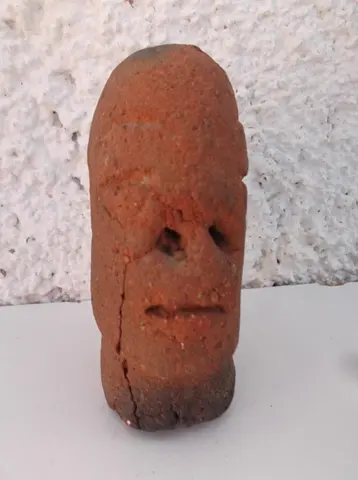
Nok It's not an ethnic group,is a small village in northern Nigeria, in the Zaria region.
TRRC-87

Nok It is not an ethnic group, it is a small town in central Nigeria, whose influence has marked an area as…
TRRC-117


