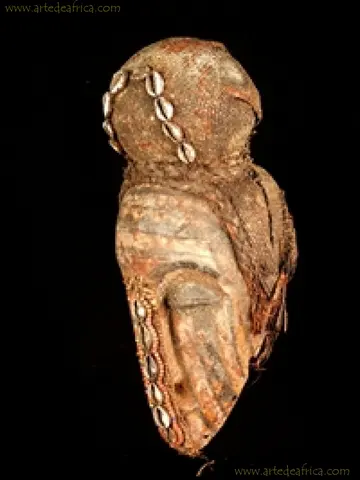
Mwaash A-Mbooy mask
Implemented in the Democratic Republic of the Congo, Kasaï Southern Africa, Kuba have always shown through their art the meaning of the…
MSO-2

Text of the original catalogue
Established in the Democratic Republic of the Congo, in southern Kasaï, between the Kasaï, Sankuru and LuluaThe Kuba kingdom was born from the federation of eighteen tribes under the authority of the Bushongo. Other important towns are the Ngeende, the Ngwoong and the Shoowa. They appeared to have come as a result of a migration that occurred in the century. XVIHis most famous reu was Shyaam Ambul to Ngoong who reigned at the beginning of the century XVII and is regarded as the father of Kuba culture. The Kuba genealogy accounts for one hundred and twenty-four kings, some of whom are represented by statues, sitting on their throne, whose realization dates back to the century. XVIII. Therefore, it is not surprising that the Kuba have always shown through their art the meaning of the monarchical institution. The monarch, invested with supernatural powers, was the guarantor of the fertility of fields and women. To be enthroned king he had to commit incest with his sister, an act strictly forbidden in society, but inherent in the sacred nature of her power that prohibited her from any relationship outside the family. Art Kuba is a real and aristocratic art, known mainly for its masks. In addition to about twenty different masks the Kuba manufacture numerous ornamental or utilitarian objects such as cups, stools, pipes, drums, reclining heads, etc., where the utilitarian function is subordinated to aesthetic function. Royal masks constitute one of the most important representations of Kuba art.These masks are of three types: Ngaady a-Mwaash, Moshambwooy or Mwaash a-Mbooy and Bwoom. The use of coris in these masks is abundant. The Mwaash a-Mbooy or Moshambwooy mask represents Ngaady a mwaash, sister and wife of Woot, an ancestor of the Bushongo from whom the great family comes KubaThey were called Bushongo until the Luba gave them the name of KubaIt's a female mask with no eyes. It's the most representative mask of the Kuba people. It presents a beautiful polychrome and a rich ornamentation: leather, cauris, ceramic pearls. Its red color represents bleeding and wealth, white mourning and religious purity and blue is the symbol of a high social level.
29 objects · page 1 of 2
Implemented in the Democratic Republic of the Congo, Kasaï Southern Africa, Kuba have always shown through their art the meaning of the…
MSO-2

Implemented in the Democratic Republic of the Congo, Kasaï Southern Africa, Kuba have always shown through their art the meaning of the…
MSO-3

Reliquary representing A Ngaady a mwaashsister and wife of Woot, ancestor of the Bushongos, i.e.
RLC-13

Set up for four centuries between the Kasai and Sankuru rivers Kuba subdivide into numerous clans that govern themselves autonomously but pay…
EMS-23

Contrary to the visuality of art Kuba this mask presents a great sobriety.
MFAZ-11
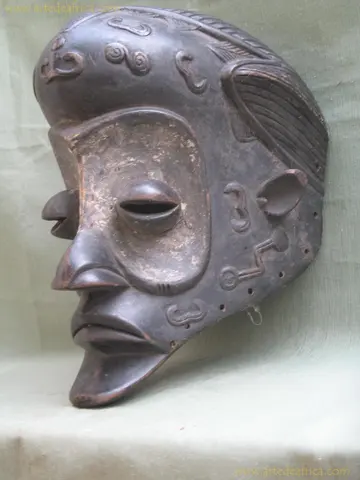
More of a sorcerer with a beautiful black patina. His morphology is similar to that of the Bwoom masacras.
MCYC-16
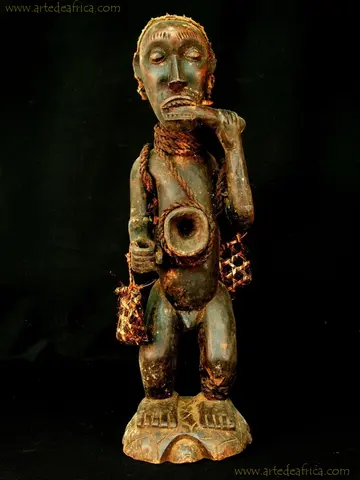
the iboga is a potent drug that is extracted from a root and exerts a great influence on the social life of…
FET-33
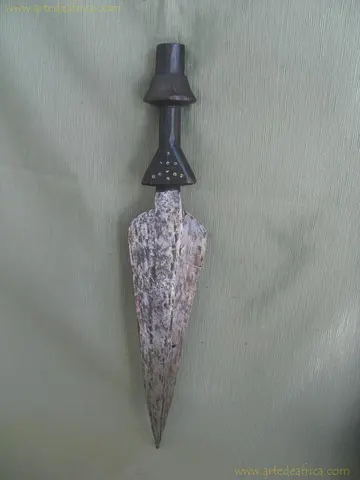
Wide alveolated blade, with embossed lines. Black handle with thick rear edge for better grip of the weapon.
ARM-26

Mask considered real for representing the king's brother who apparently went mad with remorse for killing his nephew.
MFAZ-28

MASK MUKENGE ELEFANT OR MUKYEEM OF THE NGEENDE Gets a strong influence from the mask Moshambwooy to whom it is often attributed.
MFANT-125

Mask considered real for representing the king's brother who apparently went mad with remorse for killing his nephew.
MYL-12

Elegant and artistic figure of sacrificing in charge of making sacrifices destined to the cult of the ancestors and to the different…
EMS-52

The mask Mwaash A-Mbooy or Moshambwooy, represents sister and wife of Woot, ancestor from whom the great family comes KubaThey were called.
MFANT-138
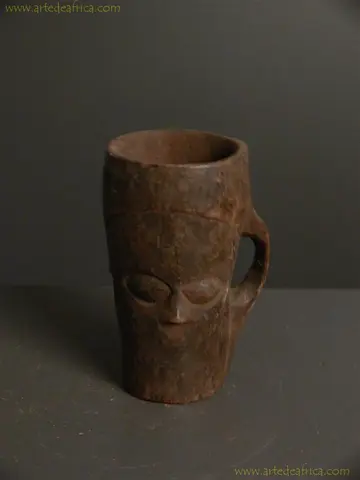
Cup intended to drink the palm wine, the chapalo or the distilled sodabi or kutuku.
RCPT-5

Duster intended to transport the black powder that the hunter will use.
ARM-40

Ceremony pipe. It is a pipe of apparatus, not intended to smoke in it but is a sign of notability.
PIP-7

This pipe represents a woman sitting in prayerful attitude, which proves the ceremonial character of this object.
PIP-8

Ceremony axe with two heads, Janus, opposite the back of the head, one with big teeth and mouth closed the other.
BST-4

Known under the name of “velours kassaï”.
TPC-13

Known under the name of “velours kassaï”.
TPC-14
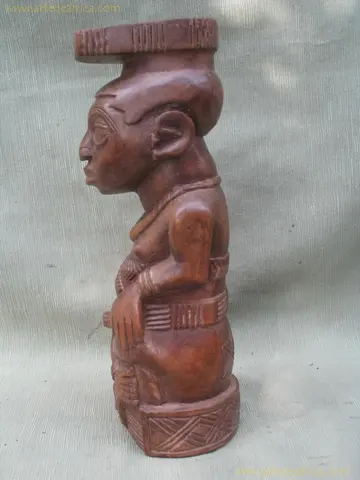
Some statues of kings Kuba represent King Kata Mbula, who reigned of the year 1.800 as at 1.810They get the name of…
EMS-101
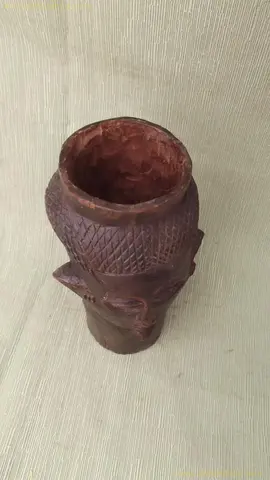
Cup intended to drink palm wine at ceremonies or on great occasions.
RCPT-28

Artistic pipe depicting a character with his hands resting on his belly.
PIP-18

This name is given to cauris, ceramic beads, bronze handles and bracelets, small bronze or iron bars, tools and tools of tillage,…
MND-17


