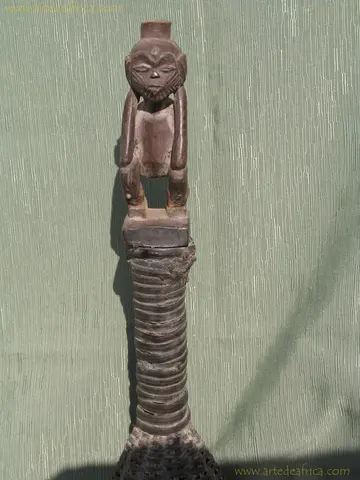
Maraca
Maraca topped by a small statue at the top of the handle. The character seems to be very attentively uchar.
INM-13

Text of the original catalogue
The people Kota is located in Gabon with a small representation in the Democratic Republic of the Congo on a plateau, with equatorial climate, which dominates the upper Ogué valley in the west and the eastern side of the Congo. Water-rich area, rivers and swampy areas abound. The Ivindo along with the Ogué are its two main rivers that have numerous tributaries. The Bakota form a very eterogenous society that has numerous subgroups in which geographical location plays an important role, dominating the matrilineal regime in the northern and matrilineal groups in the south. Each group has its own dialect although they are easily understood among them. The cult of Bwete to ancestors is widespread as are the initiatic societies Mungala and Ngoy for men and Lisimbu for women. And as Louis Perrois tells us, as throughout Gabon, they regularly and especially in particularly difficult situations practice the rituals of divination, healing and propitiation, which together with the rites of passage and the revelation of masks are the essential manifestations of the Bakota community. Healing rituals are the work of women while men are involved in the fight against witchcraft and initiatic rituals. The main cell is the family in which men and women perform complementary tasks, both at home and at work, hunting and fishing, war when there is one, for men and the primary care of the house and the education of children for women. The clans are independent and although theoretically they have a leader it is actually a group of notables who are in charge of resolving conflicts and establishing order in the community. Despite the apparent similarity, in the diversity, of their objects of worship, each Kota group has its own customs. The family Kota It brings together as many styles as ethnic groups make up its people. They are mainly known for the cult they dedicate to the dead. In times past they left the dead at the mercy of the elements of nature, later began to bury them and then to preserve some of the most important bones in baskets that served as reliquary, called bweté, kept by stylized figures covered with copper plates.
4 objects · page 1 of 1
Maraca topped by a small statue at the top of the handle. The character seems to be very attentively uchar.
INM-13
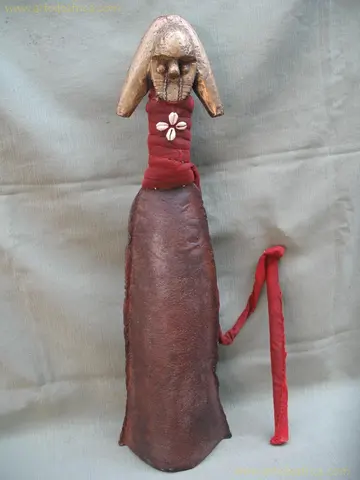
Bells and bells, both metallic and wooden, besides having their use in playful and religious ceremonies are a valuable instrument used by…
IDIOF-9
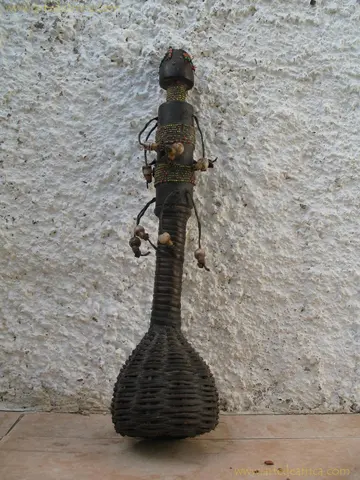
Body decorated with multicolored ceramic beads and fine leather strips from which thick white beads hang.
IDIOF-10
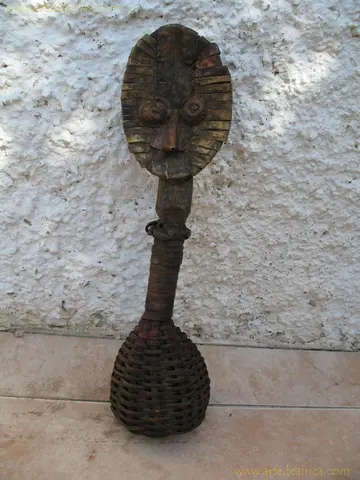
Maraca topped with a kota sanghu head.
IDIOF-19


