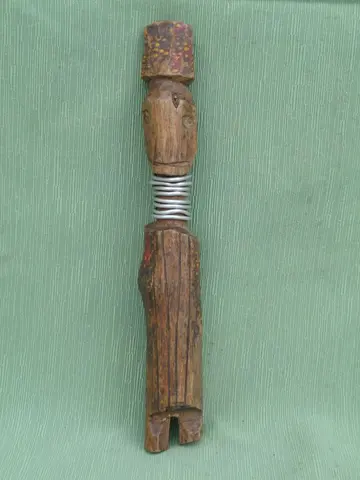
Ritual Figure
Protective figure intended to receive worship in the family altars of the Karo, the most sedentary group of all the peoples of…
-39

Text of the original catalogue
The Karo form the sedentary village of the Omo Valley. Small-group people. These groups have clan leaders although they have no central authority, but they do accept the control of the Un-Imba or parents of fire, who are the ones who summon the groups and come into contact with the ancestors to ask for advice and protection. They are essentially nimists and practice the cult of ancestors. They live mostly in circular straw huts, adobe, implanted in a beautiful place on the eastern shore of the Omo, in the village of Douss and also in the village of Korcho. Its barns are built on palafitos. During the dry season they are mainly dedicated to agriculture. They grow cereals, tobacco, millet, beans, cotton, sugar cane, they also produce honey and practice hunting and fishing. In the past, they were cattle ranchers, but a serious rinderpest epidemic decimated their herds, which are still mainly occupied in the rainy season. They take hydromiel to fight the thirst and blood of cattle to strengthen themselves but are not meat consumers. It is a small ethnic group, in the process of disappearing. 1500 like the Hamars. Karo They practice the Ukuli, or jump the bull, rite of passage that allows young people to become men and to have access to own cattle or a wife. The ceremony consists of making two comings and goings without falling, totally naked, on a group of bovids lined up. After the test, the young man is declared a man by the clan leader. You can already have your own cattle and a wife, or all that you can maintain because they are polygamous. For these celebrations as well as for the big party at the end of the collection they are decorated by painting their faces and bodies artistically. All the tribes of the Omo are famous for these paintings. Scarifications are also made and women from young people are adorned with a round stick under their lips. Men and women are also adorned with colorful necklaces, flowers and different vegetables Today it is common to see Karos armed with kalashnikov, mainly in border areas. They are declared enemies of the Mursi but good friends of the Hamers, whose wives they can marry. Weapons acquired by contraband with Uganda, Kenya and Sudan.
5 objects · page 1 of 1
Protective figure intended to receive worship in the family altars of the Karo, the most sedentary group of all the peoples of…
-39
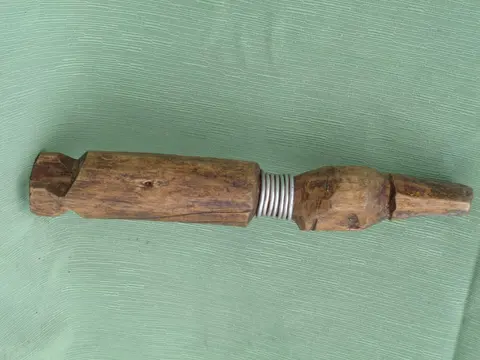
Protective figure intended to receive worship in the family altars of the Karo, the most sedentary group of all the peoples of…
-40
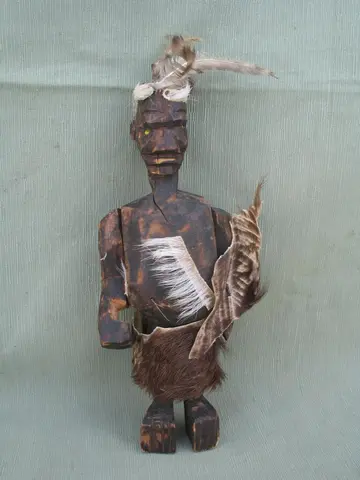
Like the Hamars Karo They practice the Ukuli, or jump the bull, rite of passage that allows young people to become men…
EMS-127
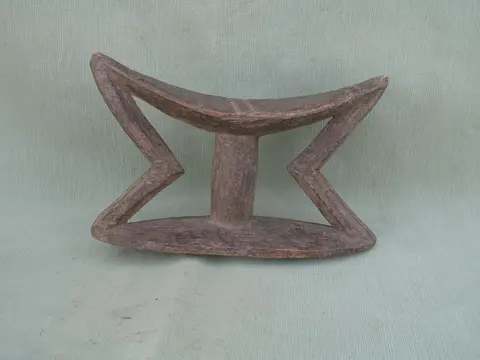
Small curved seat stool and folded side sides.
TAB-20
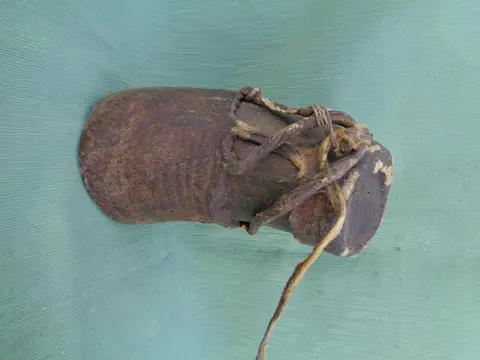
Rare piece that the Karo of the banks of the river Omo put their handle to preserve it.
RCPT-39


