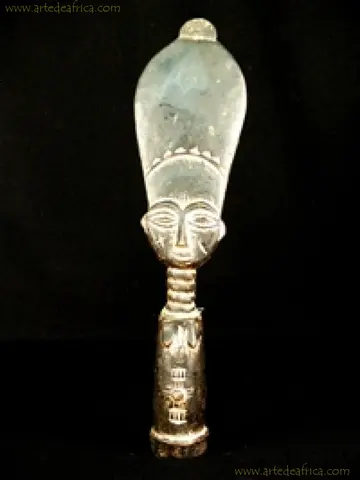
Fertility Doll
These dolls are carried behind the back by women who are expecting a child or by those who want to become pregnant.
FRT-1

Text of the original catalogue
Implanted mainly on the southwestern coast of Ghana is one of the most important villages of the group Akan, with great similarities to the Ashantis with whom they have long been confronted in harsh wars invading and plundering Kumassi. They were divided into numerous small kingdoms that finally managed to unite in a federation. After resisting the Portuguese, they allied themselves with the Dutch and the English to stop the rule. Ashanti, dog it was finally his English friends who destroyed his federative system thinking it would be a danger to his hegemony on the coast. The Fanti of the coast were the first to make contact with Europeans. They have received a strong influence from the English, even in their vocabulary. They are organized in matrilineal system. Their ritual artistic production is quite reduced. Like the Ashantis, their Akua Ba dolls are known. “AKWA BA” means “welcome” in most ethnic groups of the group Akan. It is a way to welcome the stranger or the person who arrives at home and especially the newborn who arrives at the family. And it is in this welcome to the newborn that these statuettes called fertility dolls take their origin. The “akwa ba” dolls represent the female ideal of Ashanti women. Round and flat face, with clear forehead, large eyebrows, small mouth and elongated neck. These figures are carried by pregnant women to ensure a good pregnancy and a good delivery. During this period if you look at beautiful things your child will be beautiful, ugly and deformed otherwise. It is the reason why they always carry with them, among their clothes, usually behind their backs, these dolls that embody their ideal of beauty. As in other ethnic groups, fanti women since becoming pregnant carry in their clothes these dolls that must be as beautiful as possible, idealizing beauty so that the child who is to be born acquires this beauty as well. During pregnancy, a woman will refrain from looking at things or people that are counter-made or look unpleasant to avoid any malformation or defect in her future child. They favor childbirth and are protective of the child once born. After being carved the doll by the sculptor is consecrated by the priest to obtain his apotropaic power. Young girls also carry them to promote their future fertility. When out of use they are stored in family altars. These figures have neither arms nor legs. In the torso the feminine breasts are highlighted symbol of fertility, and a narrowing at the bottom represents the waist. The head always has a high rectangular relief. If you want a child's head will look like a flat disc, with almond eyes and well arched eyebrows. From the cylindrical body, the arms come out forming a cross. Two small bumps indicate the breasts. If you want a girl, the head will be more rectangular and also flat, with round eyes, hair on the head and body without arms. The deacralized dolls, once they have fulfilled their goal, become a toy for girls who use them playing as mothers.
3 objects · page 1 of 1
These dolls are carried behind the back by women who are expecting a child or by those who want to become pregnant.
FRT-1
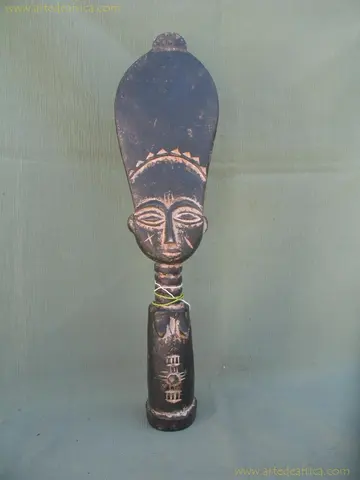
“AKWA BA” means “welcome” in most ethnic groups of the group Akan.
FRT-27
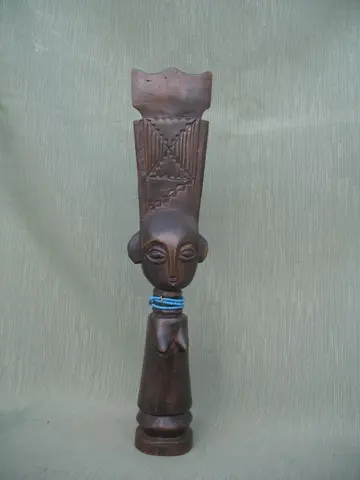
Like all fertility dolls of different ethnicities, fanti women since becoming pregnant carry in their clothes these dolls that must be as…
FRT-37


