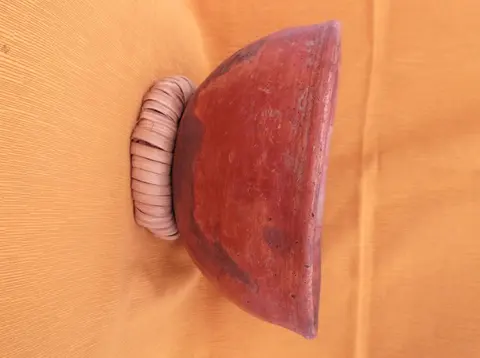
Bowl
Large and heavy bowl, intended to contain grain and other household uses.
TRRC-104

Text of the original catalogue
The Ashantiethnic majority of the large group Akanare mainly located in the central regions of Ghana. There are different theories about their origin but none of them is proven. They are known from the century on. XVII and mainly in the XVIII with King Osei Tutu, founder of Kumassi, in which the priest, legislator, co-founder and unifier of the kingdom Okomfo Anokye received from the gods the golden stool containing the soul of the nation over which he established his power Osei Tutu. The unification that had just been obtained was considered a blessing of the gods and Osei Tutu was proclaimed Ashandene, absolute king of the whole Kingdom Ashanti. Villages, districts and provinces had their autonomy in the form of small states forming the well-known Federation Ashanti. The Ashanti, moved by historical circumstances, have been a warrior people. After fighting fiercely against the powerful Akan kingdom of Denkyra and against the Fanti fall under the yoke of the English at the end of the century XIX After four deadly wars, the English colonizers boldly sought out the golden stool, symbol of the supreme power of the Ashanti, which was the cause of a new revolt promoted by the Queen Mother of Ejisu that lasted from March to September of 1900 And it happened in history as the War of the Golden Stool. Ashanti leaders were sent to the Seychelles Islands and their Kingdom was definitely annexed to their Gold Coast colony (now Ghana). This stool, which has come down from heaven and which has been so bloody, has become the national altar, the receptacle of the souls of the people. Ashanti And in symbol of their unity. There is a whole hierarchy of stools starting with the famous golden stool of the king and in these stools the ancestors receive a cult because their souls have remained in them. Above the forefathers have a supreme god, the god of heaven Nyame, creator of all that exists, and between them, multitude of secondary divinities. For Ashanti the human person is very complex. The blood comes from the mother, so the offspring takes place by maternal line while the koro, is for them and for the Akan The spirit, most of the time totemic, is transmitted from parents to children, therefore by paternal line. It should not be confused with the okra, the soul, so that a person can have several spiritual principles. The knelt is the spirit that does not die, but does not die as long as they have children. Ntoro literally means semen. Ashanti believe that the person has seven souls, one for each day of the week, which is why the newborn is given the name of the day of his birth. The Gold Coast, as its name indicates, has been very rich in this metal and the Ashanti They knew very soon how to exploit the great mining wealth that the country treasured. Like other peoples Akan We have been left with a rich and varied production of objects being the weights of weighing the gold powder the best known. We have been left with a multitude of weights of the most varied forms and comprising figures of both the plant and animal kingdoms, as well as small human figurines and others representing proverbs. These weights served as coins for a long time. They are famous for their “akwa ba” fertility dolls, with a cylindrical body and a disc-shaped head, which the women wear among their clothes to favor childbirth and with which the girls learn to be mothers.
3 objects · page 1 of 1
Large and heavy bowl, intended to contain grain and other household uses.
TRRC-104

Although it seems to go back more than a thousand years it is difficult to specify the age ofawalé, game spread throughout…
JGS-11
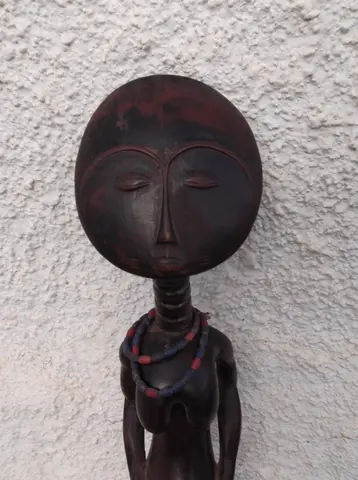
Sitting maternity, with large fallen breasts indicating that she has already been a mother.
MTR-74


