
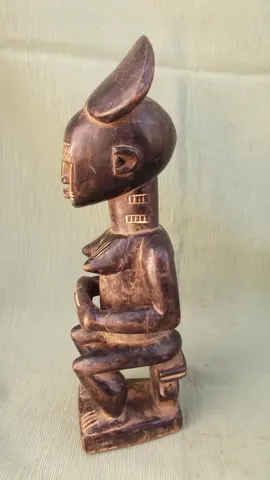
Female Statue
Great statue of woman with body covered in scarificacies painted with a mixture of kaolin and indigo.
EFM-108

List of the historical catalogue
Text and organisation of the original catalogue · Jesús Arrimadas Saavedra
BENIN HEADS (NIGERIA) Commemorative heads seem to date back to the time of Ogiso (S. XII) These heads are a symbol of the continuity and permanence of royalty. They were meant to honor ancestors in family altars, while beautifying them. At first they were made of wood or clay, difficult to preserve throughout the times. These heads representing the Oba were the replica of its owner’s face, in a size equivalent to about two thirds of the original. From the wood or clay they passed to metal, bronze, actually brass with a significant proportion of zinc, with a central upper hole in which a finely sculpted elephant tusk was inserted. The glowing color of bronze or brass helped to keep the forces away from evil. These heads representing the Oba were the replica of its owner’s face, in a size equivalent to about two thirds of the original. From the wood or mud they were passed to metal, bronze, actually brass with a significant proportion of zinc, with a central upper hole in which a finely sculpted elephant tusk was inserted. The glowing color of bronze or brass helped to keep the forces away from evil. MOTHER QUEEN In African cultures, all mothers of sovereigns or chiefs enjoy respect and special status whether they are matriarchs or patriarchates. These women exercise a symbolic and spiritual power because power has come out of their womb and sometimes they have real material power. They usually have their own court and their main function is to advise the king to or the boss. Women of experience who know the clan genealogy. Queen Mother is a title that they attain by being mothers of kings or chiefs, even though they do not necessarily belong to royalty or be the mother of king. There is a whole hierarchy from the queen mother of a village chief to the queen mother of the kingdom. But it is not even necessary to be the mother, it can be an aunt, cousin or older sister. In Africa, the name “brother” is given to all members of the same age class and of the same lineage and that of “mother” to all women of the previous generation. QUEEN MOTHER ASHANTI (GHANA) Of all the African mother queens the one who enjoys a greater celebrity is the Ohemmea, that is, the Queen Mother of the Ashanti. Contrary to popular beliefs the Queen Mother Ashanti is not the King’s mother, as in the case of YorubaBut the sister, who is the only one who can truly occupy this rank. She is not a regent queen, in the European sense, nor does she represent real power but rather motherhood, even if she has not conceived. Because she belongs to royalty, she is an expert in the genealogy of royal lineages, which confers on her a specific authority in electing a new sovereign, who cannot be appointed without her consent and will retain her rank until the new successor is elected. He does not perform political functions, which does not prevent him from being the only person who can advise his brother or censor his attitude and enjoy great authority and specific privileges, such as being able to have carnal relations outside marriage. His verdict is required when there is no consensus between the parties in which he presides over a court composed of male advisers. She is not a priestess but is the first woman who can relate spiritually to female ancestors. It is the official stoner in funeral and purification rites. And you can also participate in the initiation rites of the young women of some clans. QUEEN MOTHER YORUBA (NIGERIA) In the century XVI the Oba Esigie, 1504-1550, instituted the title of “kingdom mother”, in honor of his mother Idia, or Iyoba, in recognition of his help in the succession struggle against his brother Aruaran and later against the head of the city of Igala, Ata. She was appointed her advisor and enjoyed political powers equivalent to those of a traditional chief even if she did not have an official political power, assisted by her own court. As the mother of the reigning sovereign and queen widow of the former sovereign his prestige and power have been important and his function passed down from generation to generation, since the creation of the title by Esigie. But he could not see his son again from the moment he became Oba. From the death of Idia the custom was created to make symbolic reproductions of his head cast in bronze. These heads are a symbol of the continuity and permanence of royalty. They were meant to honor ancestors in family altars, while beautifying them. At first they were made of wood or clay, difficult to preserve throughout the times. The brass, or African bronze, in addition to enduring through the times, by its shining brightness had the virtue of turning away the forces from evil. One of the most reproduced heads is that of the queen mother adorned with royal cofia. On the eyes, on the forehead, there are three relief scarifications. Its high neck is adorned by a wide necklace of coral pearls that it represents, without a doubt, this head, as confirmed by its headdress, called “chicken pico” that high-ranking women continue to use today. This headdress, a species of capirote, is embroidered with semiprecious stones and interlaced corals, as well as the high coral necklace and the front scarifications. GRIOTS Musician, rapsoda, singer, narrator, panegirist, historian, genealogist, fabulist and literate the griot is essentially the master of the word, the guarantor of traditions, the social memory of the group. He knows the events of the present and the history of the past, transmitted by his parents and ancestors. It is the living permanence of oral tradition. He knows the genealogy of families and the ancient forms of languages. It is the encyclopedia of African cultures. They accompany kings, lords and notables in great events, whether playful, warlike or lucid. The griot extols and sings his lord’s reputation, quiets or aflames the fierceness of the fighters, magnifies or destroys a life or reputation of a kingdom and erases from history or causes a new legendary hero to enter it. They are, in short, masters of word and tradition. This is defined by the famous griot mandingo Mamadou Kouyaté: “We are sacks of words, we are sacks that enclose what has remained secret for centuries. The Art of speaking, lacks secrets for us; Without us the names of kings would fall into oblivion, we are the memory of men; By word we give life to the deeds and deeds of kings before the younger generations. My science comes from my father Djeli Kedian who got it from him; History has no secrets for us; we teach the common people what we want to teach them, and it is we who possess the twelve keys of the gates of the Mandingo… “ Djibril.Tamsir. NIANE, Soundjata ou L’épopée Manding. KINGS, NOTEBLES, JEFES, WARERS AND CHARTER PERSONS Many are the ethnic groups that have represented, mainly in wood, their bosses or their mythical heroes founders of the clan. But it is certainly the kingdom of Benin that has left for history the largest number of these statues representing the Oba (kings), warriors, musicians, pages and other court figures. Bronze statues that show in great detail the ornaments of the time. Even older than the statues of Benin those of Ife, representing their Oni, in full-bodied figures or their heads, show their perfect mastery of the foundry, for some reason their castors were the masters of Benin’s castors to whom they communicated their know-how.
35 objects · page 2 of 2
Great statue of woman with body covered in scarificacies painted with a mixture of kaolin and indigo.
EFM-108

One hand in the chest and the other in the belly clearly indicate a next maternity.
EFM-117
Kulango art is influenced by ethnic groups Akan.
EFM-124

The rider or knight in his saddle is a redundant theme in dogon art.
FEC-10

The rider or knight in his saddle is a redundant theme in dogon art.
FEC-16

It is certainly a matter of evoking the memory of an ancestor dedicated to the grazing of dromedaries.
FEC-25

Majestic statue of king or chief from the Dimbokro region.
EMS-61

Chibinda Ilunga, the youngest son of the Great Chief Luba Kalala YungaHe was a great warrior, and he married the queen.
EMS-7

It is a fine sculpture as shown by the numerous sizes, hairstyle, earrings, necklace.
COL-7

The woman appears sitting on an akan stool, only the women of the notables have this privilege.
EFM-54

They are known as legless statues, being represented with an artistically scarified torso that reaches practically to the ground.
EMS-116


