Reclineheads
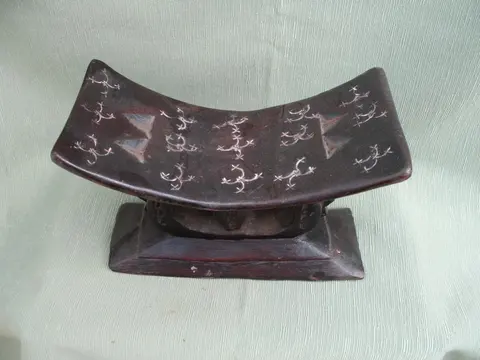
Stool decorated with geometric drawings. Nice dark patina.
TAB-14

List of the historical catalogue
Text and organisation of the original catalogue · Jesús Arrimadas Saavedra
The existence of headrests or backrests from ancient Egypt is known. With greater or lesser intensity, its use extends to almost all of Africa. It’s actually this part of the head, the back of the head, that’s looking for support. Its purpose is not for the head to rest to fall asleep. Its purpose is to support the neck to protect the hairstyle. African women, especially those of high social status, are played, on the occasion of parties and ceremonies, with showy hairstyles that sometimes last several days. Although men have also used them less often because in some regions on special occasions they also wear artistic hairstyles. These small objects, which rarely exceed the 15 Or twenty centimeters high, they are usually artistically sculpted or soberly realized according to the range and culture to which their owner belongs. Normally constructed from a single piece of wood are often true works of art, as is the case with Ashanti supports. For the Luba this object is the receptacle of dreams during which it receives confidences from ancestors. They are famous for their waterfall reclining heads called mikanda, whose caryatids have a laborious hairstyle that imitates that of the women of the Luba region, whose elaboration sometimes takes more than two days of work. Another typical hairstyle of these women is the cross-shaped hairstyle on the back of the head. TABURETES, TRONS AND SEATS Three terms that, in large part of the African peoples, are used interchangeably. In most cases they are not meant to sit on them, as in almost all of Black Africa one sits directly on the ground. They are prestigious objects, they denote the rank of their owner. Sitting in Africa is a privilege, a sign of distinction. The guest will be immediately offered a seat. But no one will dare to sit in a seat belonging to a higher rank or in another person’s seat without permission. The seat of a chief is sacred. There are stools of common use, daily, more sober, and there are ceremonials, artistically decorated, with representations that are but symbols of their cultures with meanings that are unknown to us in most cases. A deep respect presides over the use of the different seats. No one would commit the offense of occupying a seat that is not his own. They are not, as in our cultures, part of the furniture, but rather part of the personality of the owner, a symbol that characterizes him and that will continue to distinguish him after his death and that are therefore associated with his spirit. The use of them over many years will only strengthen this bond, so that at the death of the owner the stool will be placed on the family altar and will serve as an intermediary to communicate with the soul of the deceased. But their different forms and functions characterize not only their owners but through them the cultures from which they come and as material goods are integrated, in the course of time, into the family heritage.
34 objects · page 2 of 2
Stool decorated with geometric drawings. Nice dark patina.
TAB-14
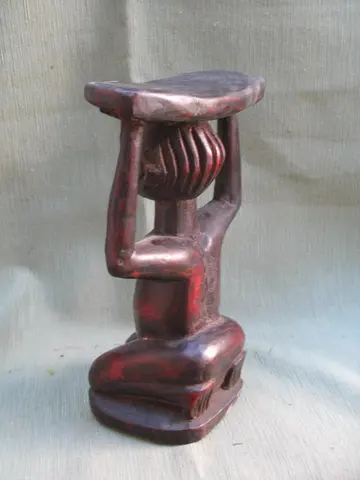
Small stool with a female figure in a kneeling position, carrying a seat base over his head.
TAB-15
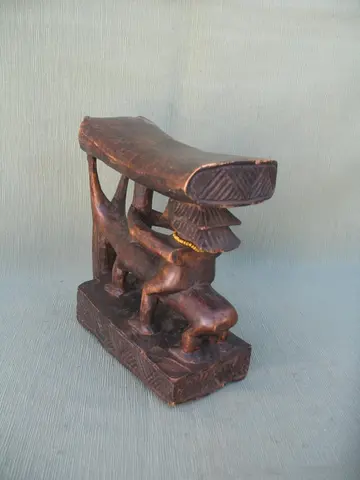
This stool represents a woman on an antelope, by the shape of her horns, which serves as a mount.
RECL-17
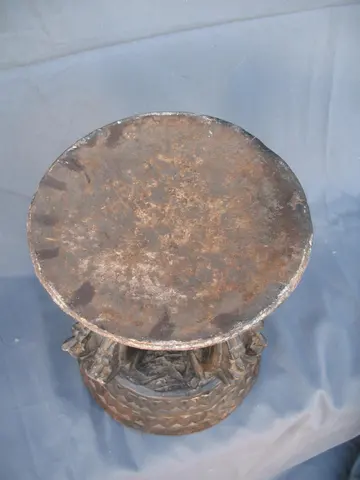
Stool artistically decorated with the four pairs of nomos, like cariatides, which are the origin of everything created.
TAB-16
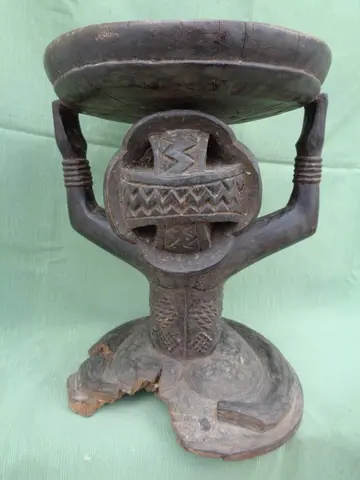
Luba stools are made up of one or two cariatids.
TAB-17
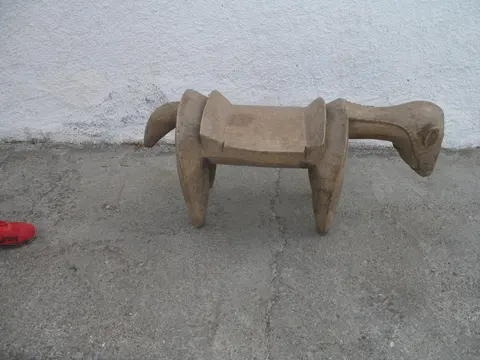
Chief stool, carved in very heavy wood, representing a saddle.
TAB-18
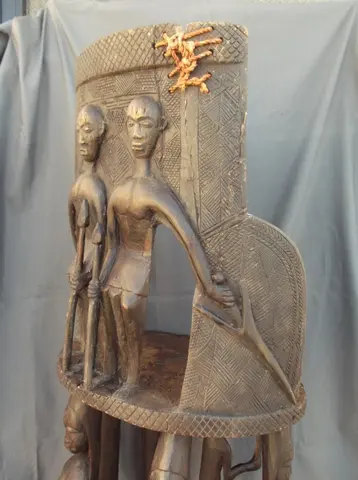
Important throne belonging to a boss. This type were chairs or thrones were used exclusively in ceremonies and important occasions.
TAB-19
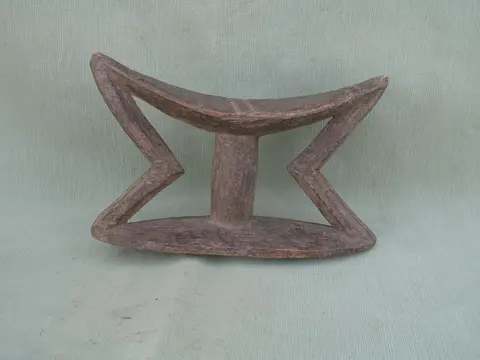
Small curved seat stool and folded side sides.
TAB-20

Supportnuts or reclinacabrazas of simple extructure, topped on one side with a figure, equally simple, that could represent a horse, possibly…
RECL-18

The wood is very simple but with laborious engravings sculpted.
RECL-19


