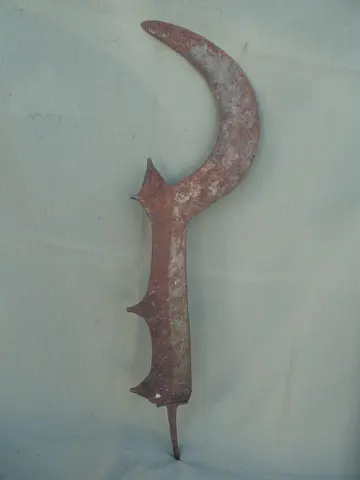
Currency Knife
Knife used as a tool to work in the field, to cut herbs and as a weapon of defense and attack, also…
MND-33

Text of the original catalogue
Bantu people from Cameroon at the end of the century XVII and installed in the north-west of the country, mainly in the Province of Ecuador, also though in fewer numbers in the Orientale Province and in several districts of the Democratic Republic of the Congo. After numerous ethnic displacements and wars with the peoples of the north of the Congo establish and become strong at the end of the century XIX in the Mongala basin, in Lisala, from where the different groups part to their current implantations. They are good warriors and showed strong resistance to colonization. They have deep respect for him. Kumu, the traditional chief, who enjoyed absolute, sacred and hereditary power. The Kumu is a mediator between the living and the dead, knows how to foresee the dangers that can haunt society and protects it from all evils because it embodies the protective magic of the village. He is a Greek and a healer and, as a fortune-teller, he is consulted whenever an important decision has to be made for the development of the social life of the village. Their society is hierarchical in respected social classes. First, the firstborn sons of the families, called Somi, who are the heirs. Second the class of guardians of customs, also called Kumu, chosen according to the rules of tradition regardless of age and thirdly the class of nephews, called Noko, who enjoyed important power. The family bond is very important for the NgombeThey profess great respect for the elderly and children embody the survival of the village. It is a people of solidarity. It is a village of fishermen and mainly of growers, the work of the land is its main activity. They also practiced trade and before the introduction of the currency they practiced it on the basis of barter. They are good blacksmiths and experts practicing magic and have a wealth of musical genres.
1 object · page 1 of 1


