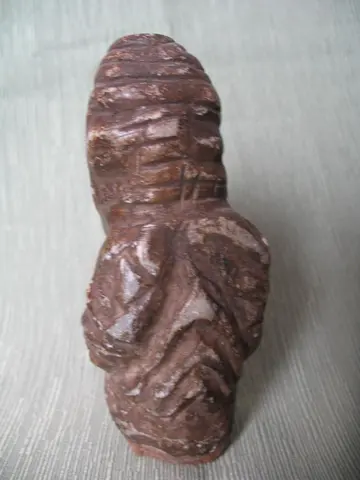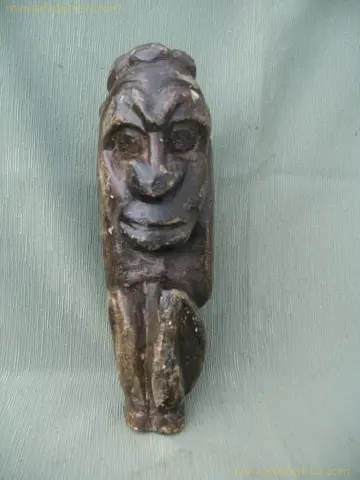
Pomdo stone
The Kissi they grow the land and mainly rice. Kissi are steatite funeral statuettes that appear in a fetal position.
PDR-5

Text of the original catalogue
The Kissi Or rice people as they called them the famous ethnologist Denise Paulme live in the southeast of the Futa-Djallon, in the north center of a forest massif of Guinea, on horseback between the three countries. In Sierra Leone, they are located in two small areas in the east. They are mainly rice growers, for which they take advantage of the slopes of the mountains and the bottom of humid and sunny fencedles, which in the rainy season are flooded by the waters, that favor the cultivation. They also grow coffee. Their villages, as the distinguished ethnologist tells us, are hidden among the forests in which their places of worship, their sacred trees and the clearings in which adolescents live their initiatory retituto. They have no masks and their statues are reduced to small but well-known figurines called pomdo or kissa stones. The so-called kissi stones are steatite funeral statuettes that appear in a fetal position. The name of the stones in Kissi language is pomdo, in singular and pomta in plural, which means death or image of dead, because they represent the dead ancestor. The bare statuettes do not bear the name of the ancestor while the dressed statuettes have their own name, that of the ancestor they represent and in this case they are called Pom-Kandya. They are placed in the family altars, where they receive the offerings and honors of all descendants during ceremonies. They are offered the last seeds and the firstfruits of the harvests. During the ceremonies the depositary or guardian of the statuette, usually the soothsayer, carries it over his head in a kind of angarillas and holds it with both hands. Family members and relatives can ask questions to the statuette and if the answer is yes it will lean to the right and if it is negative to the left. They detect what person has committed an evil. They are considered divinities of rice by the population. They appear in the fields, where they were introduced in order to obtain good harvests and have not been able to date accurately. They have appeared for four hundred years and seem to date from nine hundred to two thousand years. Kissi call them pomdo and mende nomoli, or moonstones.
2 objects · page 1 of 1