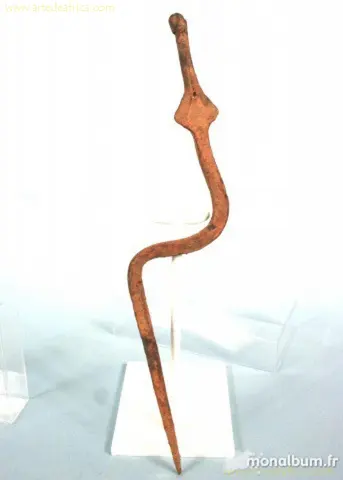
Ritual Snake
The Gan, ancient kingdom in southwestern Burkina faso, apparently originally from Ghana led by its king Kerumono in the century XVI, and…
FET-16

Text of the original catalogue
The Gan o Kaa (plural Kaaba), former kingdom in southwestern Burkina faso, apparently originally from Ghana led by its king Kerumono in the century XVI, and currently in vicinity with Lobi and near Gagoua, the capital of the Lobi Small population and little known, settled after multiple migrations, mainly in the regions of Obiré and Loropeni (both in Poni province), in the latter is located in the only place in Burkina Faso declared universal heritage by UNESCO, the ruins of a four-metre-high millenary wall built with the land of laterite, an area in which the main activity was the extraction of gold and where, apparently, there must be numerous fortified villages. These walls would have been used to defend themselves against the thieves of gold and the Berber slave traders. Traditionally, Gan, being stuck in the bushy savannah, lived from agriculture and the search and washing of gold. But even today society Gan, matriarchal, is solidly established and led by a King, the Khan Yia, with his court of 12 Ministers, the 29 Monarch of the dynasty, which is responsible for establishing a balance between modern administration and traditional power, so he is responsible for providing a solution to all internal disputes. The Gan They stand out in their domain of metal foundry and goldsmithing, mainly iron and bronze with which they manufacture figures preferably of ritual and divinatory use, among which the snake stands out, which implies a great symbolism in most African cultures. Serpent intended to be placed on family altars, in the form of a sentinel that will protect against evil spirits, diseases, witches and sorcerers. The serpent is a symbol of wisdom and faithfulness, as well as being the symbol of the union between earth and heaven. In their bronze objects are also frequent chameleons, turtles, crocodiles, panther or calao, their mythical protective animals, which are sacred to them. Most objects Gan have appeared in fortuitous excavations. Ganbefore being buried and proceeding to funeral honors, the magician or taumaturgo, interrogates the deceased, who goes over an angarillas, to know if he was a sorcerer or practiced black magic. If the answer, interpreted by the magician, is positive, he will not be entitled to any funeral or to be buried in dignity, a hole will be thrown into the field, filled with holes, in which the corpses of the sorcerers are thrown.
11 objects · page 1 of 1
The Gan, ancient kingdom in southwestern Burkina faso, apparently originally from Ghana led by its king Kerumono in the century XVI, and…
FET-16
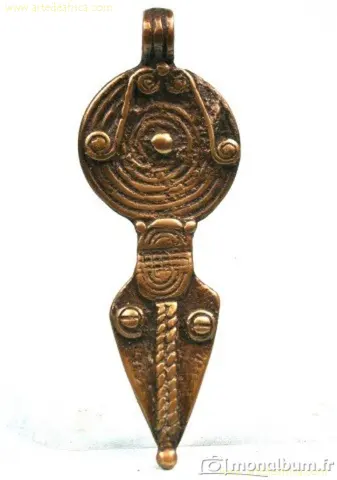
The Gan, former kingdom in southwestern Burkina Faso, apparently originally from Ghana, arrived at the place led by their king Kerumono in…
CYA-3
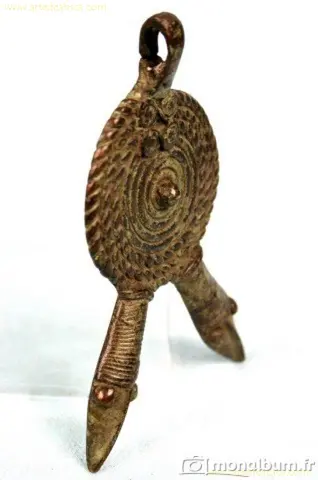
The Gan, former kingdom in southwestern Burkina Faso, apparently originally from Ghana, arrived at the place led by their king Kerumono in…
CYA-4
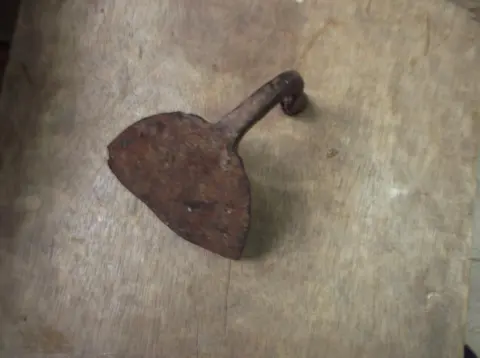
Small tool intended to work the land that was used as currency.
MND-36

Some of the great African animals are protagonists of many myths.
MYA-43

In Africa the elephant represents the head of the animals and the role of the patriarch because of its strength and longevity.
MYA-44

In Africa the elephant represents the head of the animals and the role of the patriarch because of its strength and longevity.
MYA-45

Ornamentation is not just a female symbol.
ANLL-30

The comb is one of the prestigious objects of African women.
PNS-39

The comb is one of the prestigious objects of African women.
PNS-40

Former piece found in an excavation several tens of years ago.
BRN-151


