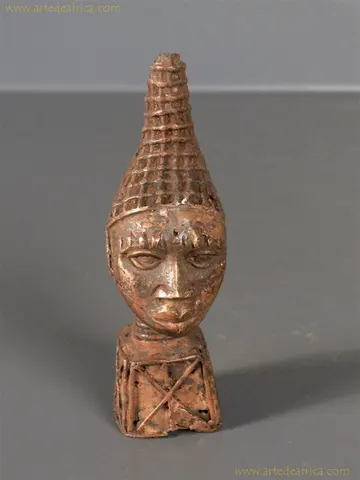
Head of Queen Iyoba
The commemorative heads seem to date from the time of the Ogiso, as the kings of Igodomigodo were called, the name given…
BRN-59

Text of the original catalogue
Benin owes its name to the Portuguese who on their arrival during the last third of the century XV they gave him the name Beny, which would later be transformed into Benin. Benin is located west of the country Yoruba. Only in a single city of this country, in the city of Binin City, appeared the artistic objects of ivory and bronze that we know today. They are remarkable, among other pieces, their heads of Oba and their pendants. For the binis the kings are Obas, originally from Ife, who were their conquerors. Towards 1.140 The binis ask Oba Oguolo to send them artists from Ife. The bronze sculptor and castor Iguegha will be in charge of teaching his art to the binis. At first the art of Benin represents kings and queens. Later, he specializes in making plaques covering the pillars of the royal palace and depicting hunting and cutting scenes, kings and notables in ceremonial and war suits. The artists in Binin City were organized into corporations living in opposite neighborhoods. The corporation that worked bronze was called Iguneromwo, and the corporation that worked ivory Igbesamwan. The Portuguese Sequeira discovered these plates in the city of Binin City, 1472. Later the Dutch navigator Dapper, and later Nyedal in 1702. In 1846 the Consul General of Great Britain Philippe having read the accounts of other sailors wanted to present himself in Binin City, on a day of ceremony, despite the fact that the Oba rejected the proposed date for the visit. The Consul will fall into a trap laid by the binis. In 1847 Admiral Rawson organizes a punitive expedition; the king of the time, Oba Ovenramwe was taken prisoner and deported. The expedition protects itself from all the treasures of the binis. More than 3000 Mostly today at the British Museum in London and many others sold in their day to European antique dealers. Ife's art was realistic, while Benin's art, at the end of the reign, will be oriented towards expressionism. The art of Benin is associated with royalty. The artistic pieces from Benin are symbols of power intended to extol the divine sovereignty of the Oba. The Oba is not a divine being but possesses a sacred power coming from divinity. These objects reinforce the sacred power of the king. Most of the objects in Benin were in the royal palaces, in the altars dedicated to the royal ancestors or that had been used in the great official ceremonies.
8 objects · page 1 of 1
The commemorative heads seem to date from the time of the Ogiso, as the kings of Igodomigodo were called, the name given…
BRN-59
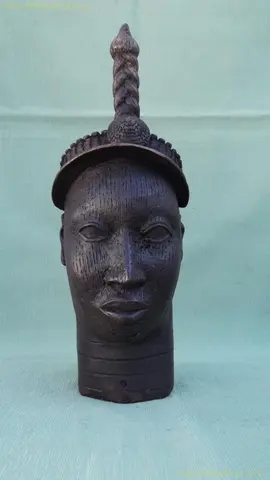
Commemorative heads seem to date back to the time of Ogiso.
BRN-64
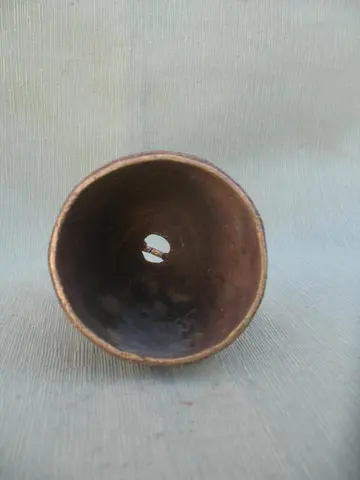
Bronze bell intended for ritual and divinatory uses. He's missing the badass.
MYA-28
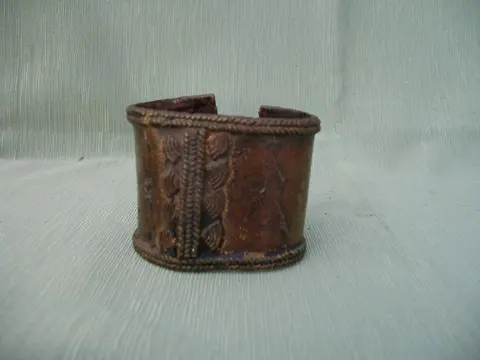
Old open bracelet with relief drawings characteristic of the ethnic group.
PYB-53
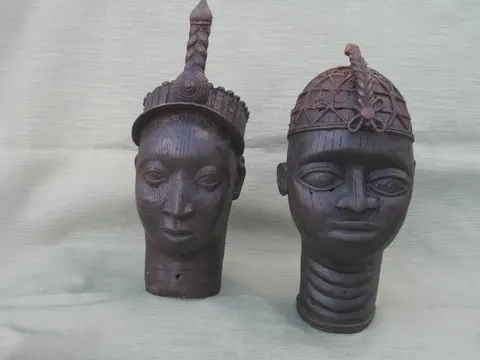
A reduced head of an Oni, king of ife, with its characteristic crown on the head on whose forehead stands a plume.
BRN-127
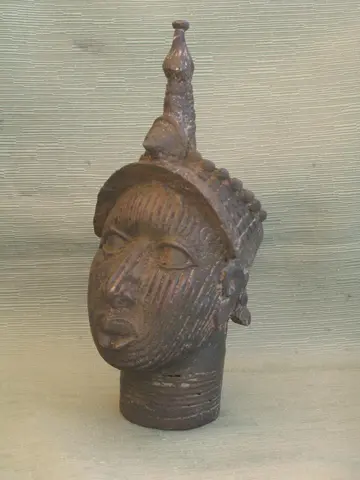
Ife's art is characterized by the beauty and balance of its lines and by a penetrating realism and a swrenity that seems…
BRN-128

Bracelet of the Kingdom of Benin featuring four women of notables in the typical costume of their era of splendor.
PYB-73

Bracelet of the Kingdom of Benin featuring four notable male characters in the typical costume of their era of splendor.
PYB-74


