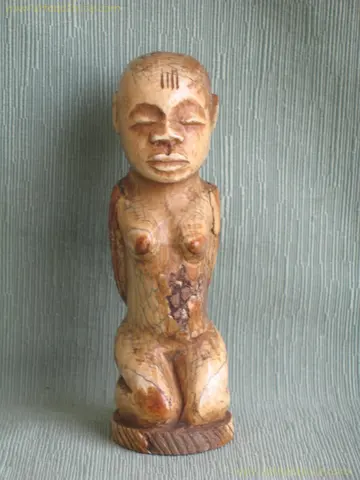
Statuette Bakongo
Little ivory statuette depicting a young woman kneeling in an imploratory attitude.
MRF-2

Text of the original catalogue
The noblest living material par excellence, ivory, was reserved exclusively for the use of the monarch and only some important court dignitaries could make a personal commission. Since the end of the century XVbrought by the Portuguese, the European courts discover the first pieces of ivory beautifully sculpted by African artists. The main highlights are the cups, salt salts and spoons carved by the Sapi of Sierra Leone and the magnificent tubes or smells of both the Sapi and other peoples of the Congo. Few are the European courts or famous collectors who, from that date, have not managed to take one of these exceptional creations, known under the name of sapi-Portuguese ivorys. Other important creations are due to the Bini or Edo of the former Kingdom of Benin in Nigeria. Some other villages have sculpted interesting pieces of ivory, such as the statues of Baule or the statuettes and small masks of the Lega. Leaving aside the fangs carved with rows of elephants during the second half of the century XX, destined for the European market, ivory has not been a material widely used in Africa. For the high level of his creations and for the nobility of the material the work of ivory was always a real art. SMALL HOUSING MASKS These small masks are usually carved into bovid bone, preferably the tibia. The most well-known are those manufactured by Baulé. On average they range between ten and twenty centimeters. The larger ones are usually commemorative masks, representing an ancestor or, like some passport masks, representing a known or important mask. Some are intended to be ported as protective pendants or amulets, others as ornament or simply decorative.
40 objects · page 1 of 2
Little ivory statuette depicting a young woman kneeling in an imploratory attitude.
MRF-2
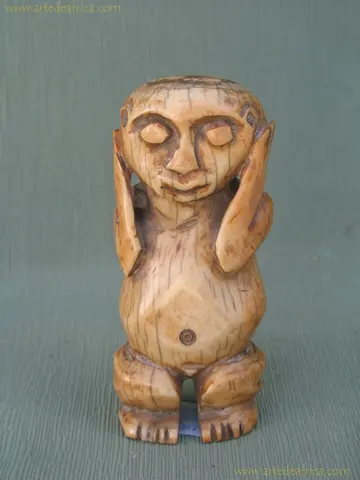
The figure kakinga ya bubake is one of the ritual figures of the LegaIt is used in the ceremonies of the high…
MRF-3
These miniature masks, due to their great magical strength, can only be used during initiation rites at the different degrees of Kindi,…
MRF-4
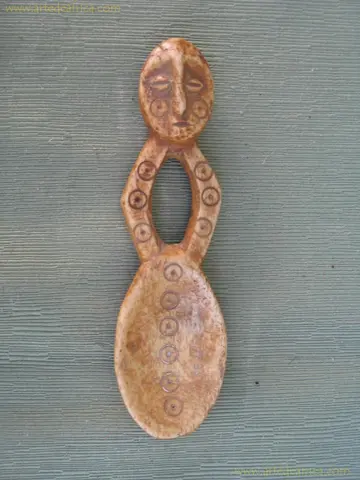
Ritual spoon called lukili or kalukili.
MRF-5
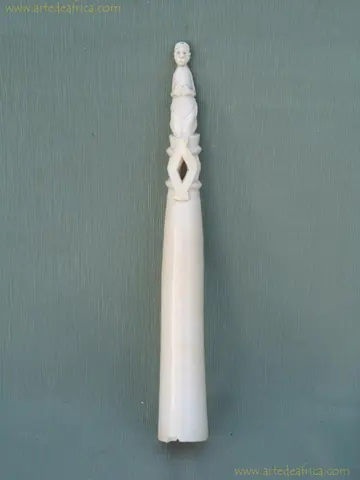
Trompa intended to produce musical sounds during court ceremonies.
MRF-6
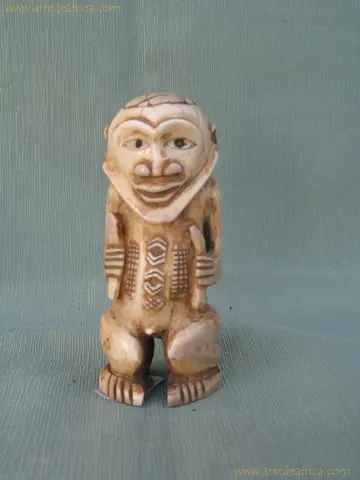
An ancestor with the attributes that characterized his rank during his life.Numerous ventral geometric scarifications.
MRF-7
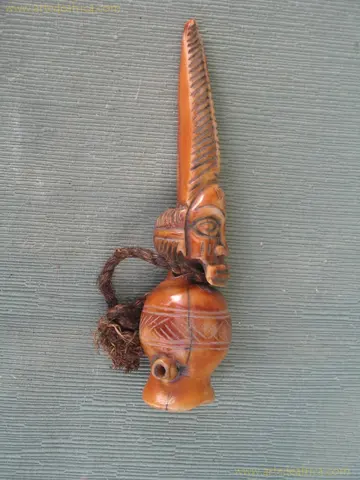
In addition to serving for communication, transmission of messages and participation in ritual ceremonies these small whistles are used by…
MRF-8
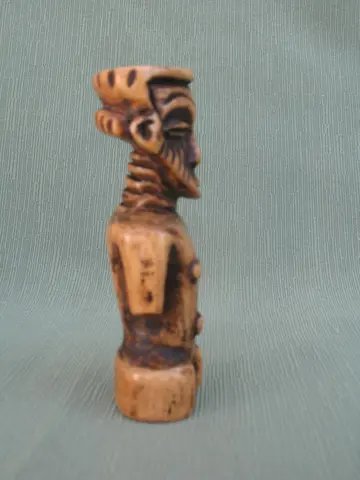
Small figure intended to be used in divinatory rites.
MRF-22
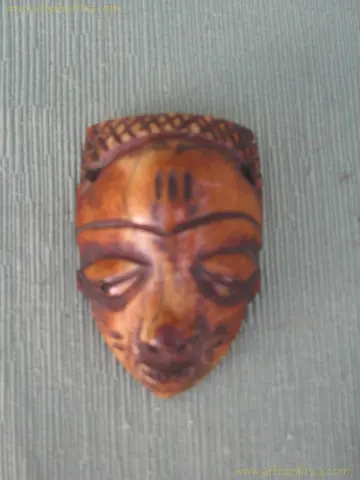
The Ikhoko are small amulets of the Pende, carved in ivory, to be carried as a medallion, neck-slope or concealed between the…
MRF-10
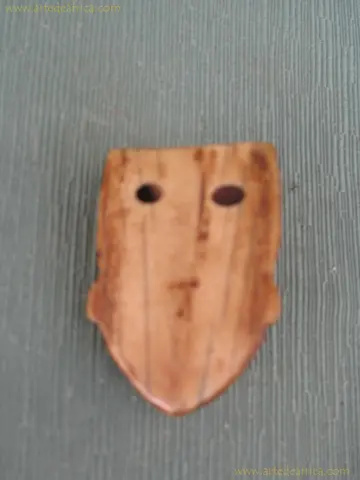
The Ikhoko are small amulets of the Pende, carved in ivory, to be carried as a medallion, neck-slope or concealed between the…
MRF-11
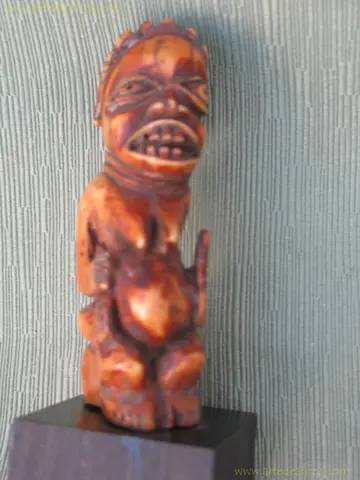
Figure of woman, no doubt sorcerer, taking into account the small containers in his hands intended to contain his magic ointments.
MRF-12
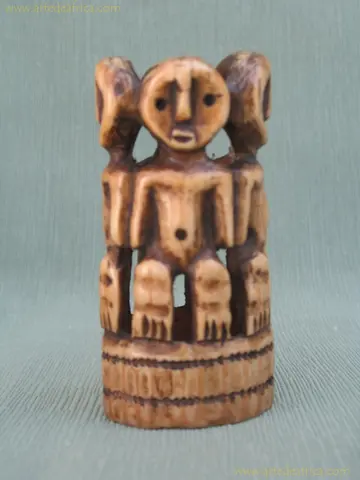
Fourfold figure from the Shabunda area.
MRF-14
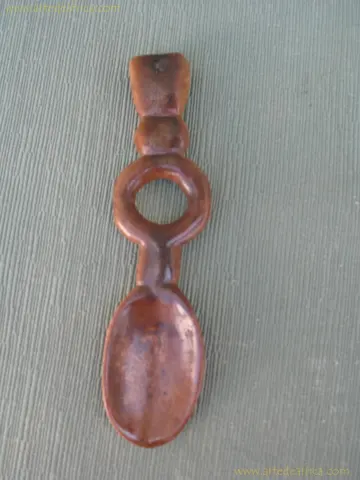
Ritual spoon called Lukili or Kalukili.
MRF-15
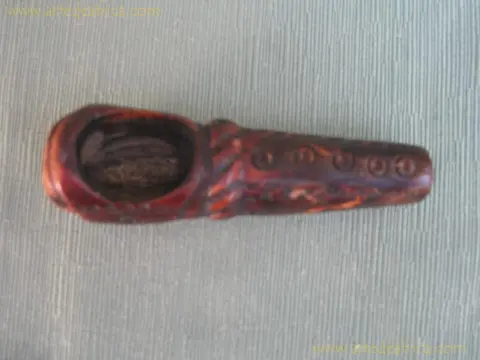
Little pipe in whose bowl is engraved a small Ikhiko, representing a Mbuya mask, which suggests that this pipe belonged to some…
MRF-16
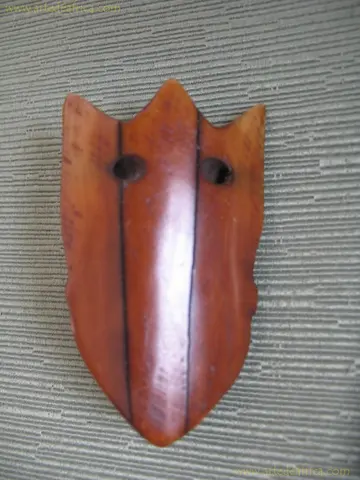
The Ikhoko are small amulets of the Pende, carved in ivory, to be carried as a medallion, neck-slope or concealed between the…
MRF-17
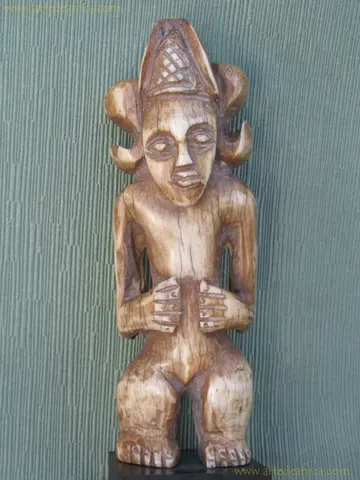
Chibinda Ilunga, the youngest son of Grand Chief Luba Kalala Yunga, was a great warrior.
MRF-18
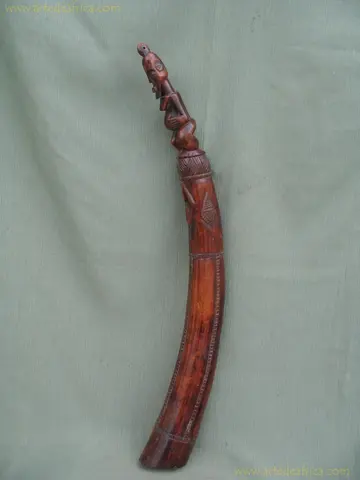
Former cross-bone tube finely chiseled in ivory, topped with the figure of a woman in which her breasts and her belly stand…
MRF-19
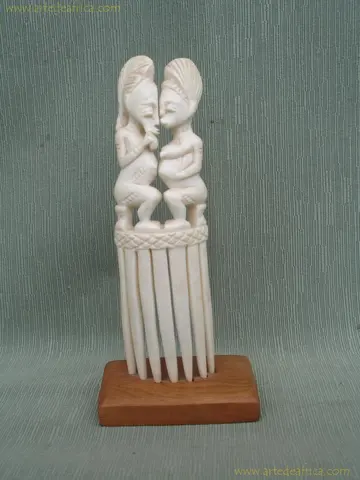
Tender scene of two lovers sitting on the traditional Akan stools or thrones, with the most significant traits and scarifications of the…
PNS-2
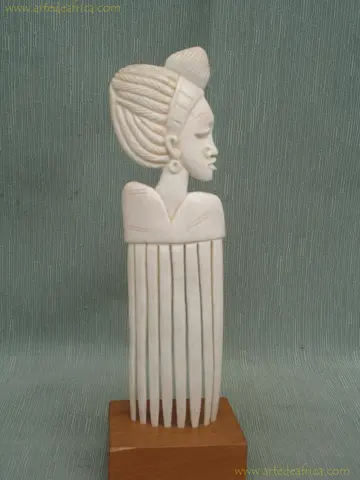
The face of a beautiful young woman with a typical baule hairstyle.
PNS-3
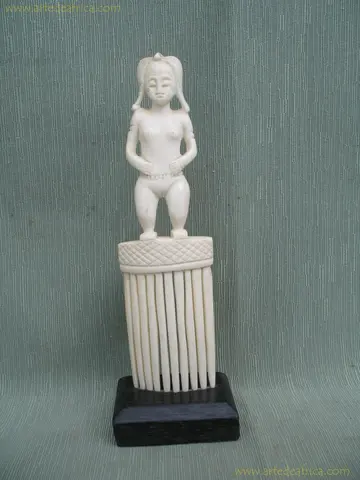
Young started from incipient breasts, with a pearl necklace, sculpted, on the waist and hairstyle divided into two braided side manes.
PNS-4
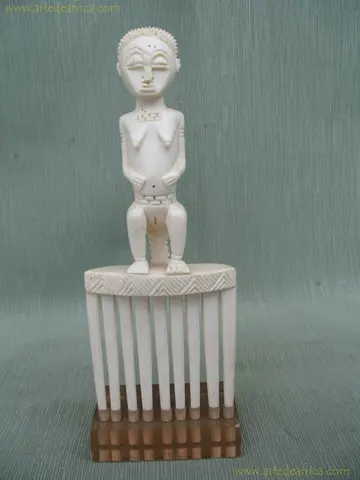
Representation of a woman of high rank, seated on an Akan throne, symbol of authority and dignity.
PNS-5
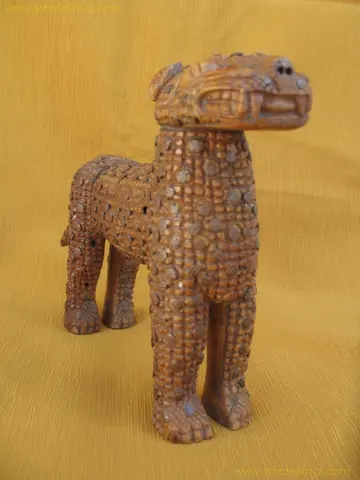
In bronze or ivory, leopard is an attribute of royalty, only the king can use this symbol, which represents strength, agility, beauty…
MRF-20
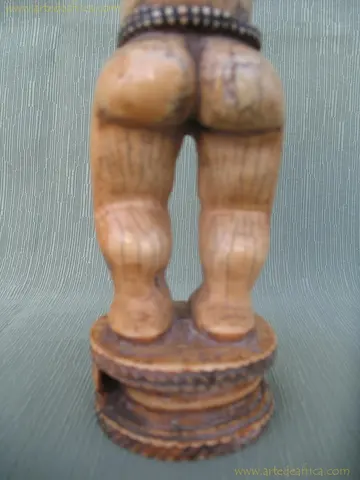
Beautiful statue of young princess or queen who has received a high degree of initiation as shown by her tattoos.
MRF-21
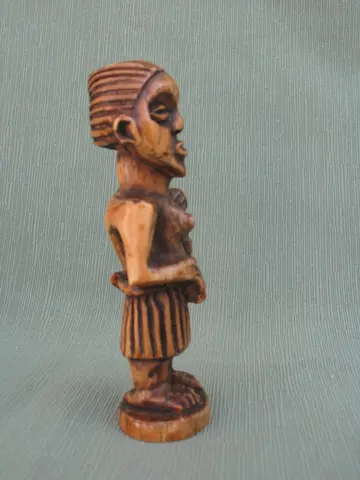
Little figure representing a motherhood with the child in his arms.
MRF-24


